 Lynn True, Nelson Walker, and Tsering Perlo's documentary Summer Pasture premiered at this year's Full Frame Film Festival, where it received a Full Frame Inspiration Award Honorable Mention. Summer Pasture takes place in the Kham region of Tibet, where nomads have lived off the land for 4,000 years -- but many nomads today find themselves at a crossroads of tradition and modernity.
Among a hundred other documentaries and dozens of premieres, Summer Pasture jumped out at me because of the dedicated and principled filmmaking on display -- not to mention the gorgeous cinematography, which was achieved without the support of a grip truck and an electrical department but rather by living in the field and grabbing shots opportunistically while putting to use solar-powered battery chargers. The film addresses timely global issues of rural self-subsistence living versus urban wage labor, and despite the faraway setting, Summer Pasture addresses universal themes through its depiction of the young couple at the heart of the film, Locho and Yama. Here's the trailer; my interview with directors Lynn True and Nelson Walker follows.
 1. How did the two of you start working together, and how did Summer Pasture come together?
 We actually attended the same college but didn't meet until after graduation when we were both living in New York. We had a couple of mutual friends and eventually ended up working together with our friend Keefe Murren on a documentary called iThemba|Hope, which was a documentary about an HIV-positive choir from South Africa, which aired on Sundance Channel. That was a great early filmmaking experience for all of us, to really be the authors of a project and start getting a sense of our personal approaches to filmmaking. Summer Pasture is now the third film Nelson and I have made together.
2. Even though Locho and Yama are Tibetan nomads living what is ostensibly the opposite lifestyle of many Americans, in the film they deal with life issues that are universal. How much of the film had taken shape in your head before filming began, and how much of it was following a narrative thread that took shape organically?
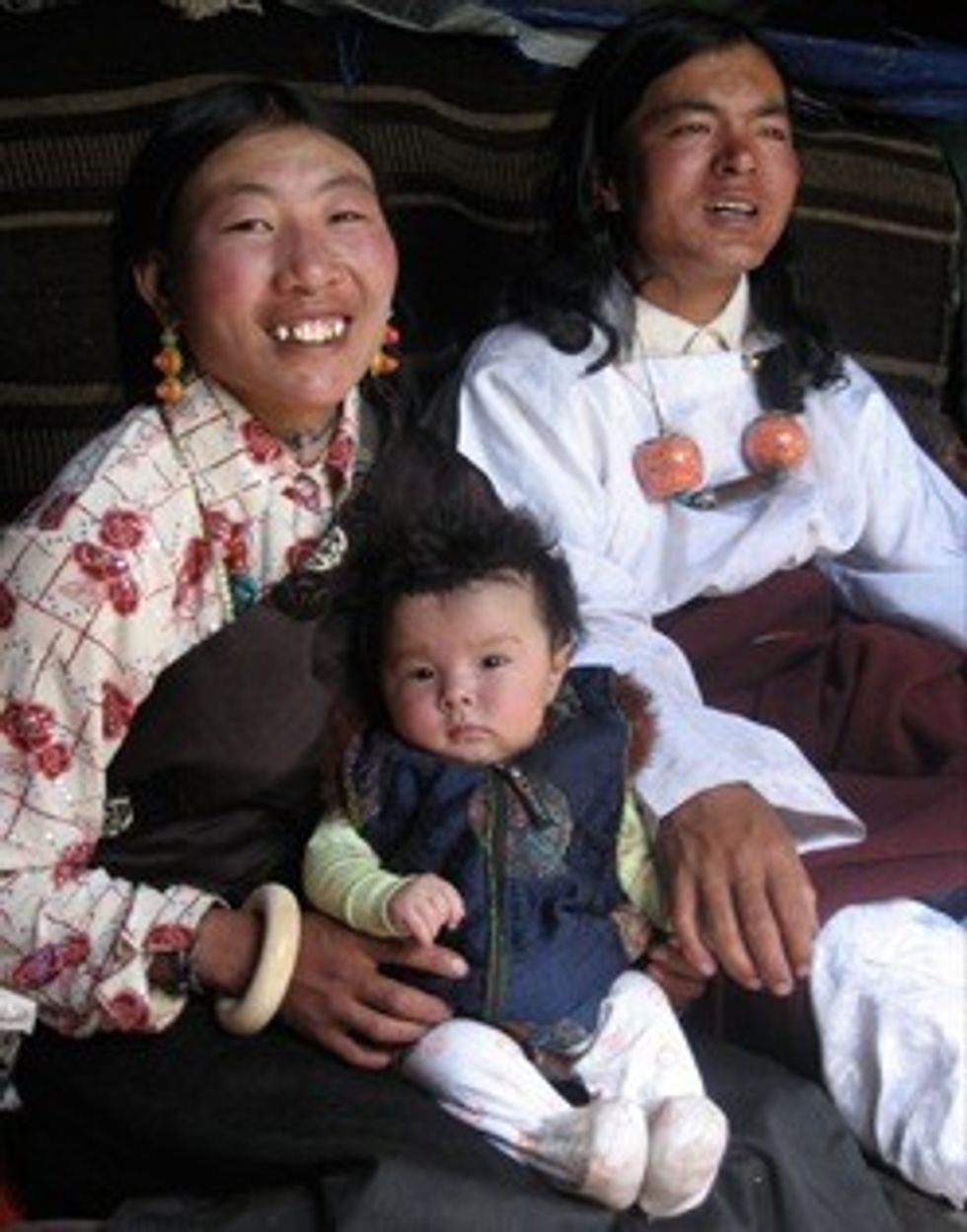 We had very little idea of what to expect, so we couldn't plan or anticipate what happened in the film. We knew the physical journey and the logistics of working in the nomadic pastures would be quite extreme, so our first priority was simply to make it out there in one piece with all of our equipment. Thanks mostly to our co-filmmaker Tsering Perlo who is from Dzachukha, where we filmed, we did get to the pasture safely with pretty much all of our gear intact. And then we were beyond lucky to meet Locho and Yama, who are amazing. We filmed them ongoing for 3 months and then it took about 2 1/2 years of editing back in New York to figure out the story of the film and put it all together.
 All we knew is that we were going to spend the summer living in a nomadic community in Dzachukha -- beyond that we had no plan. Tsering had arranged for Locho to escort us and our gear out to the pasture, and almost immediately things just sort of clicked. Locho was extraordinarily outgoing and comfortable around the camera, and Yama was equally generous with her thoughts and feelings. We became interested in getting to know them more intimately, and eventually made the decision to focus solely on their lives and relationship.
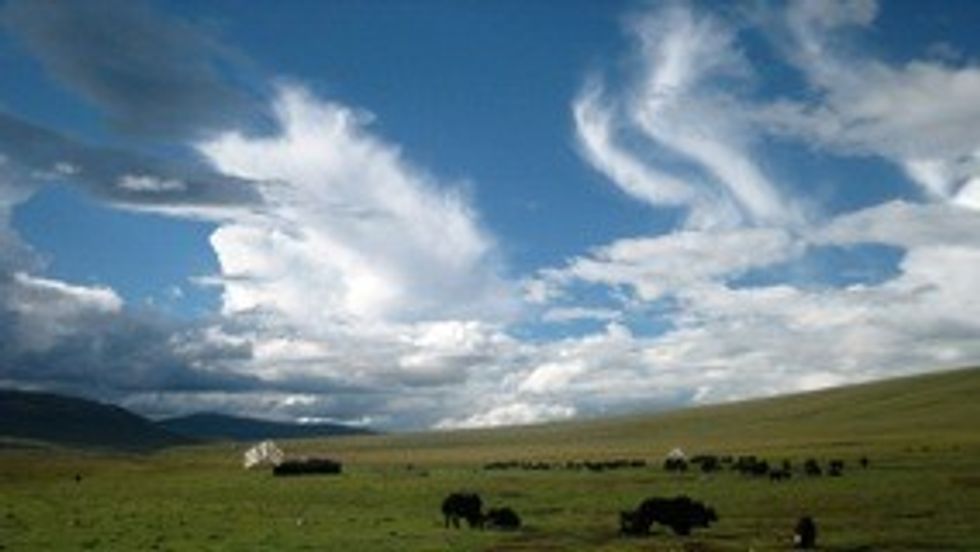 In shooting the film, we didn't have any preconceived notions of what the story needed to be, or what sort of scenes we had to capture. We basically just cast a wide net and filmed anything that we found interesting. We also asked Locho and Yama what they thought would be important to include, and made it a point to capture these things as well. We returned with around 200 hours of footage, and began piecing together the narrative structure as we made sense of what we had.
3. Are Locho and Yama speaking Khams Tibetan? Who in the crew spoke Tibetan, and how did you deal with any translation issues, both in shooting and in editing?
There's a great deal of variation in spoken Tibetan and all the different distinctions can get pretty confusing. There are three or four main language groupings of Tibetan that correspond to the different geographical regions of Tibet. Locho and Yama live in Kham, so they speak Kham-ke Tibetan -- but it's a dialect that is specific to nomads from Dzachukha and difficult even for most Kham-ke speakers to understand. Unfortunately we didn't realize until we tried to get the footage translated back in New York!
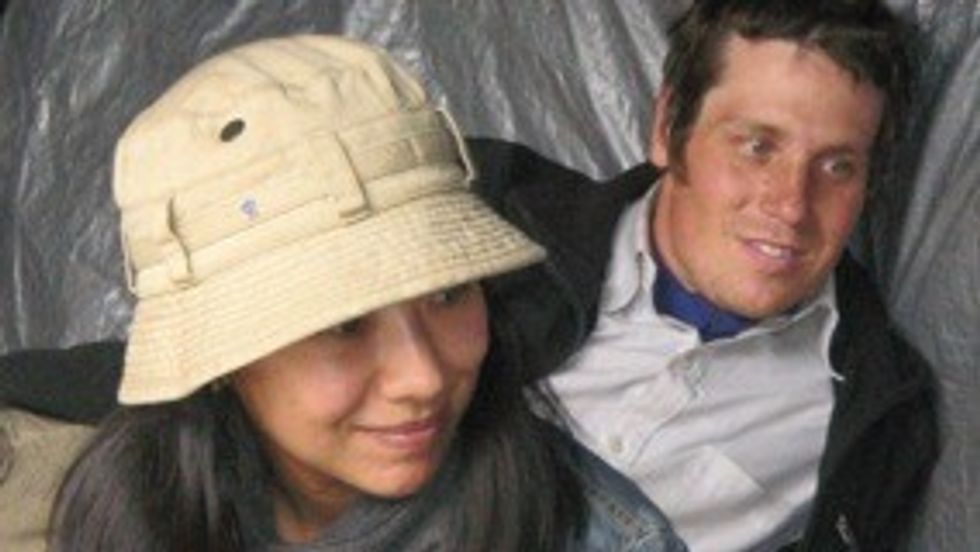
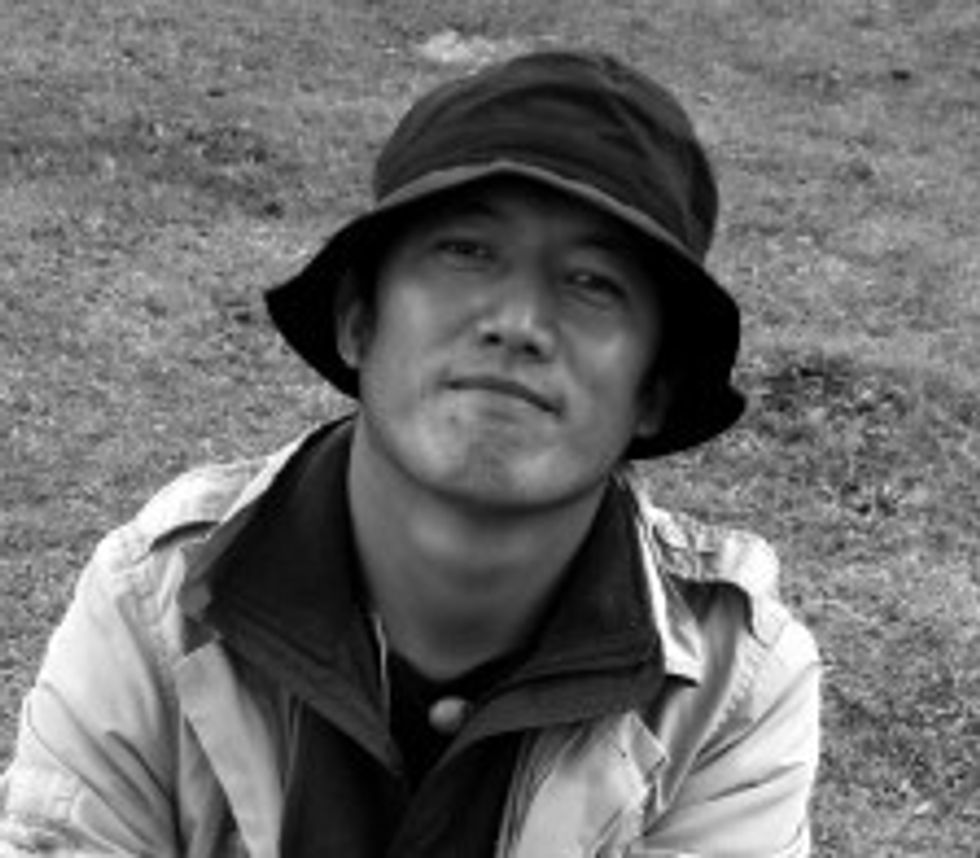 When were in Dzachukha, Tsering (pictured) helped us communicate with Locho and Yama, but he wasn't actively translating for us while we were shooting. We much preferred to observe the flow of everyday life rather constantly interrupt it to find out what was going on. Even during the interviews, we were relatively hands-off. We'd discuss interview questions and give them to Tsering, but ultimately he would dictate the flow of conversation. After the interviews, Perlo would recap their discussion for us and we'd follow up with additional questions.
This way of working was great in terms of capturing footage, but a tremendous challenge as we transitioned into the edit. When we got back to the US, we could only find a handful of people who actually understood Locho and Yama's dialect, and even fewer who spoke English well enough to translate the footage. Most of our raw footage had to be translated twice -- first into a more common dialect of Tibetan, and then again into English. With so much footage to work with, the translation process ended up taking a year and a half.
It was a nightmare. Our last film took place in the Congo and was mostly in Swahili, so we had experience working on films in foreign languages, but Summer Pasture definitely takes the cake in terms of translation challenges. The double translation from nomadic dialect to more common Tibetan to English made the process extremely tedious, especially since so many expressions in the nomadic dialect simply don't have direct, corresponding wording in English. It was very important to us for the film to ring true for a Tibetan audience and also for outsiders to have a sense of the local dialogue and modes of expression. Even more difficult was the fact that we only fully understood much of the specific dialogue in our footage months and years after we left Locho and Yama in the pasture. There were a ton of revelations in the footage that I only realized back in New York and that I wished I'd been aware of in Tibet so that we could have followed up with more questions. But then again, there is something to be said for having a limit on your footage, for not being in full control of the conversation. What you see is really what you get -- we didn't follow up with anything after the fact.
4. Any updates on the couple? Are they still living nomadically or are they making changes (possibly out of considerations for Jiatomah)?
They are all doing well and still living a traditional nomadic life. The year after we finished filming, Yama had another baby and the family also acquired more yaks from another nomad who was leaving the pasture to settle in town. Jiatomah -- who was finally given the name Tsering Tsomo by the local lama -- would be about 3 years old now and we're told that both she and her little sister are healthy. We can't wait to be able to go back and visit them again.
5. Nelson, can you talk a bit about the cinematography? It's a gorgeous film, in no small part thanks to your framing of the dramatic valleys of the region; in Filmmaker Magazine I described the film as a sort of "Tibetan Western." What did you shoot it on and what were some of the challenges of filming in such conditions (how did you recharge batteries, for one)?
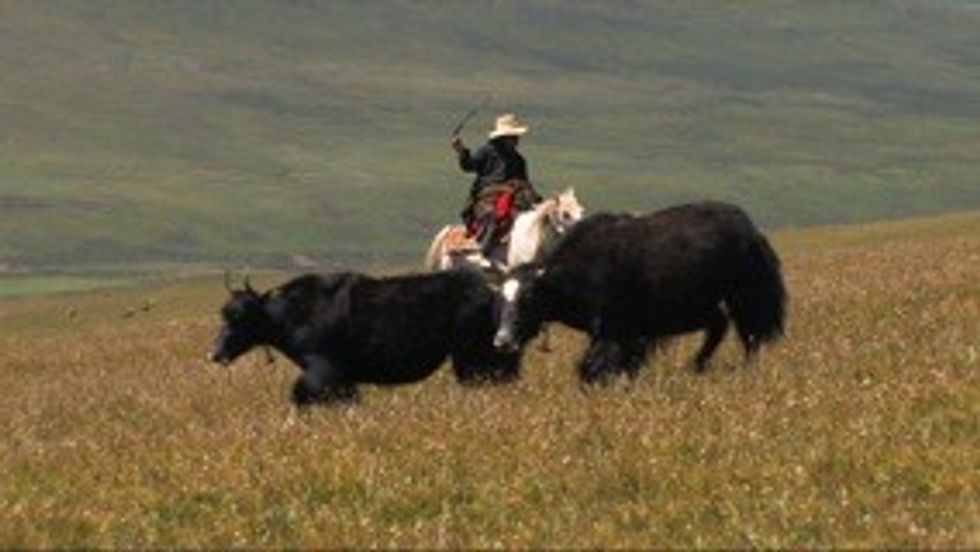 When we were planning for the trip, we had briefly considered shooting in HD using a card-based format, but I didn't want to risk it knowing that we wouldn't have a consistent power supply to download the footage. Instead we decided to shoot on HDV. We used a portable solar panel to charge the camera batteries, and ended up bringing a small generator into the pasture which we used to power Lynn's computer (for logging footage) and run projector to show Locho and Yama our dailies. The projector turned out to be a big hit, and Locho and Yama would invite nearby families to come over and watch. It was like a drive-in, but with horses -- a "ride-in" I suppose.
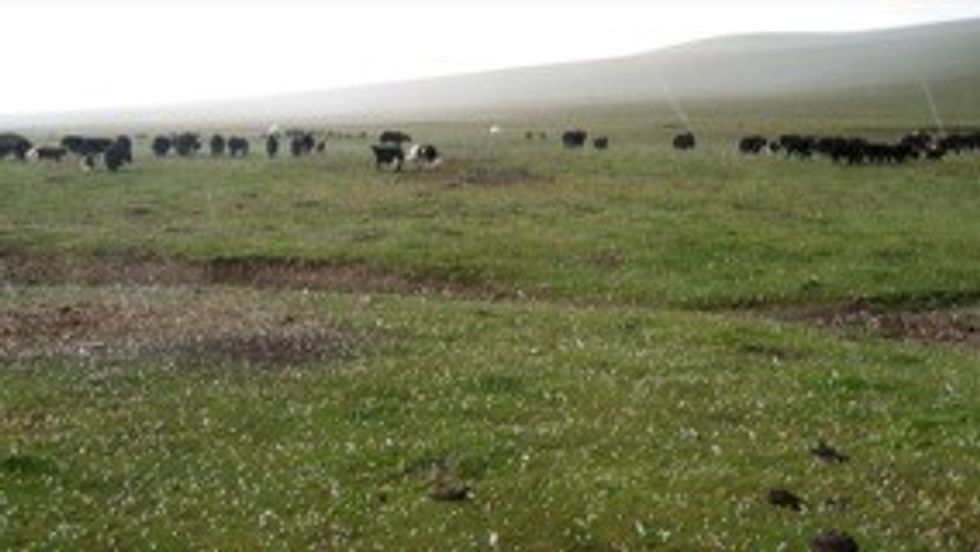 There were a number of challenges to filming itself. The weather was a huge issue. Because the temperature and humidity would change so rapidly, condensation would build up inside the camera and at times prevent us from shooting. In some instances however, the challenges actually led to creative breakthroughs -- our camera light broke on our way out to the pasture, so we had to find a way to shoot in the dark without it. This is how Tsering Perlo and I stumbled upon the beautiful silhouette shots in the early morning. Inside the tent we were forced to use a small flashlight attached to the camera, which gives the footage a much more organic feel.
And by the way, I love the "Tibetan Western" description. We were just at the Marfa Film Festival in west Texas where their great programmer Ralph McKay described the film's opening scene as a "Tibetan rodeo." My father's family is from Cheyenne, Wyoming so I went to plenty of rodeos growing up, and it's a totally accurate comparison.
6. It seems like you made the film you wanted to make. You give Locho and Yama the time, attention, and respect they deserve, without being adulatory. Yet this presents a challenge in the commercial documentary marketplace, because the film doesn't adopt a voiceover-laden style or fit into a standard TV window. What are your hopes for Summer Pasture -- where would you like it to end up?
We definitely made the film we wanted to make. Most of the films I had seen about Tibet had taken either a purely religious or political approach, and most peoples' lives can't be reduced to only those terms. We were more interested in simply observing how a typical Tibetan family living inside Tibet actually goes about their daily life, where politics and religion may be involved, but in a more subtle, integrated way. We weren't looking to foreground any particular kind of agenda or take up a cause. This is definitely a big challenge -- to make a film we believe in that also has a shot at being seen by the wider public via TV or other outlets. Our main priority has always been to start by making the film we want to make and then worry about the publicity and everything else later. We hoped the film would be compelling for a wide audience, but more so, we wanted Locho and Yama and their community to appreciate it and feel comfortable with their portrayal. We were very fortunate that the Center for Asian American Media was one of our early supporters. They are funded by the Corporation for Public Broadcasting, so the film's U.S. TV rights are actually owned by PBS. Our last film was on P.O.V. which is an incredible show that puts your film in the homes of millions of Americans. We hope that a show like that or one of the other great PBS programs chooses our film for their 2011 lineup, but nothing is guaranteed yet. Beyond that, we also hope to be able to offer it to international audiences -- especially in China and Tibet. In the upcoming months we'll be working with local partners to make this a reality.
It seems like most commercially successful character-driven documentaries rely on subjects whose experiences lend themselves to a clear dramatic arc. This makes for dynamic filmmaking, but as we all know, daily life seldom unfolds according to a three act structure. Our main goal in making this film was to present an honest and direct portrait of nomadic life. Based on our footage, this goal was better served by taking an associative approach to the narrative structure, and not trying to create drama that wasn't there. A good example of this is Yama's illness -- when it's first introduced in the film it raises concern and we wonder what will happen to her. The illness continues to manifest in subtle ways throughout the film, but as in life, it never fully resolves. Given our approach, it's unlikely that Summer Pasture will be screening at the nearest multiplex, but we do hope it feels true to Locho and Yama's experiences and offers a unique perspective on Tibetan life.
7. The film isn't a standalone documentary, it's part of the larger Kham Film Project. For documentary-watching Americans, the project could open eyes, educate, and entertain. But for Tibetans, the Kham Film Project could --
-- support them in making their own films and media projects -- both for their own communities in Tibet and beyond.
-- offer new and diverse ways of understanding contemporary Tibetan life, and inspire Tibetans to pick up the camera to express their ideas, stories, and culture.
Find the Kham Film Project on Facebook, or pay a visit to the Kham Film Project's web site, which includes a plethora of participatory video as well as a yak photo gallery. For updates on the film and to find out how you can watch it, join their mailing list.
Lynn True
After graduating from Brown University with a joint degree in Urban Studies and Architecture, Lynn worked on feature films and documentary programs for NBC News and PBS. As Creative Director at Magnet Media, she also produced educational films on multimedia technology before returning to concentrate on independent filmmaking. Her most recent film, LUMO, premiered on the PBS series, P.O.V. Lynn first traveled to Tibet as a documentarian for the Kham Geotourism Project, a joint initiative of the Tibetan & Himalayan Library and Machik, and it was out of this experience that she and Nelson Walker decided to launch the Kham Film Project.
Nelson Walker III
Nelson began his career in filmmaking working on documentaries for Discovery Channel, History Channel and PBS’s NOVA. His first film, iThemba|Hope, aired on Sundance Channel in 2005. Nelson has worked as visiting instructor of filmmaking at Tibet University in Lhasa and is a contributor to the Tibetan & Himalayan Library. His most recent film, LUMO, made its television debut as part of the P.O.V. series on PBS. Nelson holds an MFA in Film Directing from Columbia University School of the Arts and is a Project Director at the Maysles Institute.