With yesterday's announcement of the iMovie-touting iPad 2, it's worth thinking about what impact the iPad has had to date for filmakers. According to Steve Jobs, the iPad 1 sold more units than every Tablet PC ever made -- in just 9 months. With 15 million iPads currently in circulation and over $2 billion paid out to developers through the App Store, one of the primary ways the iPad has affected independent creatives is simply by being a distribution platform. But when Apple announced the "magical, revolutionary" device a year ago I wrote a piece at FreshDV speculating as to how the iPad could affect filmmakers. Here's the post revisited: in the year since, how much of this has come to pass? What did I get right and what did I get (horribly, horribly) wrong?
1. Interactive interfaces
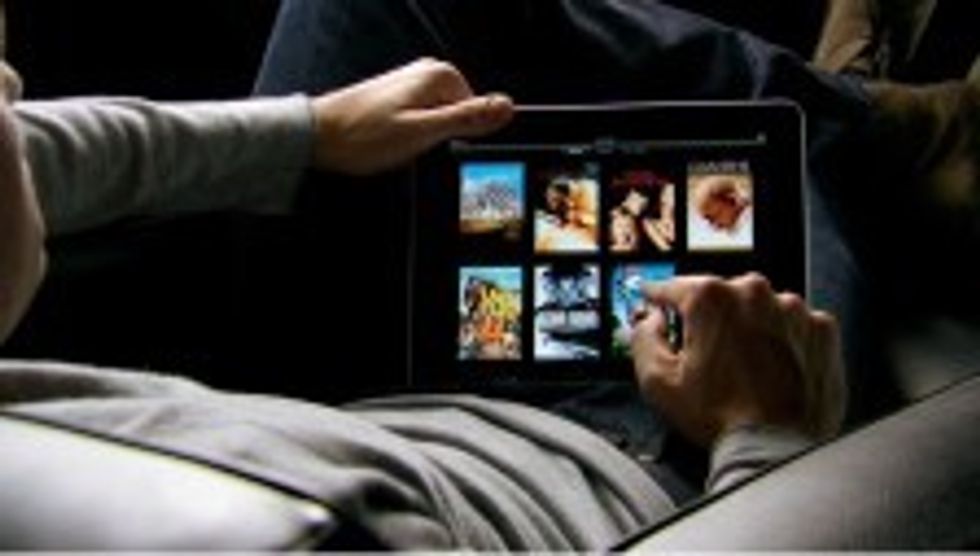
 This image (apologies for the blurriness; taken from the iPad’s live announcement, courtesy Gizmodo) demonstrates a couple of simple possibilities for interface overlays on top of video. For live sports broadcasts, these interfaces may be merely informational, but for narrative content, touch-based widgets offer a whole new world of interactivity. From “choose your own adventure”-style video content to multi-angle controls, by giving audiences real-time interfaces on screen, filmmakers can turn viewers into a participants. TV and set-top manufacturers are increasingly integrating internet connectivity and on-screen widgets as well, but none of them have the immediate tactile control of a iPad. While widgets are an easy-to-visualize example, the touch screen itself offers all sorts of interactive affordances; you don’t need something displayed on top of the video to allow viewers to interact with your content.
Current example: I'm going to cheat on this one and offer my transmedia project 3rd Rail as a potential example, since it's not out yet (or even in production). If you'd like to invest in some next-generation interactive storytelling, however, I have a demo I'd love to show you...
2. It’s a book, it’s a movie, it’s… an app
Anthony Zuiker (CSI) released a “digi-novel” last year, wherein a printed book contained a URL every 20 pages; readers could enter the URL into a browser and watch a related online video. In a lot of ways transmedia storytelling to date has been mostly about promotion (The Dark Knight, for example, used an Alternate Reality Game to promote its theatrical release), but the iPad offers a different set of possibilities: instead of these experiences existing as separate, promotional entrypoints, they can all be brought together on one platform. This is not to say that a project can’t have a live component that exists separately, but the iPad will play a pivotal role in bringing together different forms of storytelling: words, still images, moving images, audio, and interactive experiences can all live together on one handheld, connected device. The iPad will profoundly blur the line between book, movie, and game, and it will do so by offering these new-media experiences for sale through iTunes as… an application. When you’re developing a cross-platform story, what happens if you can’t define your project along clear lines? Should I say it? “There’s an app for that.”
Current example: as it turns out, Anthony Zuiker just released Dark Prophecy for the iPad, which represents very well the hybridization of book, movie, soundtrack, and app.
3. Serialization (of payment)
In the old world, you’d develop a feature — a two-hour piece of content — and spend years making and distributing it. Then, on your next project you’d start the whole process all over again — possibly with a different studio — who then spends a lot of money on P&A to (re)mobilize an audience for another round of one-time payments. In the new world, as a filmmaker it is your responsibility to own your audience and mobilize them, not only from project to project but also from episode to episode. There’s a reason almost every movie in the local multiplex is a sequel, and it’s not just because Hollywood is risk-adverse; it’s also because audiences come back to stories and characters they like. So where does the iPad fit in with all this? Well, not only can you sell a hybrid book/movie/game as an app, but you can also charge the viewer a la carte for entries within the series. Apple calls this in-app subscriptions, which means the iTunes season pass — where a customer must decide on the spot to buy an entire TV season — isn’t the only option. Instead, your interactive application allows you to bundle installments however you like. For example, you can bundle “acts” of a show, where each act consists of several episodes, or if your storyline branches, charge separately for different paths. While it may be hard to convince someone to part with $20 all at once (the iTunes price for a high-def new release), if you’ve got a good story you may be able to convince them to part with that same $20 through a series of micropayments.
Current example: it took Apple much longer than expected, but they finally launched their long-overdue, big-deal subscription service last month.
4. Charging money for digital content
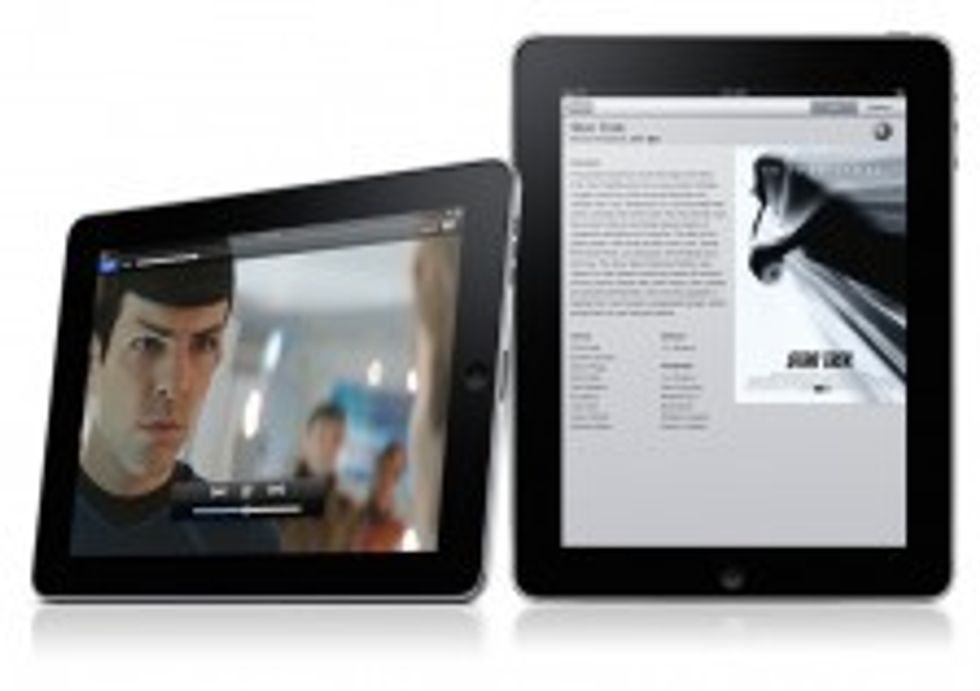
 Every newspaper and magazine in the country was hoping for something more than the iBook functionality that Steve Jobs demonstrated on stage, and while subscription print models are probably in the works — it’s not clear yet — one thing’s for sure: people are used to buying content through iTunes. There are currently 75 million iPhone users who have collectively downloaded 12 billion apps, songs, and movies; those numbers will only grow once the iPad is released. In an era where everyone’s struggling to monetize content with free, ad-based models, the iPad (by virtue of its large, high-quality screen) offers an even better platform for filmmakers than the iPhone. The iPad’s tech specs show that it plays back h.264 video at 720p (identical specs to the Apple TV), and its IPS screen will be bright, accurate, and viewable from a wide angle (meaning more than one person will be able to watch). The challenge for independent creatives comes in figuring out how to get indie content into iTunes (previously it was nigh impossible, and these days there are conflicting reports; chime in with a comment if you know better). The revenue split between creators and Apple is generally 70-30 in your favor, and iTunes does a good job of convincing customers to pay for 1s and 0s (this is the whole reason the iBook application gives you a nice-looking bookshelf: you feel like you’re buying something tangible). The iPad means more potential customers for filmmakers.
Current example: refer to the same subscription service referenced above...
5. Everyone’s connected to the internet
FreshDV’s Matt Jeppsen tweeted the following during the iPad’s announcement: “Know who desperately needs the iPad? Grandma. That +3G access is all she needs. No interface in the way, no routers to worry about.” He’s absolutely right: don’t underestimate the value of the built-in 3G. If you’re reading this, obviously you have decent internet access. But there are a lot of people who don’t have broadband — 40% of the US last I checked — and for content creators, they’re all potential customers. Previously, these people were unreachable through the series of tubes, and while I doubt an old-fashioned household without broadband access was going to buy an iPhone or $1,000 Macbook, they just might spring for an iPad. This is why Apple wanted to get the entry price point so low: to bring iTunes to a huge, previously untapped market, who will now use the iPad as their portal to a world of paid content (which Apple takes a cut of). With the addition of the iPad, iTunes TV and movie sales should jump significantly; now more than ever, your digital distribution strategy is key (see:Peter Broderick, Jon Reiss).
Current example: as I said up top, there are 15 million iPads currently in circulation and over $2 billion paid out to developers through the App Store. They're everywhere and certainly make for a viable distribution platform.
6. Flash is suddenly valuable again
Note: I wrote this the day of Apple's announcement, before it was revealed that the iPad would not allow applications ported from Flash. As a result, this point turned out to be hilariously wrong!
If you’ve released a video online, you’ve likely been reliant on Adobe’s rich-media platform Flash (it powers the players at YouTube, Vimeo, and basically every other online video portal; we distributed The West Side using a custom Flash player). But Apple has famously kept Flash off the iPhone, and it looks like the iPad will be no different. With the iPhone bypassing Flash and serving up separate h.264 videos and with HTML5 looking to push Flash further towards irrelevancy, how is the iPad a good thing for Flash? Because of Adobe’s announcement that Flash CS5 will support iPhone app development — and now iPad development as well. Suddenly there are millions of Flash developers who can develop rich-media applications for Apple’s mobile platforms. While Flash won’t be an ideal development platform for applications that rely on hardware interactions (camera apps, for example), for filmmakers interested in extending their experience beyond “traditional” movies, this is a big deal. Why? Because with Flash, you can develop your rich-media experience once, and then output to web, iPhone, iPad, set-top boxes, and Blu-Ray platforms all at once. It remains to be seen how effective Flash will be implemented on some of these devices, but for productions with smaller budgets, being able to output to several different platforms without incurring huge costs will be… well, huge. And the iPad, I suspect, will be the crown jewel in Flash’s cross-platform strategy.
Current example: I hang my head in shame for that one. Though Apple did eventually reverse their decision and allow Flash-developed apps (which is different than approving the Flash plugin), the damage had been done. Apple and Adobe are now anything but BFFs.
7. Communal watching
 A world where everyone walks around staring at little screens doesn’t sound like very much fun. Many of us (still) enjoy watching movies at the theater, where every laugh, groan, and gasp in the audience becomes part of the experience. However, movies are increasingly viewed less and less in the theater and more and more at home (or on the go). Here’s where the iPad offers filmmakers an opportunity: a connected viewing device like the iPad can afford the viewer a new community-based watching experience. With an always-on internet connection, it’s possible to implement real-time comments, twitters, audio chats, and on-screen pointers… the possibilities are endless. No one’s saying it’s a good idea to overlay your cinematic masterpiece with a chat window, but watching a live TV broadcast while Skype-ing someone almost feels like you’re there in person; with the iPad, this type of “virtually there” experience could be even more integrated. It’s not a replacement for the “real” thing, but we have to embrace the fact that our content is going to be viewed in all sorts of conditions, and giving viewers the ability to watch something together is only a good thing. It’s our duty as filmmakers to offer our audience the best viewing experience we can, and the iPad places more of that power in our hands than ever before.
Current example: off the top of my head, I can't think of one. Anyone have any examples? FaceTime will certainly change video communication on the iPad, but that's a bit different. In general, do you think the iPad has had an impact on the business plans and distribution strategies of filmmakers since its release a year ago?