 As many of you know, one of the goals of No Film School is to keep our readers up to date regarding the latest in acquisition options and upcoming formats, as well as ways to put it all together. Less often are we able to move in the other direction so to speak, and bring you news about really innovative recording systems -- from over 100 years ago. As digital filmmakers, videographers, and photographers, in a technological sense, we're standing on the shoulders of giants. I'm sure there are moments in which many of us forget the years it has taken to bring our tools to the advanced level they've reached, and in which we just plain take those tools for granted. Why wouldn't we? The recent (re)discovery of a comparatively ancient audio recording -- one that allegedly features the world's first recorded musical performance, as well as its first blooper -- may help to remind us how good we really have it! Read on to hear the recording, and to find out how it was made possible.
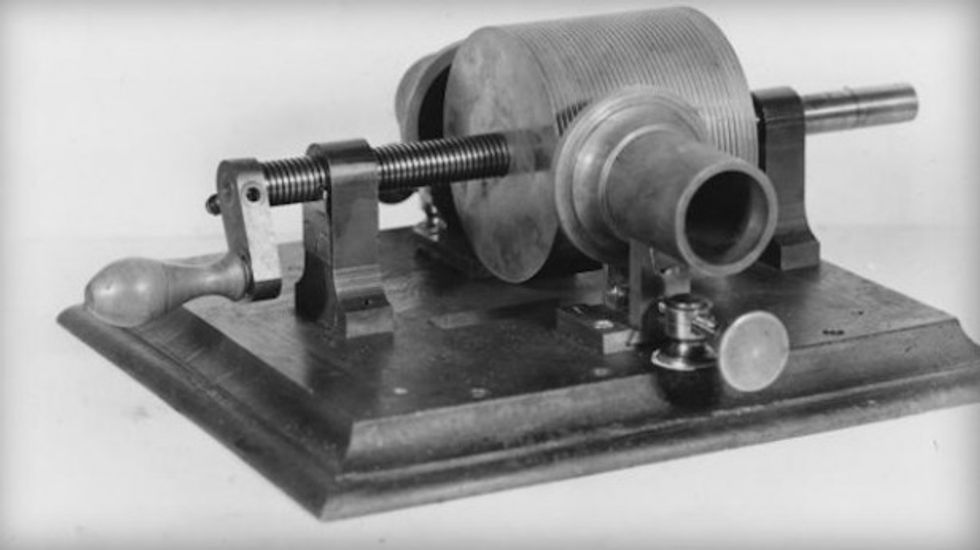
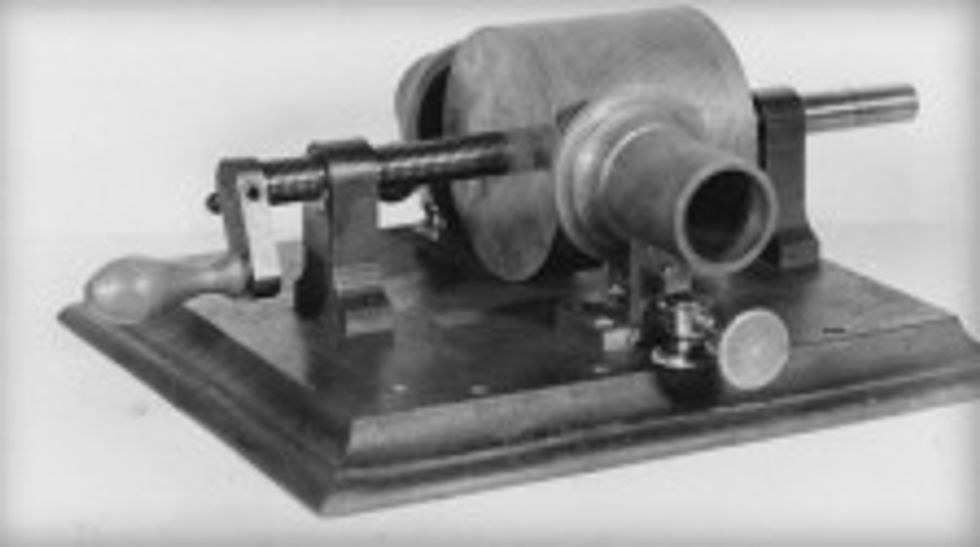
The 78-second recording, made in 1878, still exists to this day in its original recorded format -- a 5 x 15 inch sheet of tin foil, upon which the stylus of a Thomas Edison original phonograph scratched the sound waves sampled by its microphone. The phonograph used a hand-crank mechanism, and apparently each recording could only be replayed a few times before the "recording" (the sheet of tin foil) was totally teared through by the stylus itself. Even with the ability to record sound in this manner, the extremely temperamental nature of the tin foil format meant a short life-span for the recording, and as such, this particular tin foil sheet couldn't be played back in its originally intended manner.
Instead, the foil was scanned in three dimensions, its 'topography' analyzed, then converted and plugged in to a waveform reader. As CBS News reported, it was converted "with optical scanning technology to replicate the action of the phonograph's stylus, reading the grooves in the foil [and]... then analyzed by a computer program that recovered the original recorded sound." I can, with fair certainty, therefore call this the longest gap between the major steps of an A/D (Analog to Digital) conversion in the history of A/D conversions -- and that brings me serious joy to be able to say.
As for the contents of the recording themselves, here's the summary from The Creators Project:
The recording opens with a 23-second cornet solo of an unidentified song, followed by a man's voice reciting "Mary Had a Little Lamb" and "Old Mother Hubbard." The man laughs at two spots during the recording, including at the end, when he recites the wrong words in the second nursery rhyme.
Finally, the recording itself, which The Creators Project attributes to the Reddit community (specifically user Liberationdemonology -- the original CBS News post did not include any of the actual audio):
CBS News attributes the "popping noises heard on this recording [to] scars left from where the foil was folded up for more than a century" -- now that's what I call Lo-Fi. Still, the fact that a hand-cranked mechanism driving a stylus was able to etch sound waves as heard by a connected microphone onto any medium, never mind a piece of tin foil, is pretty impressive. On top of all that, the recording actually surviving long enough for us to digitally reproduce and therefore truly immortalize it as historical media is nothing short of amazing. I wish I could convince my friends in the field of audio to record my sync tracks on Edison's phonograph instead of Edirols and Sound Devices recorders. One of the sentences in this paragraph may be tongue-in-cheek... maybe. Regardless, the recording truly represents a milestone, and may help to remind us sometimes of how very far our gear has come.
What do you guys think? Do you find this as "wow-worthy" as I do? Let us know in the comments below.
Link: Audio Clip on Soundcloud
[CBS News via The Creators Project]