» Posts Tagged ‘color’

Description image

waveform monitor histogram after effects adobeDepending on the acquisition system, waveform monitors and vectorscopes can guide quality control of your imagery from shooting all the way down the pipeline to grading, mastering, and compression for delivery. Scopes can seem a little intimidating and esoteric to the new user, but getting the basics down can really help in owning your image. Recently, Alexis Van Hurkman over at ProVideo Coalition has answered some key questions about scopes: find out which ones he considers the most indispensable below, plus when it may be a good idea to trust your own pair of eyes in making adjustments — even when your scopes are reading ‘A-Okay.’ More »

Description image

Sin CityWe’ve been talking quite a bit about Adobe over the past few months, as they’ve announced new versions of all their major desktop applications and ended the Creative Suite as we know it. Even though some folks are none too thrilled with Adobe right now due to the complete switch to the Creative Cloud, they still make what many consider to be the rising star of NLEs with Premiere Pro, and it’s more packed than ever with features to make filmmaker’s lives easier. Today we’re going to explore two of the lesser known color effects that come with Premiere Pro, the Leave Color and Change to Color effects. While these might not be something you will use day-to-day, they’re an excellent option when you need to create some highly stylized shots at a moment’s notice. So without any further ado, here are the tutorials, straight from Creative COW: More »

Description image

Color spaces and color models can be difficult to wrap your head around completely. There are additive and subtractive spaces, like RGB vs. CMYK, and different format/display technologies, like analog’s YUV vs. digital’s YCbCr — all of which you may have to traverse to achieve the final ‘look’ you want for your imagery. Not to mention that many color spaces are not absolute, meaning they don’t profile device-specific color representation. This can certainly induce a bit of a headache for newcomers to the color science realm. A great post by photographer Mark Meyer, featured recently on PetaPixel, explains how you can quite literally better-orient yourself to color spaces and models by, well, modeling them — in 3D open suite Blender, no less. More »

Description image

The most common way we get color images with digital cameras is with a Bayer pattern CMOS sensor, but there are plenty of variations on that design being used today. The upcoming Aaton Penelope Delta uses a Bayer pattern over a Dalsa CCD, for example, while the RED EPIC-M Monochrome uses the MX CMOS sensor foregoing color filtration entirely. By their very nature, though, color filters of any kind cut down the amount of light transmitted to the sensor. That’s why Panasonic is developing a brand new type of color filter that will employ diffraction to split up the color spectrum, instead of filtration, and thus will be capable of doubling the light sensitivity of the sensor. More »

Description image

This is a guest post by Tristan Kneschke.

With the release of Apple Color several years ago, the once-niche field of high-end color grading trickled down to the average user. When Blackmagic released DaVinci Resolve on Mac it became more obvious that color grading was the next big wave. Having already been grading professionally with Color shortly after it was released, I quickly decided to invest in a traveling DaVinci Resolve Mac Pro tower. The client demand for color grading in particular, and a traveling station specifically, has grown my business at a rate I never thought possible. Now, with Resolve 9 nearing its official, non-beta release, Blackmagic has separated itself even more from Apple’s killed product. More »

Description image

Many argue the legitimacy of games when it comes to learning, but games can certainly exercise the mind if they challenge you to think and problem-solve. I’ve never really seen a game of any kind that could possibly help me become a better filmmaker — that is, until now. If you’re brand new to color correction, or even any sort of graphic art where color is involved, there is now a game called Color that will help you improve your skills. More »

Description image

Gamma & Density make high-end tools for DIT (Digital Imaging Technicians) such as their complex 3cP data management system. However, as more and more productions go digital, it seems to me there will be a need for a more budget-friendly DIT solution. Utilizing the iPad seems like a perfect way to allow cinematographers and directors to communicate their aesthetic intentions on-set. However, G&D’s $400 pricing seems a bit high for the indie crowd; anyone know of any alternatives? Here’s the promo video: More »

Description image

I’m live at the sold-out FCPUG SuperMeet in Las Vegas, where the “surprise” guest has turned out to be none other than Apple (“surprise” is in quotes because everyone, this site included, expected it to be AAPL). As expected, Apple has announced the new version of Final Cut Pro, now called Final Cut Pro X, with OpenCL support, backround rendering, and a completely redesigned interface. Here are the new features: More »

Description image

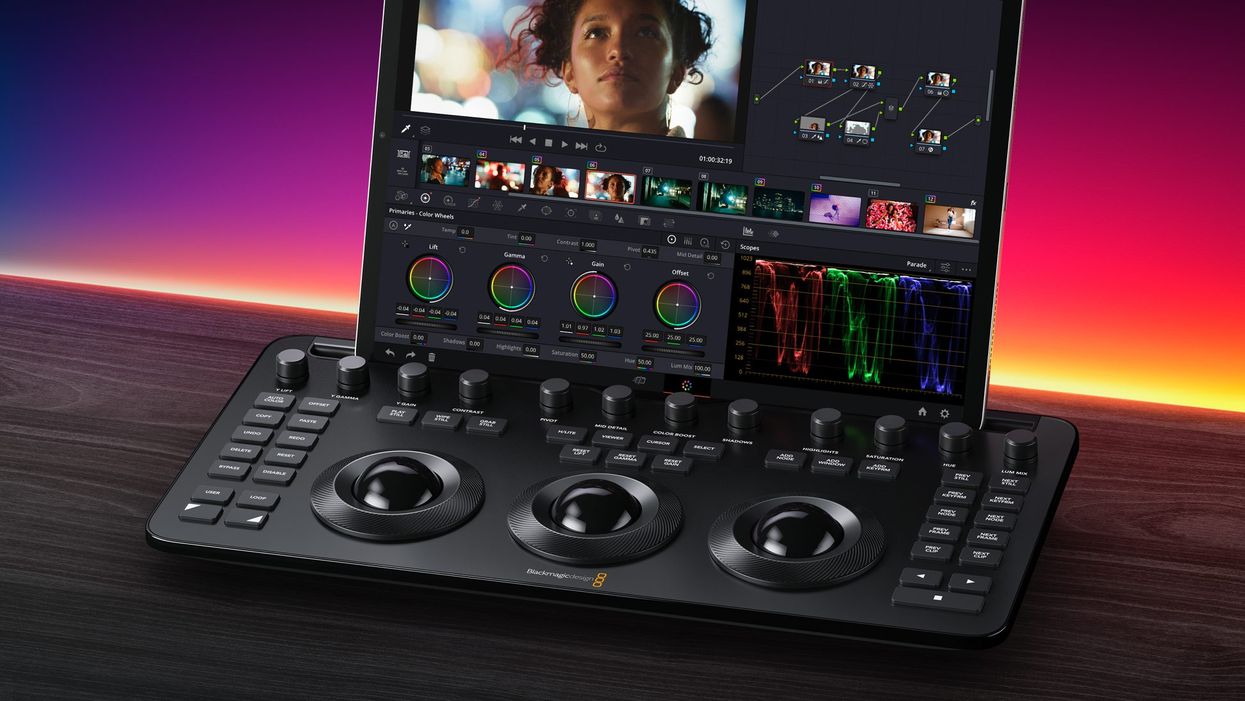
Serious colorists don’t use a mouse; they use a much more capable hardware control surface based around three trackballs that control lift, gamma, and gain. These hardware devices are important because they give the colorist control over multiple push-pull adjustments at the same time. Such surfaces have traditionally run $25k or more, but Tangent Devices managed to get this triple-trackball interface down in price to $1,500 with their Wave Control Surface released last year. Now they’ve created a brilliant virtual version using the iPad‘s multi-touch screen. Here’s a video of the interface in action, and instructions to get the free application: More »