Journey Through Time: The Ultimate 7 Best Time Travel Movies
A subgenre of sci-fi that’s all about possibilities.
Back to the Future (1985)
If you do not think that the ebbing and flowing of time is as scary as it is fascinating, you probably have yet to watch the greatest time travel movies. One of the biggest scientific controversies, yet, from scientists to filmmakers, time travel continues to attract all sorts of minds. While it is still a distant dream (with enough research indicating its practical impossibility), Hollywood has explored the concept of travelling in time, across genres, forever.
Time travel narratives are not only packed with “fodder” for nerds like me. These movies are celebrated for their nuanced exploration of complex human complexities, including love, redemption, and self-discovery, all while making bold social commentary.
In this article, we have compiled the best time travel movies of all time, spanning a whole host of genres.
7 Best Time Travel Movies of All Time
1. The Time Machine (1960)
An H.G. Wells novel adaptation, George Pal’s The Time Machine, set the template for sci-fi films to follow. H. George Wells (Rod Taylor) travels forward in time after he successfully builds a time machine, excited to witness humanity’s progress in the distant future. But the future fails him and his utopian vision.
A pioneering film in the genre, Time Machine demonstrates the use of imaginative visual effects and set design, breaking out of the technological limitations of its time. The film also exemplifies the use of sci-fi as a vehicle for social commentary.
2. Back to the Future (1985)
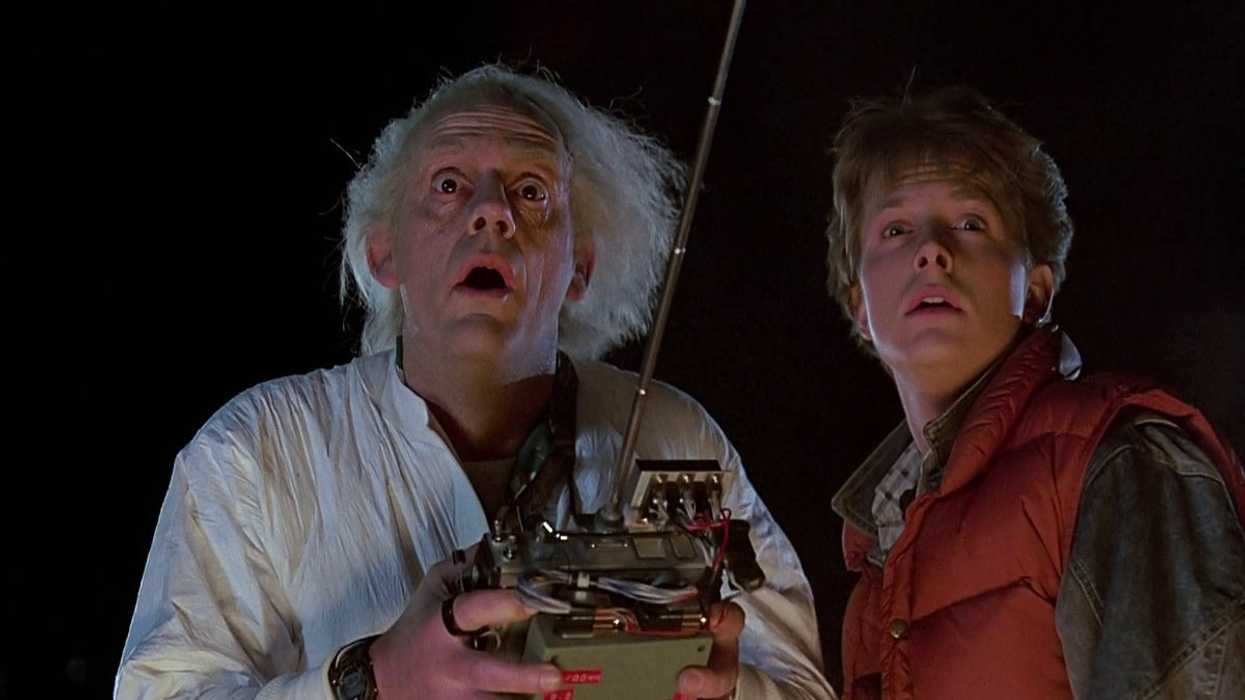
Robert Zemeckis' Back to the Future is based on the theory of time-travel paradox, a.k.a. The Grandfather Paradox. Marty McFly (Michael J. Fox), is accidentally sent back to 1955 from 1985 in a time machine invented by his quirky friend Dr. Emmett “Doc” Brown (Christopher Lloyd). There, he ends up meddling with his parents’ first meeting, by mistake, threatening his own existence.
Back to the Future poses an important philosophical question through humor and drama: Can we change our destinies, or are we bound by fate? At the same time, it highlights the dangers of acting without considering the consequences.
Zemeckis recreates the 1950s with meticulous production design and costumes, and relies on visuals to communicate instead of verbal exposition. To me, the film beautifully exemplifies blending genre conventions, seamlessly fusing comedy, romance, and adventure with sci-fi.
3. 12 Monkeys (1995)
Terry Gilliam’s 12 Monkeys follows James Cole (Bruce Willis), a convict in 2035, as he travels back in time to 1996 to gather information about a deadly virus that wiped out most of humanity. Now it’s up to Cole to save mankind by obtaining a pure sample of the virus so that the scientists can develop an antidote for it.
Sticking to his hallmark directorial style for sci-fi, as we have seen in Brazil, Fear and Loathing in Las Vegas, and Time Bandits, Gilliam crafts a subjective narrative, mainly through Cole’s perspective, to immerse the audience in his confusion and paranoia. 12 Monkeys is a masterclass in visually externalizing characters’ internal conflicts to create a thought-provoking and emotionally resonant narrative.
4. Primer (2004)
Made on a budget that can’t even get you a used car in today’s economy, Shane Carruth’s Primer is an American indie sci-fi film that explores time travel intimately and intentionally.
The story follows two gifted engineers, Aaron (Shane Carruth) and Abe (David Sullivan), who accidentally create a time machine. While it’s all fun and adventure in the beginning, the two grow increasingly ambitious about the time machine, using it recklessly to benefit themselves, even at the cost of their friendship.
Primer stands as a landmark film in sci-fi for its innovative low-budget filmmaking, inspiring filmmakers not to be limited by budget constraints. The fact that Carruth successfully executed a film like Primer for just $7000 is a reminder to all of us that money doesn’t decide the fate of art.
5. Time Crimes (2007)
A Spanish sci-fi thriller, Nacho Vigalando’s Time Crimes explores the concept of time loops in combination with time travel. A seemingly ordinary man, Héctor, gets stuck in a time loop, unwittingly being sent back in time by an hour, over and over again.
To save his present timeline and his wife, Héctor must now close the time loop by trying to enact everything that happened in that one hour in his original timeline.
But, with three different iterations of himself, already in three different timelines, things are not so simple to fix anymore.
Vigalando directs with precision and is committed to clarity, while shifting perspectives from one Héctor to another. Despite its modest budget, Time Crime effectively achieves a sense of scale and complexity through clever writing, editing, and direction. Another standout example of resourceful storytelling!
6. About Time (2013)
A must-watch, especially in these times, when we have stopped living in the moment in favor of capturing it for social media clout.. Richard Curtis’ About Time is a meditation on life and its priorities.
Pondering on how “some days you really want to relive forever; some days you only want to live once”, About Time follows 21-year-old Tim Lake (Domhnall Gleeson), who one day learns about a special gift that men in their family are bestowed with. They can not only travel in time, but also make minor alterations to fix things. What starts as “little fixes” to make everyday life better becomes a journey of enlightenment. Tim learns what it means to live in a moment, and how it’s better than reliving it.
About Time is quite unlike its peers. Breaking out of the traditional genre conventions, Curtis ditches the spectacle of the sci-fi genre and uses its conventions to explore emotional truth and life’s meaning.
7. Predestination (2014)
Another interesting time travel premise brought to the screen, Michael and Peter Spierig’s Predestination follows a temporal agent (Ethan Hawke) who’s on his final assignment, tasked with stopping an eluding terrorist by traveling in time.
Presented as a time travel action drama, Predestination explores complex themes, including identity and paradox, through a tight, cerebral narrative that demands attentive viewing. The Spierig brothers have demonstrated an ingenious use of sci-fi tropes to explore deeper existential crises.
Which of these have you watched? Do let us know if we missed any!