Imagine this. It's September 1951. You're director Akira Kurosawa, and you have just found out your film won the Golden Lion at the Venice Film Festival.
But there's a catch. You didn't even know your film had been entered into competition.
Well, that's exactly what happened.
So when Rashomon won the festival's top prize, it surprised Kurosawa, Daiei Studios, and the international film world with its success.
The film's entry into Venice came via Giuliana Stramigioli, a representative of Italiafilm who had seen Rashomon while in Japan and convinced a reluctant Daiei to submit it.
"I was shocked by Rashomon," Stramigioli said later (via Wikipedia). "Regardless of whether it would win an award, the first condition is that it would generate a great deal of buzz. In that sense, Rashomon is a very distinctive film, and because it is so Japanese, I thought it was entirely appropriate."
And boy, was she right about that buzz.
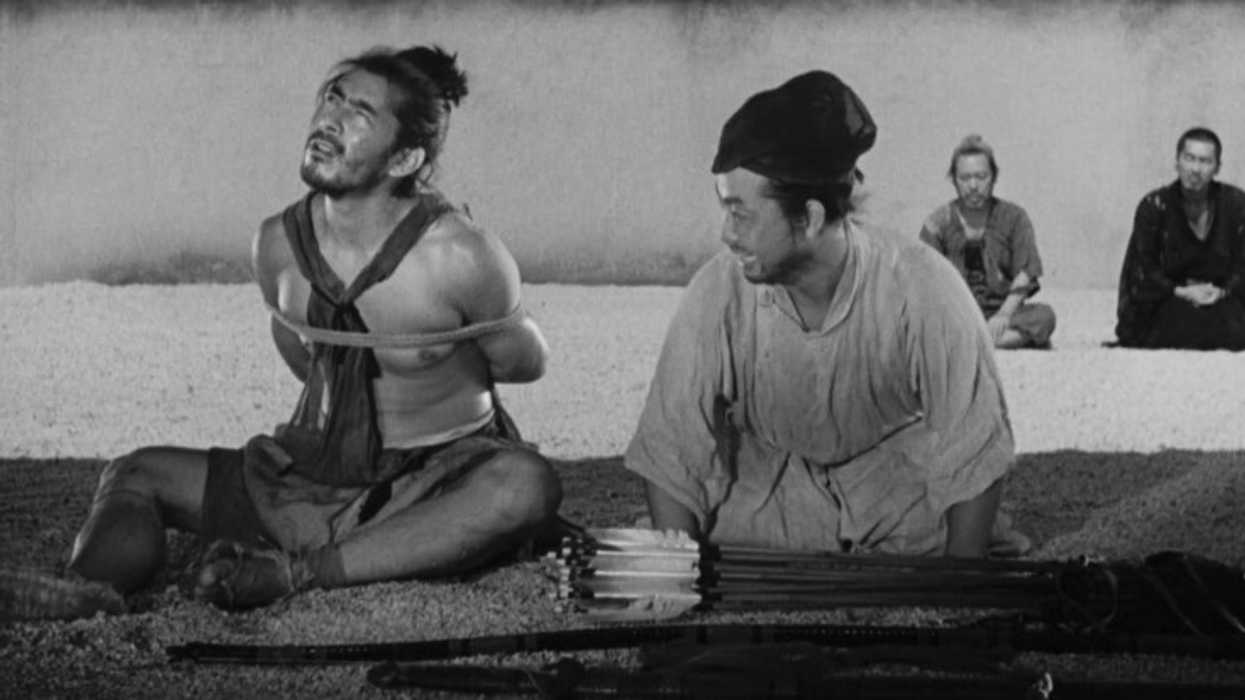
 Rashomon Credit: Daiei
In Rashomon, a samurai gets murdered, his wife gets assaulted, and we hear the story from multiple witnesses who all remember it completely differently. Who’s telling the truth? It was revolutionary, especially for that period, and could be called one of the first detective stories to come out of Japanese cinema.
Back in Japan, Daiei had disagreed with submitting Kurosawa's work. They feared that the film was too unconventional and Japanese in style to appeal to Western audiences.
"On one hand Japanese considered it so indigenous that they did not want to bring it to the West," said Maria Roberta Novielli, an instructor at Ca’ Foscari University of Venice (via The European Film Festival). She added, "On the other hand, for the producers themselves, the film would have been unattractive to Western audiences, due to the fact that it was intrinsically Japanese."
That's not to say some viewers didn't take the film as "exotic" for the period. But the story was so strong, it didn't really matter.
For example, in his review for Sight and Sound in 1952, Simon Harcourt-Smith wrote, "We find ourselves here in a world where social conventions and psychological reactions are alike alien to us, and at the same time infinitely absorbing."
After the film won at Venice, the effects were immediate. By the end of 1952, Rashomon was released in Japan, the United States, and most of Europe.
Suddenly, Japanese cinema became well known in the West, mostly thanks to the Golden Lion awarded to Rashomon. The festival also points to the Silver Lions won by Ugetsu Monogatari (1953) and Sanshô Dayû (1954) by Kenji Mizoguchi and entries like Biruma no Tategoto (1956) by Kon Ichikawa as major influences on world cinema.
It turns out that when you dig deep into the specifics of your stories and interests, you often hit something universal. Kurosawa's exploration of truth and memory spoke to people everywhere, maybe because we're all unreliable narrators of our own lives.
Don't presume to know what all audiences want. Just tell your authentic story, and release it to the world.