7 Most Brilliantly Confusing Movie Endings Ever Made
Movie endings so ambiguous they stick with you like a hangover!
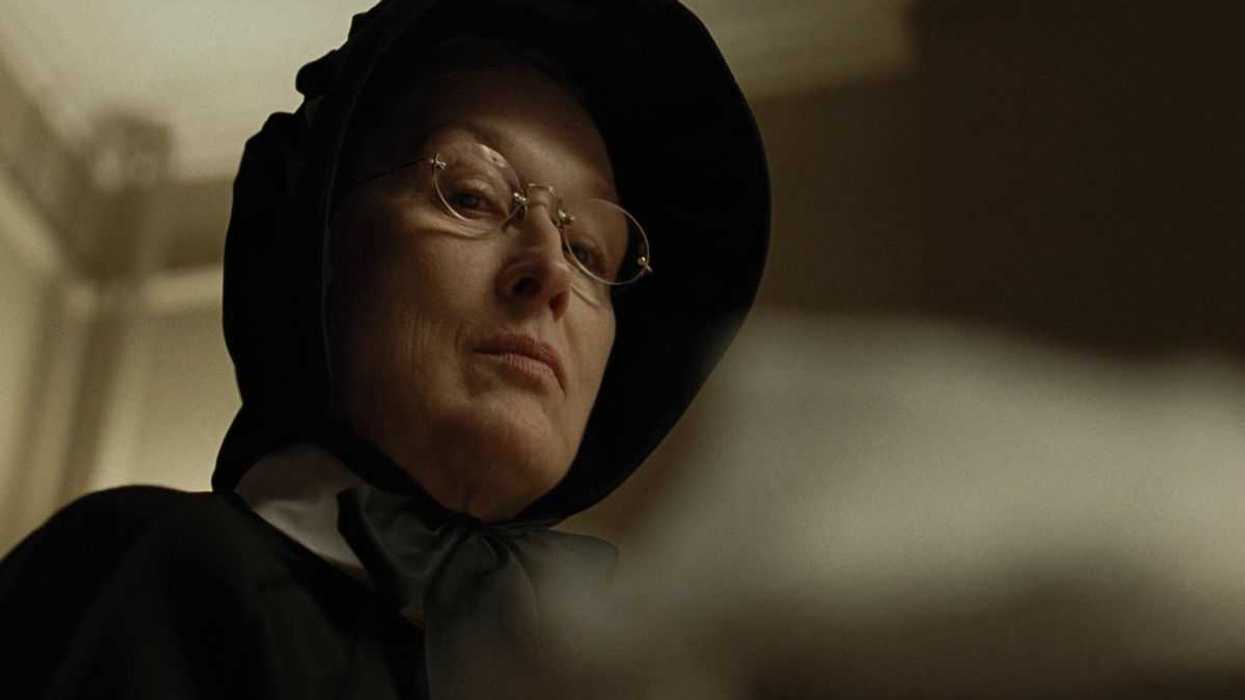
Doubt (2008)
I love myself a movie that either leaves me thinking that I’m a complete idiot or makes me get on a con-call with fellow cinephiles because I need to know what they’re thinking of it. In either case, these movies are usually the ones with open endings that rely on ambiguity to present their finale.
Misdirection in storytelling is one thing, but ambiguous endings are like an itchy mosquito bite. As much as I enjoy scratching on it, I’d be lying if I said I can stop itching at will.
So, do not mind me if I pass on some of that sensation to you!
In this article, we’ve compiled a list of movies that will leave you both tormented and captivated with their ambiguous endings.
Movie Endings So Ambiguous They Still Spark Heated Debates Years Later
1. Inception (2010)
Christopher Nolan’s Inception has had viewers scratching their heads on various levels. With its broken storyline, complex and layered timelines, and a narrative that oscillates between reality and dream, the movie keeps you hooked, fascinated, and utterly confused till the end, leaving you with an ambiguous resolution. The one scene that continues to spark heated debates even today is the closing scene of the film, where Cobb returns home to his family and finds the spinning top, still spinning on the dining table.
So, is it a dream or the reality for Cobb? Call me a cynic, but I was team “dream” until I came across Michael Maine’s statement about the film: “When I got the script of Inception, I was a bit puzzled by it and I said to him 'I don't understand where the dream is'...I said, 'When is it the dream and when is it reality?' He said, 'Well, when you're in the scene, it's reality.' So get that - if I'm in it, it's reality. If I'm not in it, it's a dream.”
Furthermore, in an interview, Nolan clarifies that he believes that Cobb came back to his family for real, but even if he didn’t, it didn’t matter, as to him, it is more important that Cobb doesn’t care anymore. So, basically, Nolan leaves it up to us to decide the fate of this flawed man.
2. The Shining (1980)
\
Stanley Kubrick’s The Shining ended with one of the most controversial endings: a vintage photograph hanging in the hotel lobby, dated 4th of July, 1921. The black and white photograph features Jack Torrance right in the center, surrounded by the guests and patrons of the Overlook Hotel, against the backdrop of a ball. Sounds pretty simple, only Jack was born decades after the photograph was clicked. Only recently, I came across an interview of Kubrick with Michel Ciment, a French film critic, where he said, “The ballroom photograph at the very end suggests the reincarnation of Jack.” That being said, keep the discussions coming!
3. Doubt (2008)
Doubt left me with a literal itch in my brain, like somewhere deep inside the lobes! The narrative follows a liberal catholic priest, Father Flynn, who joins a Catholic elementary school, only to be forced to resign from his job, after being accused of molesting a 12-year-old black boy by the disciplinarian headmistress of the school, Sister Aloysius Bouvier. Neither has any proof of their word, yet they fight for what they believe, until Flynn finally resigns. I’ve watched the film enough times and yet do not know if the accusations made against Flynn were true or not. Let me know if you can catch the truth from in between the lines.
4. Life of Pie (2012)
A meditation on reality and metaphor, Life of Pi revolves around a young man, Pi, who, on his way to Canada with his family to start a new life, survives a ship wreck and is cast away to an island with a few animals that belonged to the zoo owned by his family, back in India. The story is narrated in two different realities: one in which Pi is stuck with animals, and the other in which he is stuck with his mom and a few other people from the ship's crew.
While director Ang Lee does give us a resolution in saying that drama always triumphs reality, I bet you won’t be able to catch on to what actually happened after the shipwreck.
5. Lost In Translation (2003)
Some things are better left unknown, just like nobody needs to know what Bob murmurs into Charlotte’s ears, right before they parted ways with each other forever. This is one such secret that I can live without knowing. Highly controversial due to the onscreen age gap, but their love story is pure, like a profound realization of your existence you suddenly have on a dull afternoon. They part ways, never to see each other again, carrying a few last words in their hearts that were only for their ears.
A last memory and a kiss they shared before they let go of each other. So, let’s just let them have this one!
6. The Thing (1982)
John Carpenter’s The Thing continues to be my “bogart” (pardon my Harry Potter reference), with an ending so disturbingly ambiguous. The movie follows a group of scientists at work in Antarctica who begin to get hunted by a shape-shifting alien. Soon, mistrust spreads across the group as they are enabled to differentiate between their teammates and the alien, who is taking their forms to infiltrate. I guess we’ll never know if either of them was actually The Thing. I think Childs is The Thing and not the real guy; what do you think?
7. American Psycho (2000)
Mary Harron’s American PsychoAmerican Psycho takes us through a total hell as we follow Patrick Bateman, a wealthy, full-time investment banker and part-time serial killer, on a killing spree, as he ruthlessly murders people in random fits of rage. Or was he just fantasizing about everything? Harron leaves us hanging, and honestly, it feels a little cruel since I’ve been trying to get my head around this for quite some time now, all in vain. While Harron clarified that she never wanted to end it in a dream, the movie kind of leaves you there. And even if it didn’t, if it's not a dream and Carnes had dinner with Paul Allen in London, which would mean Bateman didn’t kill him, what exactly happened?
Ambiguous endings to movies are more common than you realize—it seems we love ambiguity as much as we love a resolution. Let us know if you’d like part 2.