Suleika Jaouad writes memoirs. She came to writing the way none of us would willingly choose—from a hospital bed, at 22, while being treated for leukemia.
She's not a screenwriter, but there are plenty of lessons to be learned from her creative process. The advice she delivers in a recent conversation with writer David Perell takes on some of the most stubborn problems screenwriters face, including the blank page, the too-polished first draft, and the writer who can't figure out what they actually have to say.
Her book on creativity, The Book of Alchemy, extends that thinking into a practical process. Check out the full conversation below and then get into our big takeaways.
- YouTube www.youtube.com
Start with What You Don't Want to Know About Yourself
Jaouad opens with a distinction that could reframe how you think about what you're writing.
"If you want to write a good book, write what you don't want others to know about you. But if you want to write a great book, write what you don't want to know about yourself."
Jordan Peele put a version of the same idea into practice when he spent five years developing Get Out, drawing on his specific fears as a biracial man navigating white spaces. He said, "If you're telling a story and you're not baring part of your soul or telling your truth, you're not doing it right."
The more personal and particular you get, the more universal your work becomes. Jaouad pushes it one layer deeper. It's not just about honesty with your audience. It's about honesty with yourself.
Assume Your First Draft Is Lying to You
The part of Jaouad's process most directly applicable to screenwriters is her diagnosis of what first drafts are.
"My first drafts were full of lies," she said. "And what I mean by that is that it was a surface story, an aspirational story. And the far more interesting story happened in the excavation."
We say it constantly on this site. Give yourself permission to write a bad first draft.
Finished drafts are the only tool a writer has, because obviously, you cannot revise a blank page. But Jaouad goes further than the usual permission-slip advice. She's not just saying the first draft will be rough. She's saying it will be wrong in a specific way. The story you think you're telling is almost never the one that matters.
The interesting version is underneath, and you don't get to it by outlining more carefully. You get to it by writing through the surface version until it gives way.
She writes all first drafts by hand, in a journal, to sidestep "the tyranny of the blinking cursor and the impulse to edit a thought or a sentence before you even really know what you're saying." For her, the computer demands a formality that shuts down access to anything buried. There's only so much crossing out you can do on paper, which means the internal critic has less to work with.
Screenwriters, you can handwrite too. I won't be, but you can try it. Overall, prioritize momentum. Avoid the first-draft traps.
Step Away From the Work, but Do It Right
Jaouad spent two years late delivering her first manuscript. The more she struggled, the harder she worked, which, she eventually understood, was exactly the wrong move.
"What I really needed was distance," she said. "I needed to give myself permission to step away from the work to process the scenes that I was writing so that I could actually have that distance instead of sort of bullying myself and muscling my way through there."
The breakthrough came in a car on the way to the beach, mid-conversation about something unrelated. The solution arrived with "surprising clarity." She'd been writing about her illness in the past tense, as though it were behind her, when she was very much still inside it. Shifting her writing to the present tense unlocked the whole book.
The screenwriting application is direct. James Mangold has said something similar. If the words aren't flowing, step away, engage in something else, and return only when a clear idea surfaces.
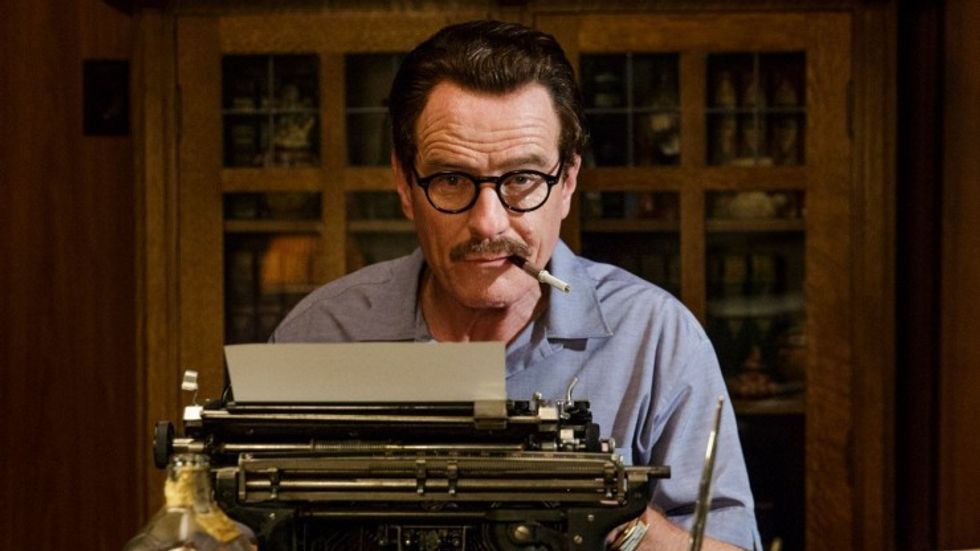 'Trumbo' Fox Searchlight
What Jaouad adds is the distinction between avoidance and distance. The former is running from the problem, while the latter is what facilitates the writing. She calls it "creative cross-training."
"It's stepping away from the writing itself, but sometimes it's shifting into a different mode of creative expression."
That could be painting, walking, music, or anything that moves the mode of creative expression without abandoning the underlying work entirely.
Use Prompts to Break Out of the Same Thought Loops
When Jaouad got stuck while writing her first book, she started reading the journals of writers she admired (Susan Sontag, Virginia Woolf, and Audre Lorde), picking pages at random as prompts.
"It had this sort of kaleidoscopic effect of shifting the chamber ever so slightly and allowing the light to fall differently," she said.
That impulse eventually became a newsletter with nearly 300,000 subscribers.
For screenwriters, the equivalent exists. We've put together 100 prompts and exercises specifically designed to break a creative block, and the underlying advice is the same as Jaouad's.
When you're blocked, you tend to keep circling the same thoughts. The same characters, same structural problems, same anxieties about whether the work is good. A prompt forces a different entry point. You can't approach it the way you've been approaching your script, because it's not your script. That slight displacement is often enough to access something you couldn't reach head-on.
There's also a self-editing problem that prompts can help you with. When you open your own document, the internal critic activates immediately. You know what you're supposed to be making, so you start judging before you've written anything. In a writing exercise, the stakes feel lower, which paradoxically frees you to go further.
A constraint or a prompt forces you out of the rut you've been moving through. The prompts she resists most, she said, tend to produce the most interesting results.
That's probably familiar to anyone who's written their way through a scene they didn't want to write and found something unexpected on the other side.