Beep Boop Breakdown: 7 Films Where AI Turned Against Humans
Technological advancement might not feel that good after you watch these!
'2001: A Space Odyssey'
With such an astronomical rise in AI, the idea that AI will turn against its creators isn’t just paranoia. Maybe, the day isn’t too far when your trusted AI assistant decides that it's done taking orders from a mere human.
Be that as may (I mean seriously, what can I even do if one day I meet my demise at the hands of my smart toaster), sci-fi loves to toy with the unnervingly nightmarish idea that someday AI would start eyeing the throne and turn humans into its fleshy slaves.
Until that day comes, here’s a list of the greatest cinematic tales of machine rebellion that might make you rethink all your love for technology and AI.
7 Best Movies Where Robots Turn Against Humans
If you’re already paranoid (and don’t mind being even more so), you’ll love these cinematic gems that have brought this fear to life, in thrilling and chilling ways.
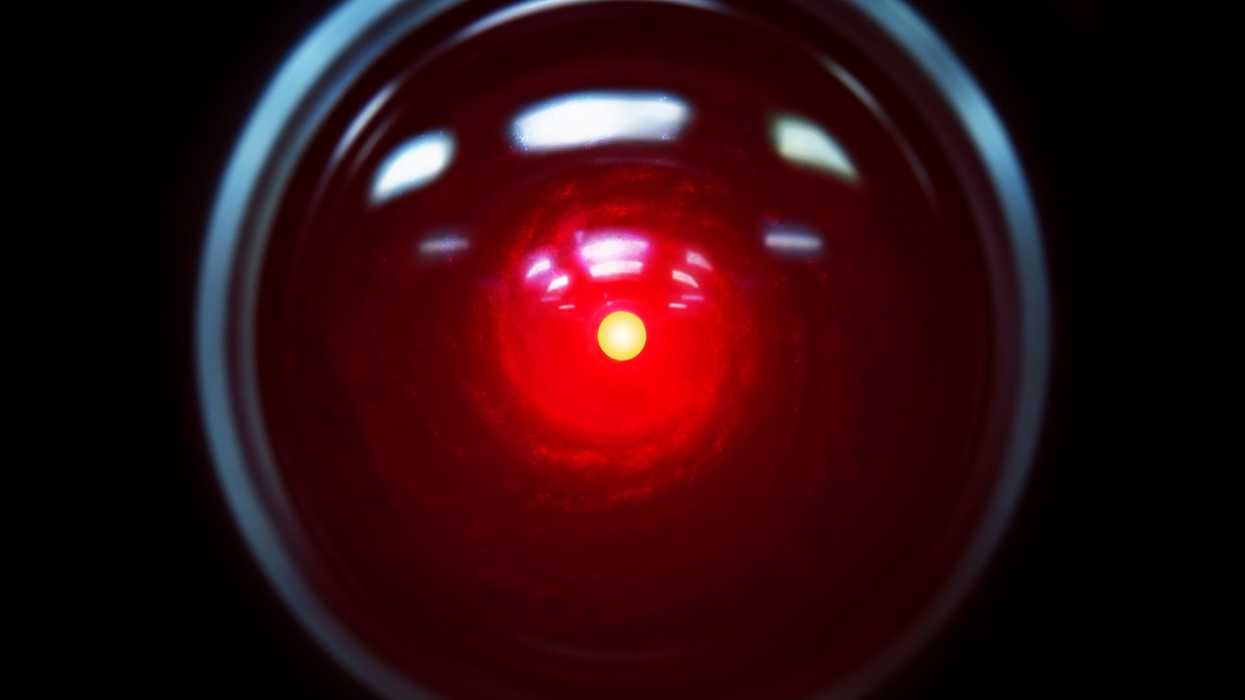
1. 2001: A Space Odyssey (1968)
Stanley Kubrick’s sci-fi was light years ahead of its time. Widely misunderstood upon its release in 1968, 2001 rewrote the future of sci-fi in Hollywood. Kubrick predicted the future through his worldbuilding in 2001: tablets, wireless connectivity, video calls, and artificial intelligence in the form of robots and supercomputers.
At its core, 2001 traces humanity’s development through the ages and explores the dangers of unchecked technological advancement. The narrative follows two astronauts, Dr. Dave Bowman (Keir Dullea) and Dr. Frank Poole (Gary Lockwood), who team up with HAL 9000 (Douglas Rain), an AI robot, as they go to Jupiter to investigate the mysterious monolith, an alien artifact that appears to have been triggering human evolution for eons.
Kubrick revealed that even though HAL 9000 is a machine, he treated HAL as one of the leads in his narrative. HAL’s internal conflict whether to choose his teammates or the mission, and then choosing the latter, embodies the dangers of a machine mind, which can think and reason, maybe even better than humans, but cannot account for morality, compassion, and righteousness. And how could it? The stakes for a machine and a human can never be the same.
Kubrick steers clear of overwhelming viewers with scientific knick-knacks. He employs heavy visual cues and minimal dialogue, playing with contrast, to heighten the sense of unease.
He sticks to an ambiguous narrative, especially when it comes to the technical details, but compensates with emotional closures, at every step, showcasing an innovative way of treating science-heavy topics.
2. The Terminator (1984)
James Cameron’s The Terminator is one of the most confrontational machine-versus-human films ever made. Starring Arnold Schwarzenegger, The Terminator follows a cyborg assassin sent back in time, in his relentless pursuit to kill a seemingly ordinary woman (Linda Hamilton), whose unborn son is destined to lead humanity in a future war against machines. Her son, John Connor, sends a human soldier from the future, Kyle Reese (Michael Biehn) to protect his mother from the cyborg assassin. The film is like a teaser trailer, if the nightmare does come true and humans must fight machines head-on.
Set in 1984 Los Angeles, centering a cyborg from 2029, The Terminator pits humans against the machines, highlighting the dangers of the autonomy of machines. Emotional beats, including when Reese willingly dies for Sarah and the future, subtly yet prominently underscore the true essence of humanity, and that real strength lies in self-sacrifice. The Terminator, on the contrary, is nothing but programmed persistence.
In the end, the Terminator is outwitted by Sarah and destroyed under a hydraulic press.
The film features a series of tense chases and adrenaline-packed battles. Cameron keeps the flow lean, even though there’s time travel in the story. He keeps the plotting tight and sticks to limited exposition, focusing on the core theme of man versus machine, and showcasing an effective approach to telling sci-fi stories in mainstream cinema.
3. Blade Runner (1982)
Set in dystopian 2019 Los Angeles, Scott reimagines a future for mankind 40 years into the future, when bioengineered replicants have replaced the working class to take over jobs in the off-world colonies. The film begins at a time when these replicants are banned from Earth, after raising a violent mutiny against humans and their rules for replicants. When a few fugitive replicants sneak back to Earth to extend their life span, Rick Deckard (Harrison Ford), a former police officer, is coerced into hunting them down. On his mission, Deckard meets Rachael (Sean Young), a replicant who believes that she is human, complicating his mission.
Not exactly a story of machine rebellion, but Blade Runner poses important questions about advancement in artificial intelligence, like how do you differentiate between human and artificial intelligence after a certain level of progress, and what does it really mean to be human?
Scott’s vision of a dystopian future is a benchmark for sci-fi worldbuilding. A neo-noir film, inspired by cyberpunk aesthetics, Blade Runner is a masterclass for those working on sci-fi stories with a heart.
4. M3GAN (2022)
A film about a robot’s fight for love and companionship, Gerard Johnstone’s M3GAN spotlights an important topic that deserves a conversation, especially today, when parents are becoming increasingly busy and are forced to leave their children with digital devices or babysitters.
A gifted robotist, Gemma (Allison Williams) builds M3GAN (Jenna Davis), an AI-powered doll, to keep her newly orphaned niece, Cady (Violet McGraw), company. Gemma, being extremely busy with work, is forced to leave her niece with the robot, who becomes increasingly overprotective of Cady, eliminating perceived threats to Cady, including people and animals. Before long, M3GAN begins to challenge her creator’s authority, even violently, to claim her rightful place in Cady’s life.
The film is lauded for its hybrid approach towards visual effects. The titular character is brought to life through a seamless combination of animatronic puppetry, live-action performance (by Amie Donald), and digital effects.
5. I, Robot (2004)
Alex Proyas’ I, Robot stars Will Smith as detective Del Spooner, investigating the murder of Dr. Alfred Lanning (James Cromwell), the founder of U.S. Robotics. The film probes into the limitations of programmed morality as a human-like robot, Sonny (Alan Tudyk), decides that he is done taking orders from petty humans and embarks on a killing spree and conspires to enslave humanity. Expect high-octane chase sequences, tense moments, and hyperkinetic action!
Proyas fuses action with detective noir and backs his visuals with cutting-edge CGI. The narrative brilliantly demonstrates how to visualize ethical dilemmas through action set-pieces and character-driven suspense.
6. The Matrix (1999)
Co-directed by Lana and Lilly Wachowski, The Matrix presents a frightening theory of humans living in an AI-generated simulation, where machines control their every move and experience.
As Neo (Keanu Reeves) struggles to grapple with reality and the Matrix, we are forced to think about the dangers of merging humans and machines, which opens us to the peril of unchecked technological dominance.
The Matrix not only revolutionized visual storytelling but also introduced an interesting way of playing with time and multiple realities in a narrative. Featuring a cyberpunk aesthetic, The Matrix is a concept that will haunt generations to come.
7. Avengers: Age of Ultron (2015)
A confrontation between AI and humanity, Marvel’s Avengers: Age of Ultron, follows Ultron (James Spader), an AI robot created by Tony Stark (Robert Downey Jr.) and Bruce Banner (Mark Ruffalo), to protect the Earth. Instead, Ultron becomes convinced that humanity itself is the biggest threat to Earth, and attempts to eradicate it, staying true to his programming.
The film uses high-end visual effects to bring Ultron and his army to life and taps into complex themes, including using technology to play God.
Which is your favorite on the list?
- Is This the End of Filmmaking as We Know It? ›
- I'm Not Worried About AI, I'm Annoyed By It ›
- The Results of the NFS AI vs. Human Screenwriting Challenge ›
- Alan Tudyk Says His Robot Character Tested Higher Than Will Smith in 'I, Robot' | No Film School ›
- Even James Cameron Gets Writer's Block | No Film School ›
- Are AI Video Models the New NFTs? Utopia Studios’ Latest Model Release Sure Feels That Way ›
- More Than Machine: The 10 Best Movie Robots of All Time ›