What a Working Screenwriter Wishes He'd Known at the Start
Matt Harry spent a decade grinding before his career caught fire.
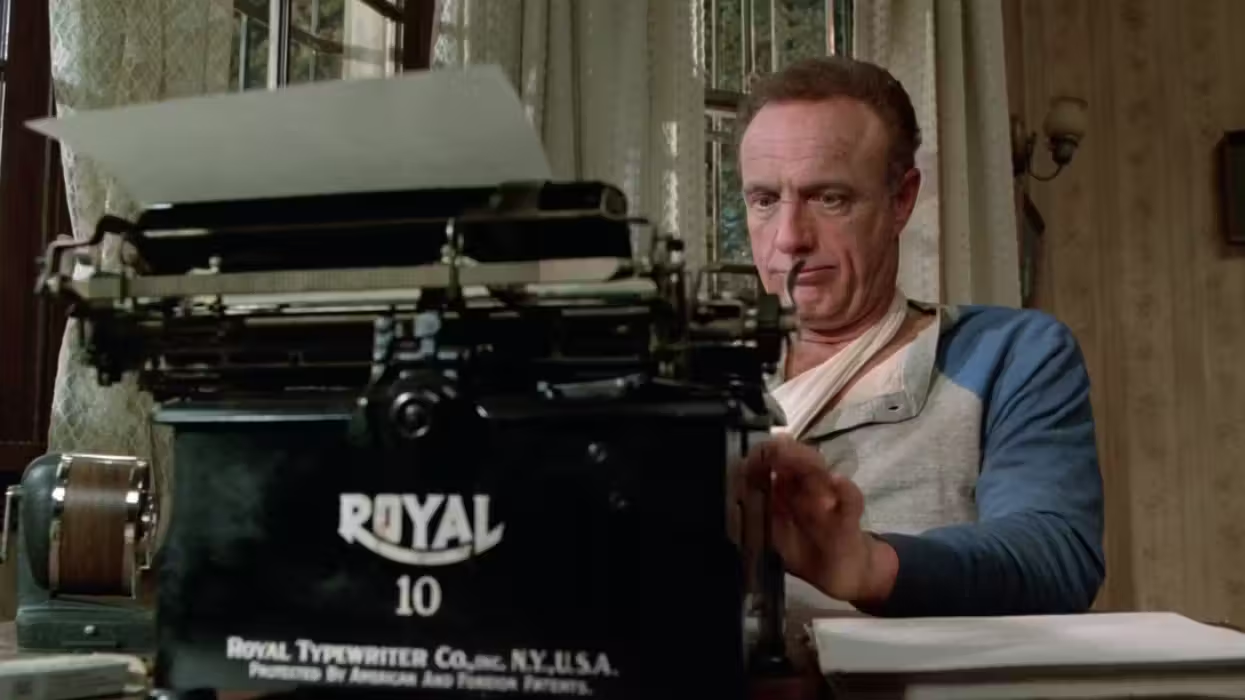
'Misery'
Screenwriter, novelist, editor, professor, and New York Film Academy instructor Matt Harry has taken one of the longer roads to a working career in Hollywood. Everyone comes to the work a different way, and we love learning from everyone's paths.
In a recent YouTube conversation with Film Courage, he broke down the realities of breaking in, staying in, and figuring out what kind of writer you actually are. If you're just starting out, this one's for you. Let's dig in.
- YouTube www.youtube.com
Film School Teaches Craft but Not Business
Harry has an MFA from USC's School of Cinematic Arts. About as strong a film school pedigree as you can get. And he'll be the first to tell you it wasn't enough.
"I learned everything there was about how to make movies, how to write scripts, how to shoot them, how to edit them," he said. "I learned very little about how the business actually works."
The mechanics of how to take a meeting, what your brand is, how to present yourself... that's rarely covered in an educational setting. He picked it up on his own and now makes a point of teaching it at NYFA alongside craft. His rough estimate is that the business side is at least 50% of a working career in film.
That tracks with what script reader and industry vet Alan Zinnes has said. Learning how Hollywood operates, who works where, what deals are happening, and how relationships form is as important as anything you'll learn in a classroom.
The Path Is Usually Slow
Harry's own timeline is a useful corrective to anyone expecting a quick launch. After graduating, he spent roughly five years writing scripts while working full-time. His goal was one screenplay per year, each submitted to the Nicholl Fellowship. Four consecutive rejections. Then, a handwritten note on a rejection letter telling him he'd been placed in the top 10%.
"That was enough that I'm like, 'All right, I'll try again next year,'" he said.
The following year, a quarterfinalist placement (in the top 2.5%) earned him attention from agents and managers. He spent another five years working with that manager before a spec script went out wide and he landed meetings. Ten years of grinding, total, before he'd call any of it a real start. That aligns with what UCLA instructor Corey Mandell has said about the reality of the industry. A career is rarely built on a single script. The first gets you meetings. The second proves you can do it again.
The Water Bottle Tour Is Real, and Meetings Are a Skill
Once you have something that attracts attention, you'll likely end up on what Harry describes as the "water bottle tour." That's a round of general meetings with production companies and industry contacts. Think of it as an informal audition for relationships, not jobs.
Harry ended up writing a script for a producer he met in one of those generals, which he credits as a turning point. But he's also careful to note that getting the job and keeping it are two different skill sets.
Sometimes a project sounds great in the room and falls apart once you're in the work. Knowing whether you're better solo or in a writers' room, whether you can thrive on assignment, is something you only learn by doing it.
A Script Is a Blueprint, Not a Building
Harry spent 15 years as an editor before he was a produced writer, and he credits that time with making him more collaborative and less precious about his own work. Watching how much a story has to flex on its way to the screen made it easier to hold his ideas loosely.
"A screenplay is just a blueprint for a house," he said. When you actually build it, the pipes have to run differently, the paint color doesn't work with the trees outside, and the people moving in want to live in a different room. You have to adapt.
This is something a lot of writers resist. As we've covered, rebreaking a script is one of the hardest things to get a newer writer to do. The impulse is to swap a side character or tweak a joke and call it a revision. But that collaborative flexibility is what makes the difference between someone who gets one job and someone who keeps getting them.
When the Industry Won't Buy Your Idea, Write a Book First
When Harry pitched his agent a big adventure concept ("kind of like The Goonies, but with magic"), the response was blunt. Nobody's buying an unproduced writer's original script that isn't based on anything. He needed IP.
So instead of shelving the idea, he wrote a novel. That book was eventually published, and a couple of years after its publication, he was hired to adapt it into a TV pilot.
This is a real tension in Hollywood right now. Studios are deeply driven by IP. The safer the bet, the better. But there are ways around it, and one of the most underrated is creating your own source material. A short story, a serialized podcast, a self-published novel, a web series... any of those can give your screenplay the pre-existing hook that buyers are looking for, while keeping full creative control in your hands.
For Harry, it became a personal philosophy. Write the novel first, own the story regardless of what Hollywood does with it, and adapt from a position of strength.
The Question That Has to Come Before Everything Else
All the craft and strategy aside, Harry comes back to one central question every screenwriter has to be able to answer. "Why does this need to exist? What is it saying that nothing else has said, in exactly this way?"
"If you can't think of that," he said, "maybe it needs a little bit more time in the oven."
You don't have to share that answer with producers. He says they often don't want to hear it anyway. But the writer needs to know it. It's also, practically speaking, your best protection against a rewrite spiraling away from what you originally wanted to say. If you know why the story matters to you, you'll know when it's drifting.
- 4 Takeaways from Bradford Young on the Daily Grind of Being a Cinematographer ›
- The Nine-Year Overnight Success Story of the 'Olympus Has Fallen' Screenwriters ›
- Greg Kwedar is the Patron Saint of the Indie Grind: Here’s What He Taught Us at SXSW ›
- Unlearning Grind Culture With Oscar-Winning Editor Paul Rogers ›
- Don't Fall into This Revision Trap ›
- Breaking Into Hollywood Today ›