The 12-Minute Rule for Writing with a Partner
Lucia Aniello and Paul W. Downs walked John August through the system that got them through five seasons of Hacks.
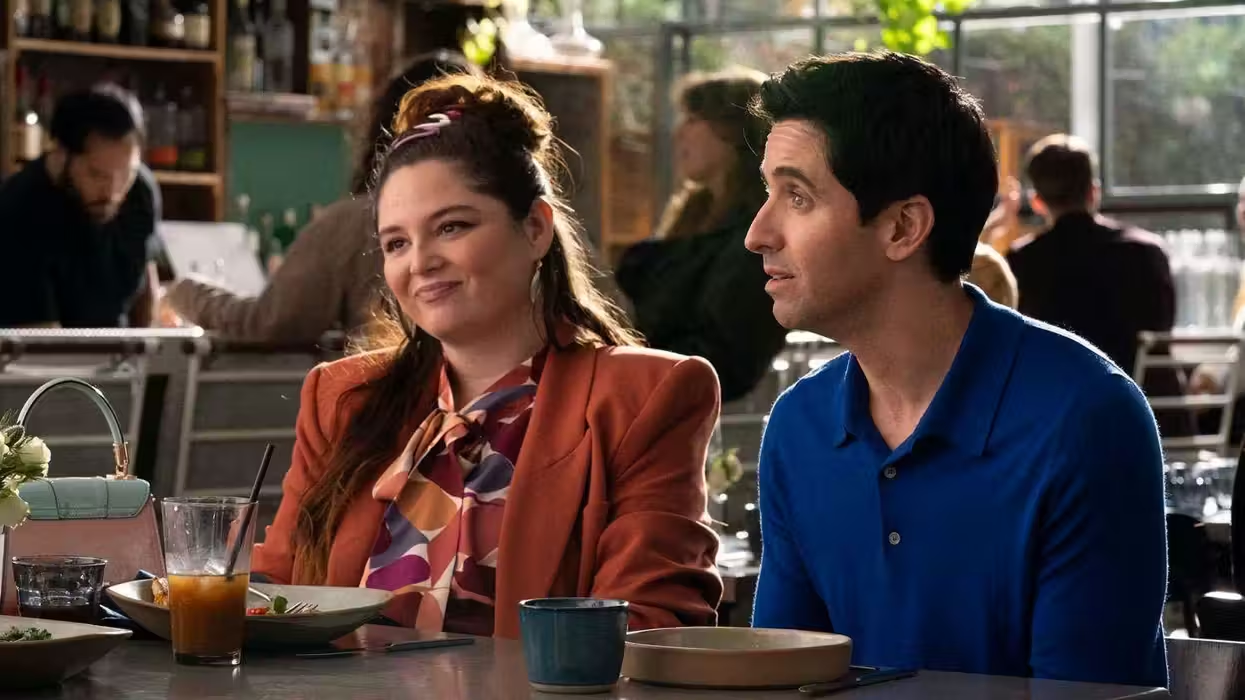
'Hacks'
Have you been thinking about the Hacks series finale since it aired a few months ago, or are you mentally stable? I'm not! So I've been watching all those emotional TikTok edits of the characters and thinking through the mastery of that last season since the end of May.
Show creators and writers Paul W. Downs and Lucia Aniello appeared on the recent episode of Scriptnotes with John August to talk about the craft of writing the show, so you know there's a ton of good advice for writers here, specifically if you want to write comedy or write with a partner or in a writers' room. (They also spend a lot of time talking about reputation in Hollywood, which is interesting in a different way, which then segues into how they thought about their Hacks characters and their reputations.)
We've got a few lessons you can take away, but definitely listen to the whole thing, because it's chock-full of insights on process and joke-writing. Pull up the Hacks pilot to see the writing in action, then dive in.
- YouTube www.youtube.com
Build Story Around a Goal
The early parts of the podcast focus on how they approached the final season thematically, and finding the beats that would support that theme. It's super instructional for anyone looking at breaking a big story and can be applied at any scale, whether you're writing a season of TV or a feature.
Downs reveals that they were always hoping for five seasons (but weren't sure of renewals). They were able to roughly plot arcs for that many chapters. And by Season 5, they knew what the end would be. So how did they get there?
Aniello said, "We knew that we wanted to have [Deborah] strive towards something, but that thing that she would get would then kind of be—it's not a MacGuffin exactly, but it would be something where she realized she thinks that the professional goal is the thing. But then by the very, very end, she realized the goal wasn't the thing. It was the creation. It was the getting there. It was the, as she says in Season 1, the scratch and the claws, the fun part."
In Season 5, a lot of focus is on Deborah's MSG show, which (spoiler alert) doesn't go the way she plans. But once the room decided that would be the season's focus, they had a direction.
Downs added, "So once we had that, then we knew, then it was easier to build episodes around that goal."
This is so simple, but so important. If you find yourself floundering in your writing, stop and consider what the character is working toward. Are they working toward anything? Build your plot around their goal. That will give the rest of your script the structure it needs.
Break the Beats Together
One of my favorite discussions from the episode is when they explained the logistics of how they write with a partner. Essentially, they know what an episode or scene will look like, so they both write a version of a scene at the same time.
"The way that Paul and I actually write, when it's just the two of us, [we] take the same scene. We had it outlined. We knew what the basic beats were," Aniello said.
"Yeah, we would break the story together," Downs said.
"And then we would each write the same scene."
"At the same time."
"And it would be kind of like, great, we have 12 minutes to write the scene," Aniello said. "So you have to just bang it out and don't get in your head about it."
Granted, getting the beats broken is a pretty big hurdle, but the interesting thing here is that once you have the outline in place, how each person fills in the colors can be totally different and allow for wildly creative approaches. And the time limitation means that you aren't staring at a blank page (or shouldn't be). You just have to get something out, even if it's a vomit draft, so you have something to show your writing partner.
"Time Chess"
Another thing they get from this method is a way to move fast on the parts that might trip you up on any given day.
Finally, out of this partnership approach, you're almost exclusively looking at what works, not what doesn't.
"It's almost like time chess," Downs said, "because if I'm like, 'I don't really have a way in, I bet you'll have a way in. And then I just go. And she didn't have a perfect button. She was like, 'He might have a button for the scene.' So it just made us move through the first draft much quicker."
Aniello added, "And then I would read his, he would read mine, and then we would highlight our favorite parts of the other person's. … And then we would take turns combining them. So oftentimes the things that weren't my highlighted were his highlighted, and vice versa. And sometimes we'd have the same jokes, and sometimes we'd have totally different jokes, and I'd be like, 'Oh, I think that's better.' And it just made us concentrate on just the positives."
Downs said, "It was positive reinforcement only. If there were the same joke in a script, it would either mean it was exactly right because we had this hive-mind moment, or it was not right because it was too 'first thought.' So it was really telling in terms of, it kind of gave us a third draft by the time we combined them."
I love the bit about a joke being "too first thought." If you both come up with something, maybe that's a lightbulb moment… or maybe it's the easy thing, and should be punched up.
- YouTube www.youtube.com
If One Person Fights for a Joke, Leave It In
When writing in partnerships, you won't always agree, and that's okay. But if you come to a point where one person really loves a joke and the other doesn't get it… try it anyway.
In Hacks, this happened with "yum yum in my tum tum," a deadpan line delivered by Ava in an early season. Aniello didn't get it. "It's simply not in my wheelhouse of things I think are funny."
However, the audience did love the joke. It went on to internet memedom.
Downs said, "If one of us really believes in a joke or if it's just one of us gets the joke, just for one, we do have the power to be like, 'But we have to try this,' and then we do. If even one person feels that passionately about it, you will see the reaction online, and it'll be like, people are quoting that thing."
If they're butting heads as writers but one person is passionate, Downs said it's "inarguable. Let it happen."
Try following that advice yourself.