This year’s Venice International Film Festival saw the return of many auteur filmmakers bringing their newest works to the island of Lido for premieres, press, and the public. As always, there were many films worth celebrating, but the most personally moving for me was Possible Love by South Korean filmmaker Lee Chang-dong. The film is coming to Netflix on November 6th after a brief theatrical run starting October 23rd. Let’s talk about why the film works so well, without any spoilers.
Character Depth
The film follows a working-class wife and mother who befriends a documentary filmmaker and her husband, as they attempt to frame their newest film around the lives of a working-class family.
The film functions as an ensemble piece with the two couples being the primary focus, and I haven’t seen characters with this much depth and richness in a very long time. The working-class couple has a young son who often acts as an audience-like observer to the dynamics at play.
Out of these five central characters, they each vary in how much their actions or backstory affect the actual progression of the narrative. However, they each have a complicated, difficult-to-fully-decipher view of their world, most concretely formulated by the economic systems put in place in their society.
How the Film Examines Class
 ‘Possible Love’Credit: Netflix
I’m very hopeful that this film reaches a wide audience with its Netflix release, because there is an easily Americanized perspective on South Korean films that tackle class, in that so many that reach the American zeitgeist are often violent crime thrillers. That’s not a dig at violent crime thrillers, but the role that the class divide and the micro-prejudices that come with it are incorporated into the film is nothing short of genius.
I briefly mentioned the ambiguity of the characters and how they see the world, and so much of this is due to how their place in the constructed social classes warps their perception of objectivity. It tackles the subgroups of classism in the ways you probably expect it would: difficulty empathizing across social class, the dreams each social class finds themselves hyperfixating on, and how that translates across to the other class, etc. However, each character has various biases confirmed and refuted multiple times throughout the film to extraordinary analytical results.
How Character Depth Compounds
I like to think of the perfect method of character growth like a game of Tetris. A piece of a character is shown in their behavior, but is missing some context. Then, another piece of information is inserted to give context to that behavior, thus completing the metaphorical block and further developing the character.
The thing that separates a good script from a great script that utilizes this methodology is that a lot of good scripts complete the blocks, but then don’t stack other blocks, or moments of character growth, on top of the completed one in a way that fuses them all together. Often, scripts will jump to the next beat of development and put all their attention on it without properly integrating the first pieces.
Not only does Possible Love compound its character growth and integrate every piece of development for each character into the next moment that moves them forward, but the growth of one character is also entirely dependent on the other. There isn’t a single inconsequential moment of characterization in the entire film. No matter how subtle, if you were to remove any, it would have major ramifications not only on that specific character, but on everyone around them as well.
Universal Empathy
 ‘Possible Love’Credit: Netflix
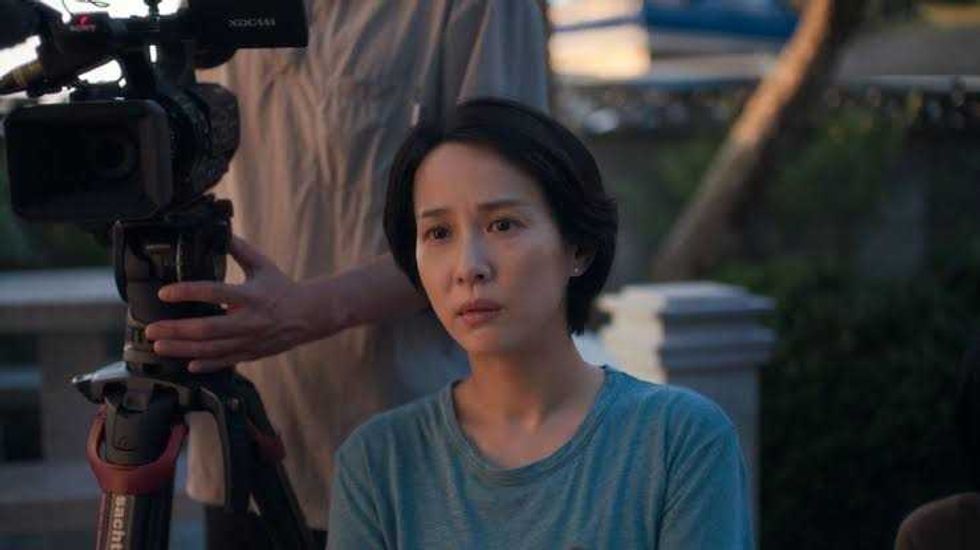
The smartest decision the film makes is its choice to not pick a side on which family’s perspective has more or less of a moral high ground. Firstly, that’s hardly the point of the narrative, so keeping score would negate the actual intent, but its decision to abstain from a moral stance also makes the tragedy of the narrative all the more palpable.
Obviously, as a viewer, while watching the film you are likely to log more than a few moments with each character that feel off or morally questionable in your head, but they come and go so quickly that the decision on what you’re supposed to feel is ultimately up to you.
Without getting into specifics, down to the closing minutes of the film, as each of the storylines is concluding, we are still shown both families’ journeys with a complete lack of bias. To be completely honest, even having seen the film, and being as far out from seeing it as I am, I’m still not entirely sure where I stand on the characters, myself. If that sounds like it can be frustrating, that’s absolutely true. But the last thing that choice is is sloppily constructed. Nearly everyone will leave their viewing of Possible Love with a wholly unique conclusion, and if my opinion means anything, that’s a treat we rarely get to see.