Some argue that designing an alien is easy since nobody has seen one, so you could just let your imagination run wild. While that might be the case in some narratives, I do not believe conceptualizing the alien in E.T. the Extraterrestrial was that simple for Steven Spielberg (and boy was I right!).
A non-human, genderless creature from a planet unknown, E.T. is everything you could ever ask for in a friend. Its attributes, both physical and psychological, are subversive of the traditional alien tropes. E.T. is not dangerous or aggressive and possesses supernatural powers that are relatable to humans: a perfect balance between the familiar and the wondrous.
But for this article, let’s focus on looks. Because, let’s be honest — E.T. looks weird and cute with that oddly-shaped head and big pug-like eyes. So, let’s break down how Spielberg conceptualised E.T.’s appearance.
Story And Themes
Spielberg’s E.T. follows the friendship between a troubled and lonely young boy, Elliot, and an extraterrestrial creature, E.T. The narrative explores themes of love, friendship, connection, sacrifice, and childhood innocence as Elliot finds a way to send his friend back home to his own planet, evading the system.
And if you think about it, E.T.’s appearance lines right up with those themes: it’s cute and not at all frightening. Those big eyes, big head, and little body kind of remind you of a toddler mixed with a brachycephalic dog. Adorable! (And also important to the narrative.)
E.T. As A Character
We’re not quite sure of what E.T.’s IQ might be, but it definitely is the one with immense EQ. It is profoundly empathetic, gentle, and displays rare wisdom. It is like a little child, confused and frightened by unfamiliarity, yet extremely curious to want to know everything. Its caring and nurturing nature is transformative.
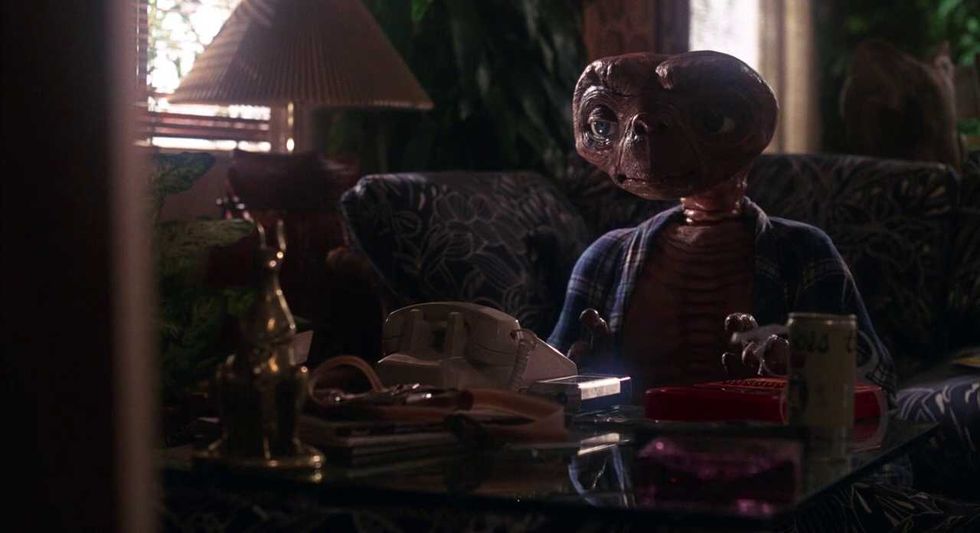 E.T. (1982)Source: Universal Pictures
Additionally, E.T. has supernatural powers that stand as a metaphor for healing and empathy. It can connect with humans physically and emotionally, transferring its experiences, sensations, and stimuli that it feels. It is patient, compassionate, and has an affinity toward learning.
Better than most humans I know.
The Idea Behind E.T.’s Appearance
Steven Spielberg had one consistent mandate about E.T., "I didn't want anybody to think that E.T. was anything other than an actual extraterrestrial. Therefore, it couldn’t look like somebody in a suit, and I wanted him to be only three feet tall.” To achieve that, Spielberg's first idea was to alter the neck, which would 100% distinguish E.T. from humans. “So, I said I need him to have such a small neck, and I want the neck to telescope like a turtle coming out of a shell,” said Spielberg.
According to Spielberg’s vision, “He is a vegetable.” Naturally, E.T. doesn’t belong to the animal kingdom. At the same time, E.T. was never meant to look anything like a monster, shared E.T.’s production illustrator, Ed Verreaux.
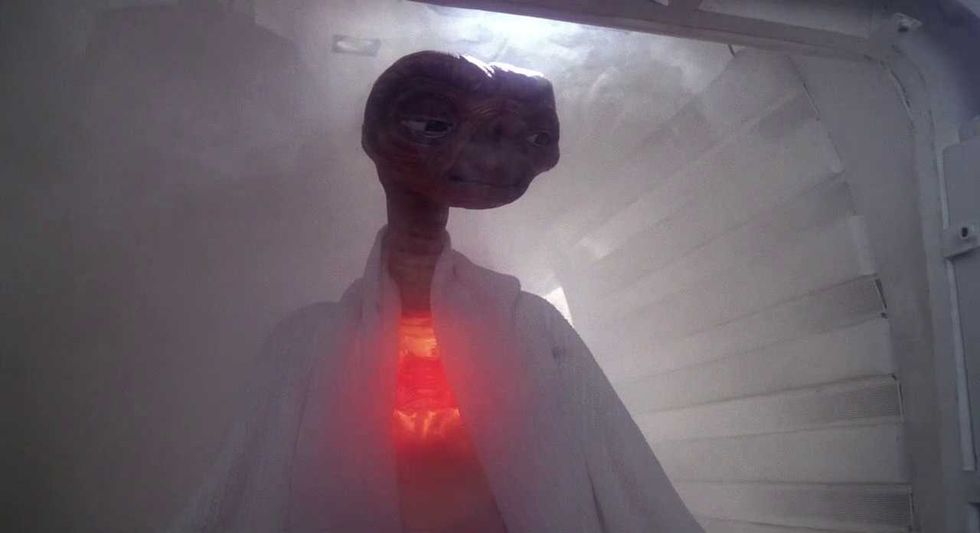 E.T. (1982)Source: Universal Pictures
After rigorous brainstorming and sessions of sketching, the briefs for E.T. were clear:
- Shouldn’t resemble a monster in any way
- Telescope neck
- Shouldn’t look like a person in a bodysuit
- Should embody wisdom, empathy, and endearment
However, it was important to strike the perfect balance—it couldn’t be too scary, too Disney, or too sweet.
Spielberg shared that he went through a couple of designers, including now-retired Rick Baker, a.k.a. “The Monster Maker”, who is known for his incredible work in An American Werewolf in London, until he found Carlo Rambaldi, whose creative vision matched his.
The Design
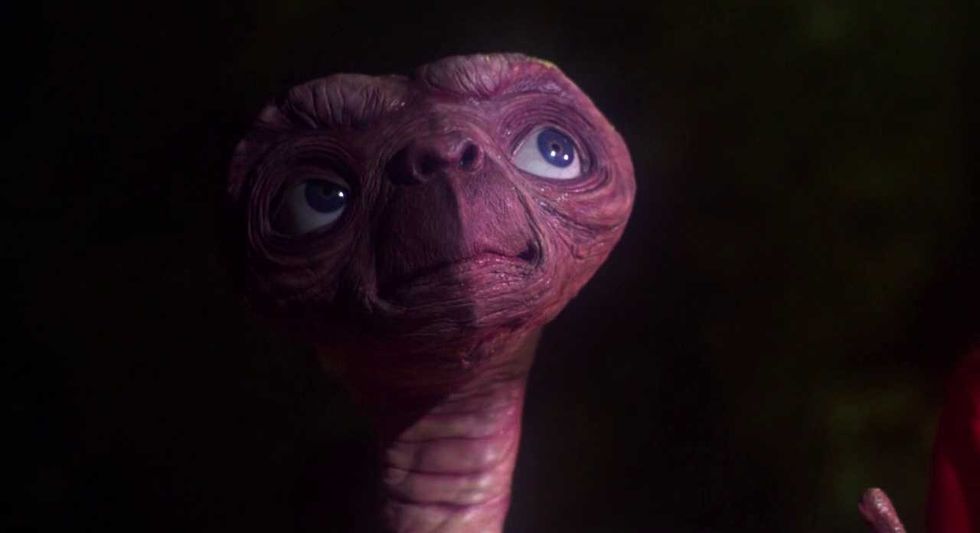
E.T.’s Eyes And Face
At first, Ed and Carlo came together to make multiple variations of E.T. as per Spielberg’s brief.
Their references were Albert Einstein, Ernest Hemingway, and Carl Sandburg, especially for E.T.’s eyes.
“I remember saying to Carlo, here are some pictures of Albert Einstein, Earnest Hemminway, and Carl Sandburg. I love their eyes…” shared Spielberg in E.T.’s BTS. Spielberg wanted E.T.’s eyes to reflect the frivolity, wisdom, and sadness in the eyes of those three icons. So, the mixing and matching began.
 E.T. (1982)Source: Universal Pictures
Spielberg also shared how he wasn’t happy with how E.T.’s eyes had turned out in the beginning. “The eye looked like a painting against almost plastic, and it didn’t have depth or anything,” said Spielberg.
To Spielberg, glass eyes made more sense because they are practically indistinguishable from a real eye and “look really real.” So the hunt for a glass eye-maker began.
Producer Kathleen Kennedy found Beverly, a staff member at the Jules Stein Eye Institute, who made E.T.’s glass eyes: oversized with an iris that moves.
Interestingly, E.T.’s facial features were inspired by the facial features of the elderly: wrinkled, subtly disfigured, but at the same time adorable.
Carlo and Ed would create mock sketches and then take them to Spielberg, where they would pin them to the walls to compare the facial features. At a later stage, Carlo began sculpting E.T. in clay. Under Spielberg’s direct supervision, Carlos would adjust E.T.’s features until finally E.T. came into existence.
E.T.’s Physical Structure
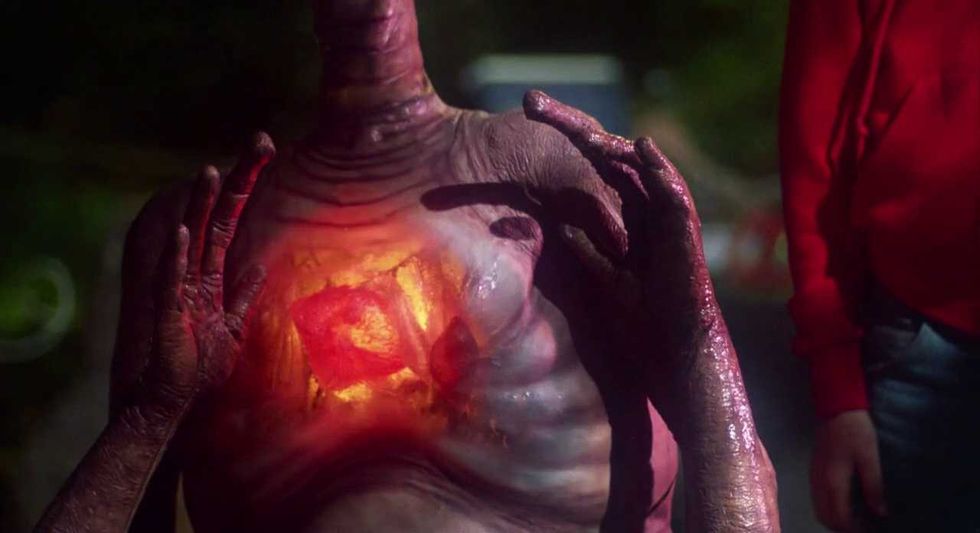
Spielberg wanted something very special to happen when E.T. illuminated his heart light. He said, “When he [E.T.] turns on his heart light, I wanna be able to see the organs around the light moving, kind of breathing and moving in a strange way.”
 E.T.Source: Universal Pictures
Since E.T. was inspired by plants, it was decided that E.T.’s internal organs would also be inspired by the plant kingdom. That’s why E.T.’s organs look like they’re out of this world!
E.T.’s Movement
Making E.T. move was harder than you would think. Here’s what they did:
E.T.’s Torso
Now, back in the early 80s, making E.T. move around believably without putting a human in a suit or using today’s advanced special effects and CGI was next to impossible. But Spielberg didn’t want a human in a suit. So how would E.T. move? So, Kathleen Kennedy did some trials on her own with a friend’s 6-year-old daughter, and presented the results to Spielberg, ultimately convincing Spielberg that E.T. should be played (in part) by a person. They found someone for the role: an 11-year-old boy, Matthew De Merritt, who was born without legs and could walk on his hands.
Alongside Matthew, they also found Tamara De Treaux, who did most of the walks, wearing the bodysuit, most memorably, in the opening scene where E.T. comes to Elliot to return the Reese’s pieces that he lost in the forest when he went in search of E.T. for the first time.
E.T.’s Hands
Next, the hand movement had to be fixed. Sadly, Carlo’s mechanical hands weren’t cutting it. “The fingers would move but almost too thoughtfully,” shared Spielberg. The problem was solved by hiring a very talented mime, Caprice Roth, who would wear E.T.’s hand makeup and perform creatively, separate from the body, ensuring that E.T.’s hand movements were not restricted. Spielberg has immensely credited Caprice for adding naturalness and “humanness” to E.T., in the little things it did, such as wiping his mouth while eating watermelon.
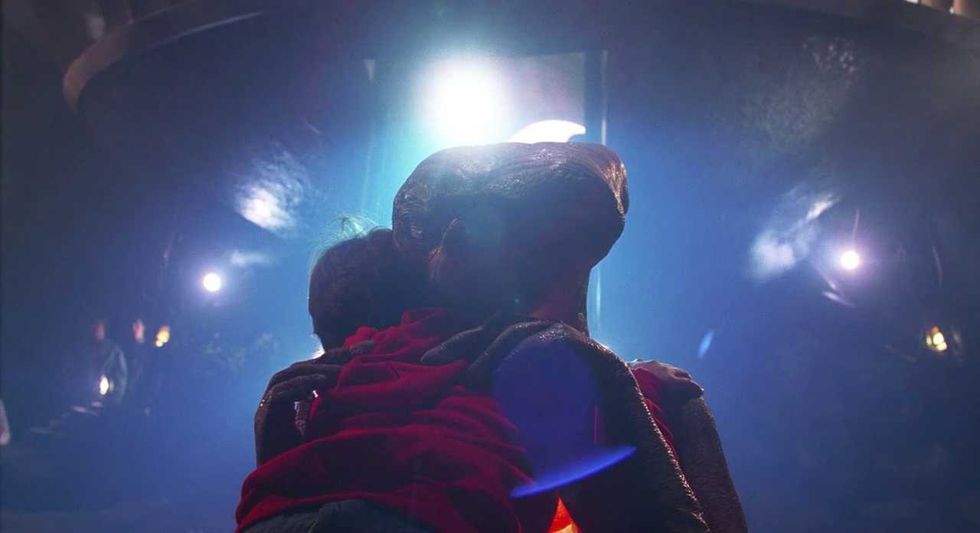
So, basically, the torso of the E.T. was worn by Matthew or Tamara while Caprice wore the hands. So, two humans would bring E.T. to life, separately.
Additionally, E.T. was being operated by 12 separate people, who were connected to him via little pumps, to give him muscle movement or eye movements, by stretching the latex of the skin.
 E.T. (1982)Source: Universal Pictures
E.T.’s Color
E.T.'s DOP, Allen Daviau, shared that “One of the things that Steven knew from the very beginning was that E.T. would be very shadowy. Hardly seen in the early stages of the film, where we would take a while to discover him.” So they began testing for colors and texture.
“I remember him being everything from somewhat of a green to much more purple than we wound up. And that brownish skin with purple overtones evolved out of those early tests,” shared Daviau. To add on and maintain its mystery, E.T. was majorly lit from the back, allowing shadows to keep his appearance obscure, until revealed to the viewers.
It’s not completely wrong that we filmmakers consider our films to be like our children, considering it takes no less than a village to make a good one. E.T. shows how special effects back in the '80s were more about engineering and less about digitization.
Do you think today’s advanced special effects and CGI would have done a better job? Let us know your views in the comments below.
- Check out Rick Baker's Alien for Steven Spielberg's Scrapped 'Close Encounters' Sequel ›
- Why E.T. Died, and How It’s the Secret to Spielberg’s Masterpiece ›
- Try Not to Cry While Reading This Vintage 'E.T.' Review by Roger Ebert ›
- Editing 'E.T.': Lessons on Creating Emotional Scenes from Carol Littleton ›
- How Was 'E.T. The Extraterrestrial' Written and Directed? ›
- 3 Words From E.T. Changed How Kids Connect With Alien Stories Forever ›
- Why Steven Spielberg Fought to Keep 'E.T.' a Standalone Film ›