What You Can Learn from Robert Rodriguez’s 4 Favorite Movies
The director behind El Mariachi, Spy Kids, and Alita: Battle Angel has eclectic influences.
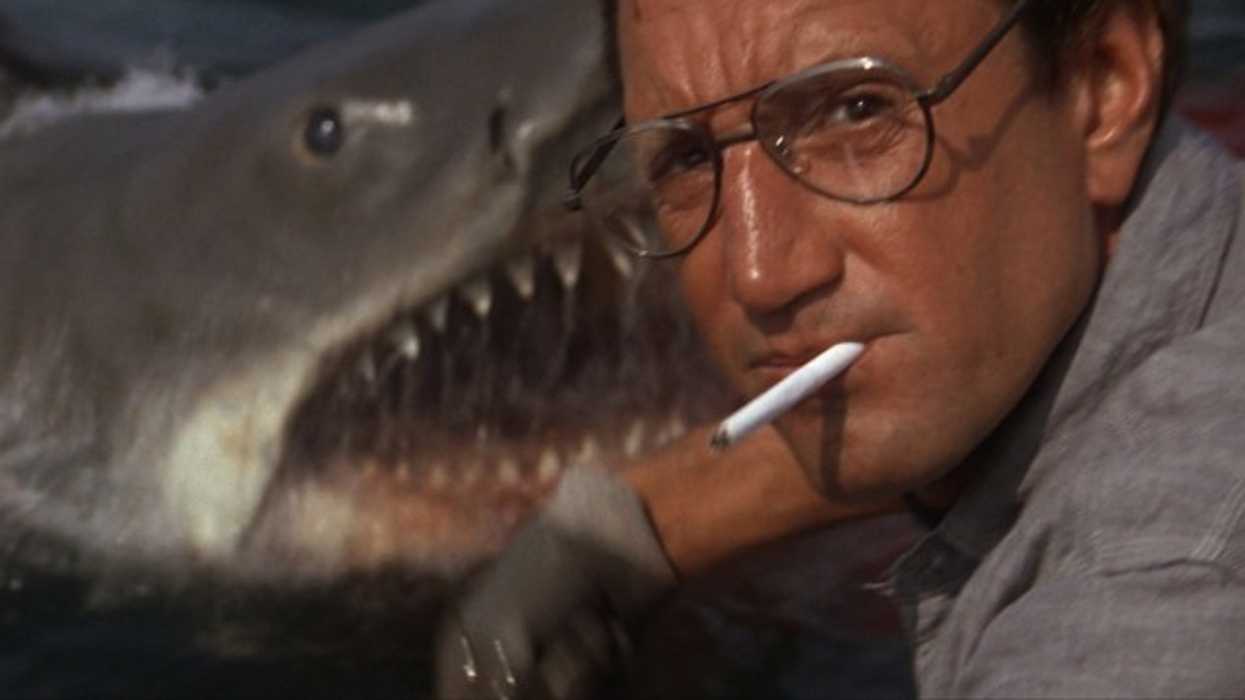
'Jaws'
There is perhaps no filmmaker working today with a more eclectic filmography than Robert Rodriguez. Other than a vague sense of “genre” and a tendency to include Latin-American themes and characters, there is little that links El Mariachi and The Faculty and Spy Kids to Sin City or Planet Terror or Alita: Battle Angel. However, his influences come into focus when looking at the four favorite movies that he shared during an interview with Letterboxd in 2024.
Let’s break those titles down one by one and see what we can learn from each of them.
Jaws (1975)
The first two titles that Robert Rodriguez shared were ones that “I just really love as great films.” Right off the bat, he picked Steven Spielberg’s killer shark thriller Jaws, which was released on his seventh birthday and “scared the crap out of me.”
While Jaws is a frequent Letterboxd four favorites pick (in fact, it is the eighth most commonly selected title by Letterboxd interviewees), it makes sense why the movie would appeal to Rodriguez in particular, in addition to providing him with a core movie memory.
The massive hit defined the summer blockbuster, but - as Rodriguez understands - it was also a full-tilt horror movie in spite of its adventure movie trappings. The fact that movies can be both terrifying and populist at the same time is an idea that has fueled quite a bit of Rodriguez’s work, especially in the 1990s.
It is this sensibility that helped him turn his vampire crime movie From Dusk Till Dawn into a sprawling franchise that now includes a sequel, a prequel, a video game, and a television spinoff. He also channeled it into the 1998 Invasion of the Body Snatchers riff The Faculty, which is one of the most highly regarded post-Scream teen horror movies from the turn of the millennium.
The Godfather (1972)
The second title that Rodriguez picked was Francis Ford Coppola’s The Godfather, the Best Picture-winning adaptation of the Mario Puzo mafia novel of the same name.
The seminal crime drama is the most-picked title during Letterboxd four favorites interviews (landing on the lists made by Matt Damon, Richard Linklater, Tony Leung, Ke Huy Quan, Michelle Yeoh, Jeff Goldblum, and more than six dozen other filmmakers and actors), but that is for a reason that almost certainly explains why it appeals to Rodriguez. Even though it was a major, big-budget studio effort, The Godfather still feels like the unadulterated vision of Coppola, one of the titans of New Hollywood.
Although the filmmaker had recently helmed the financially successful Finian’s Rainbow, he was still an untested director in the eyes of producers. This is especially the case because his follow-up movie, 1969’s The Rain People, was a flop. However, Coppola managed to deftly navigate the studio system (including fighting for several of his key casting choices, like Al Pacino) and create a big, splashy blockbuster that nevertheless feels distinctly like the work of an auteur.
Rodriguez has also developed this skill in his own career, using studio budgets to craft idiosyncratic works that feel like movies that only he could have made, including the kooky espionage comedy Spy Kids (which cost $35 million), the visually audacious Frank Miller adaptation Sin City ($40 million), and the vibrant manga adaptation Alita: Battle Angel (roughly $200 million).
Escape from New York (1981)
The second pair of titles that Rodriguez shared were ones that “really inspired me because the filmmakers were so independent and made their own thing,” making him “feel like I could do it, too.”
He started with John Carpenter’s Escape from New York, an iconic sci-fi cult film that stars Kurt Russell as Snake Plissken, a disgraced Special Forces soldier with an eyepatch who is hired to rescue the President (Donald Pleasence) after he is stranded on the island of Manhattan, which has been transformed into a maximum-security prison. The movie is an expansive vision that takes place in a sprawling world, but it is nevertheless a scrappy, low-budget effort that only cost $6 million to make.
The tricks that Carpenter and his crew used include making a faux network of computer-generated 3D imagery by attaching reflective glow tape to a physical model and shooting it in the dark. However, the aspect that appealed to Rodriguez the most was Carpenter’s jack-of-all-trades approach to making his own films.
Rodriguez said that, with Escape from New York, “John Carpenter made me realize I could be a filmmaker too and do my own music, do my own script, like he was doing.” Carpenter had been utilizing this approach for a while by that point, famously producing, directing, co-writing, and scoring his seminal 1978 slasher Halloween, which grossed $70 million against a budget of less than $350,000.
Rodriguez harnessed Carpenter’s chameleonic flexibility when creating his independent 1992 debut feature El Mariachi, the movie that put him on the Hollywood map. Rodriguez has no fewer than 10 credits on the movie, including director, co-writer, producer, cinematographer, editor, sound editor, music editor, and camera operator.
Mad Max 2: The Road Warrior (1981)
The final movie that Rodriguez selected was Mad Max 2: The Road Warrior, the sequel that gained the iconic post-apocalyptic action franchise a foothold in the United States. He said, “That one was really inspiring at that age, too, when I was starting to make movies.”
The Australian movie, which follows Max (Mel Gibson) being drawn in against his better judgment to help defend a peaceful desert community from the villainous gang leader Lord Humungus (Kjell Nilsson), is also a scrappy independent success.
Director and co-writer George Miller managed to spin a low budget into a high-octane journey taking place in a world that feels genuinely humongous. While doing so, he was also able to deliver propulsive genre thrills in a uniquely stylized manner.
In addition to inspiring Rodriguez to understand that true cinema can come from anywhere, at any budget level, it seems likely that Mad Max 2 reinforced his love of genre filmmaking, which he has embraced by creating movies in a startlingly wide variety of genres and subgenres, including horror, Western, action, superhero, sci-fi, and crime.
You can read plenty more about Robert Rodriguez on No Film School, including his advice about how to make your first film, his thoughts on what makes the best action movies, and seven of his lessons on modern DIY filmmaking.