Robert Rodriguez's 4 Rules for Making a Profitable Movie
What Rodriguez has learned about making profitable movies since El Mariachi.
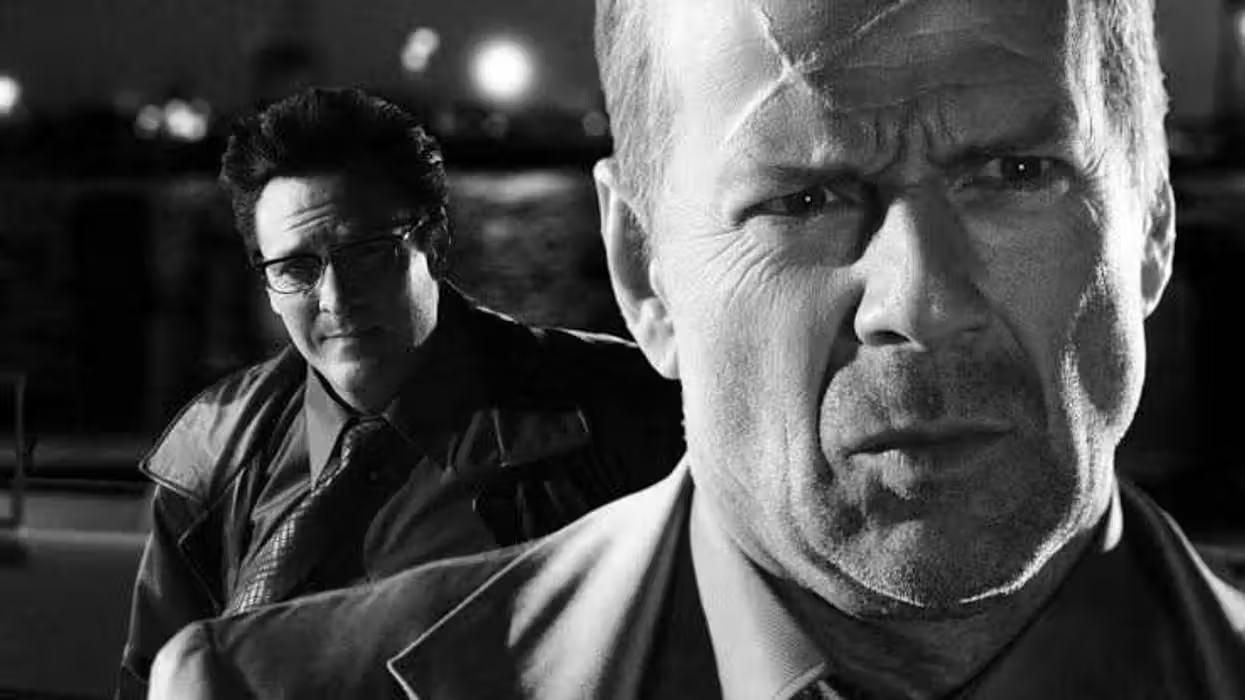
'Sin City'
Look, we don't have to tell you that making feature-length movies can be expensive. It's simply impossible not to incur some cost if you're asking people to work on something that takes as much effort and time as making a full-length film. Plus, you have costs like crafty, costumes, location fees… we could go on. Even if you try really, really hard to make something for almost nothing, you're probably going to be spending money.
Filmmaker Robert Rodriguez has been the blueprint for DIY indie filmmaking for over 30 years. We've covered his work on several projects, including the $7K budget on El Mariachi, the one-man-crew approach, the $0 production value tricks, and the scripts he used to make his films.
Rodriguez has managed to keep making profitable movies for 30 years while the studios he works with struggle. Now he's launching a film fund targeting action features, and while pitching that on a recent podcast, he gives listeners four things that indie filmmakers can use immediately.
Check out the episode of How I Invest below, where Rodriguez speaks with David Weisburd.
- YouTube www.youtube.com
Should You Ask the Buyer What They Want First?
This might be advice that bumps. Most filmmakers write what they want and then look for someone to sell it to. Or you might hear that if you write something you enjoy, you will find your audience.
Rodriguez reverses the order.
"I was at Netflix selling them some ideas on projects, and they mentioned that they wanted, like, a Spy Kids-type thing. So I was like, okay, they want a Spy Kids-type thing, I can do that. So I came up with a very Spy Kids-type thing but with superheroes, little kid superheroes, called We Can Be Heroes."
Netflix reported that about 44 million households watched the film in the first 28 days, making it one of its bigger 2020 originals.
This might be tenuous advice to apply broadly, because by this time, Rodriguez was an established filmmaker, and Netflix wanted him to repeat a past success, and he delivered for the company. In this case, he's basically filling an open writing assignment.
But the truth is, if you're a writer/director, you might want to do the same thing someday. Can you take a pitch and make it your own? Here, Rodriguez the rule-breaking rebel is also showing he's a producer-brained filmmaker.
Keep the Budget Low to Keep Your Freedom
You probably know that if you have a producer, they're going to be happy when you come in under budget and on schedule. When you start asking them for more money or get behind, you can get in trouble. The fingers start tightening around everything you do.
Rodriguez sees a low budget as leverage.
"If you turn on the money hose to wash away your problems, you can't turn that thing off," he says. "I'd like to keep my budgets and schedules low. It offers me more freedom because the studios leave you alone because they know they're getting a big movie for less. But also, creatively, it forces you to be more creative, which only makes the movie better."
By "money hose," he's essentially saying that if you start trying to use money to solve every problem, you can dig yourself into debt and create problems with your financiers. Keeping budgets low is what gets the studio to trust you, and it gives you the creative freedom to make the movie you want to. It's very possible to make an expensive-looking film while spending less.
Be Both Technical and Creative, Not Just One
Rodriguez discusses how he worked in a photo shop for his father's friend. The owner watched him take some family portraits and told him the creative part was already there, but he needed to now learn the technical side of photography.
"Creative people hate technicalities, but you can learn to be technical. Technical people can't really learn to be creative. You can learn to be technical. And if you're technical and creative, it'll be unstoppable."
This is why Rodriguez still mixes his own sound in his garage after 25 years. It's why he operates his own Steadicam and loads his own film. He knows how to do those things and doesn't have to rely on anyone else.
This is not always possible for everyone—if you're working in hair and makeup, you probably won't know how to process film, for example—but the more you can know, the better. It will help you have the language to describe your vision and needs to your crew.
Rodriguez also mentions how he had been writing his own scores for years. But then his teenage son learned music theory from YouTube and now does their orchestral scores because he can write circles around his dad.
Why Previz Is Important
Rodriguez has been an early adopter across his whole career. He famously shot Once Upon a Time in Mexico digitally, and was one of the first to shoot and edit on something other than film. Sin City was almost entirely green screen. So it's probably not a surprise that he's now using AI in his workflow.
"I just had to shoot a really fast commercial for Nike, and using AI … I could compile a version of that 60-second spot to show all my crew within a day. I could show them what the locations were, what the lighting would look like, everything, so they could start prepping, and we could be shooting in record time the very next week."
It's not clear what tool he's using here or whether any image generation is also taking place. Could this same previz be done without AI? Absolutely.
The overall point of creating something that people can work off of and be inspired by still stands. He even made a secret proof-of-concept for Sin City to convince that team to get aboard.
It's also important that the AI was used only in prep, not the final product.
What's your favorite Robert Rodriguez film?