In space, no one can hear you scream about studio interference.
1979's Alien ushered in a new era of sci-fi horror that few movies have ever matched. And it's kind of a miracle it exists and is so exemplary on every level, considering the final product is a hodgepodge of rewrites and clashing personalities.
When Dan O'Bannon pitched his original 1976 screenplay (then called Starbeast), it featured an all-male crew with names like Chaz Standard and Martin Roby, no secret robot characters, and a different tonal approach. At the time, O'Bannon had a great concept (contained space horror), but wasn't getting much interest. Then Star Wars launched a renewed fervor for space movies.
What transformed O'Bannon's script into the film that launched a franchise was a contentious rewrite process driven by screenwriters/producers Walter Hill and David Giler.
- YouTube www.youtube.com
Hill and Giler's Rewrites
As O'Bannon and Ronald Shusett (who had story credit on the first script) shopped their project, they caught the interest of Brandywine Productions, the production company run by Hill and Giler. They didn't love O'Bannon's original script and decided to revise it before taking it over to 20th Century Fox, where they had a deal.
The friction was immediate. According to Shusett, Hill and Giler "weren't good at making it better, or, in fact, at not making it even worse," because they had little background in sci-fi writing.
Visually, the scripts could not be more different. O'Bannon's draft contained illustrations. The rewritten draft famously looks a little bit wonky for a screenplay, with single lines of action and description that look more like poetry.
O'Bannon was vocal about his frustrations, telling Starburst Magazine that when Hill began working on the script, Hill said, "My strength is that I don't know a thing about science fiction," adding that the producers were "literally going back to step one, ignoring all that has happened in SF literature since the '30s" (via Alien Explorations).
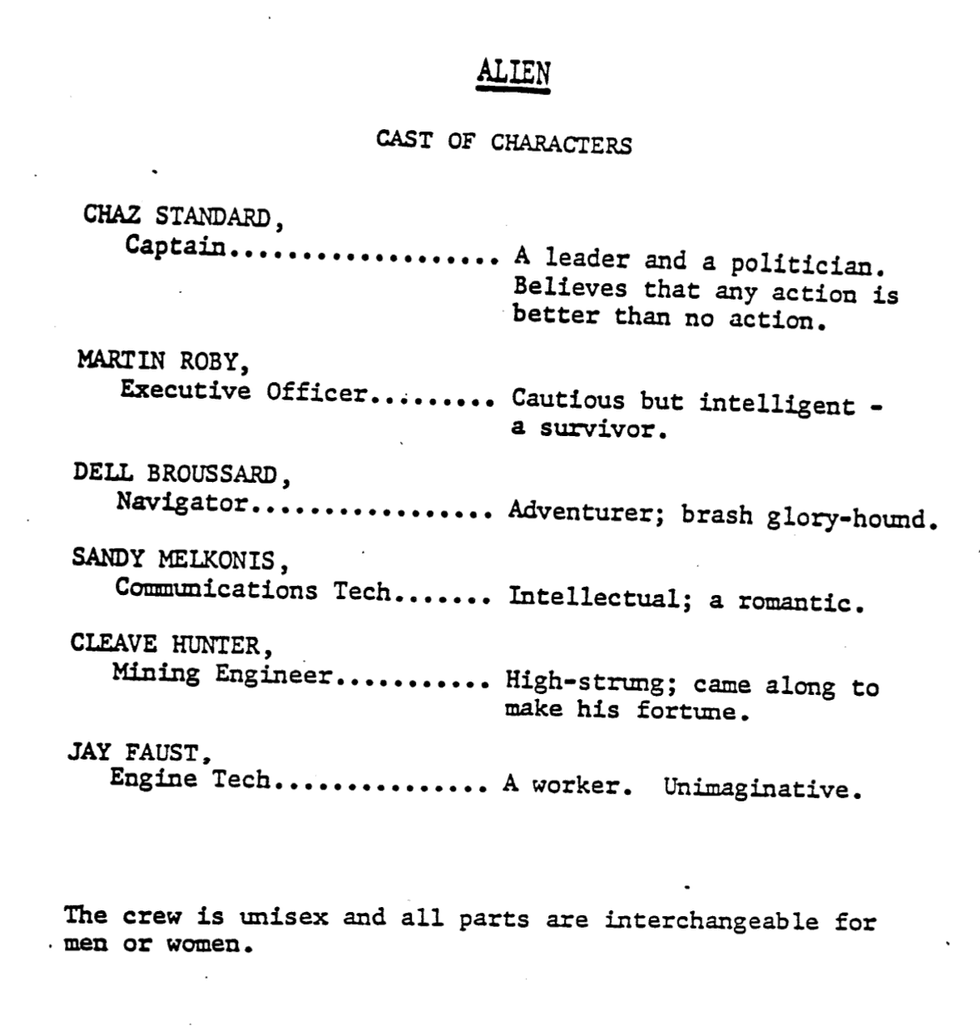 An exerpt from Dan O'Bannon's Alien
The Major Script Changes
The differences between O'Bannon's 1976 draft and the Hill/Giler 1978 revision were substantial, beyond the visuals of their pages.
Characters
O'Bannon's all-male crew with interchangeable roles became a mixed-gender group with distinct personalities. Standard, Roby, Broussard, Melkonis, Hunter, and Faust were renamed Dallas, Kane, Ripley, Ash, Lambert, Parker, and Brett.
The working-class friction between Parker and Brett versus the officers was entirely an invention of Hill/Giler.
The Synthetic subplot
The most significant addition was Ash, the android science officer with a secret corporate directive.
While Shusett later lauded the character's addition, O'Bannon thought it was unnecessary, according to Screen Rant.
Special Order 937—the Company's directive to bring back the Xenomorph at all costs—didn't exist in O'Bannon's version.
 An excerpt from Hill and Giler's Alien draft
Ripley's Gender
O'Bannon's script noted that the crew was "unisex and all parts are interchangeable for men or women," but his survivor character, "Roby," was written as male. Hill and Giler changed the name to Ripley.
The decision to make Ripley a woman came from Alan Ladd Jr., who was then the president of 20th Century Fox (and the guy who greenlit Star Wars). It was pretty radical for the time for a woman to lead a sci-fi movie, although tides were already changing in horror with the establishment of the final girl trope.
Streamlined Structure
O'Bannon's version included more elaborate sequences—multiple trips between a pyramid and the derelict ship, a poison gas attempt in the food locker, and a more explicit alien lifecycle showing victims being transformed into egg casings.
Hill/Giler condensed these into tighter, more focused encounters.
Dialogue
Giler was particularly dismissive of O'Bannon's work, claiming in an interview with Cinefantastique (Vol. 9 No. #1) that "we changed all the dialogue. Every word of it. Nothing is left of O'Bannon's draft. Not a word of his dialogue is left in the film" (via Alien Explorations).
It's true that a lot of the scenes have been reworked. Just look at this example of the crew waking up.
O'Bannon's 1976 draft:
ROBY: Oh... God... am I cold...BROUSSARD: Is that you, Roby?ROBY: I feel like shit...BROUSSARD: Yeah, it's you all right.
Hill/Giler's 1978 draft, the same scene:
LAMBERT: Jesus am I cold.PARKER: Still with us, Brett.BRETT: Yo.RIPLEY: Lucky us.
O'Bannon's dialogue is more complete sentences with standard grammar. Hill/Giler strips it down to fragments and overlapping banter. Parker's running commentary about Brett, and Brett's minimalist responses ("Yo," "Right") are frequent in the latter draft.
 An exerpt from Dan O'Bannon's Alien
The WGA Arbitration
With all these changes and new drafts, and resulting unhappiness, it makes sense that the WGA had to get involved.
Hill and Giler wanted the credits to read "Screenplay by Walter Hill and David Giler based on a screenplay by Dan O'Bannon."
O'Bannon took it to the big dogs.
"So I took it to the Writers Guild for arbitration," O'Bannon told Futurism. "On a Friday, I get a call from the WGA telling me that they've decided in my favor. Then, in the next breath, they tell me Hill had immediately submitted an appeal of that decision. Finally, after months and months of hassle, the WGA has decided, and the writing credit will read: 'A Screenplay by Dan O'Bannon from a story by Dan O'Bannon and Ron Shusett.' I've been vindicated."
The producers weren't happy about this.
"I've made the statement before that on-screen credits often have very little relation to who did what on a film," Hill told Starlog in 1979 (via Alien Covenant). "In this instance, the Writers' Guild has a rule whereby, in a case like this, you have to show that 70 percent of the material was your own and brand new in kind. The fact that David and I carried the O'Bannon screenplay through five drafts to the final shooting script is immaterial. And of course, these things are very difficult to quantify."
Ridley Scott's Take
Ironically, director Ridley Scott mashed together much of O'Bannon's original with the Hill and Giler rewrite. He liked the vaguer cosmic horror of the original draft (bless him).
During production in 1978, Scott grew frustrated with Hill and Giler's "failure to make any of the promised revisions," O'Bannon said, and he was brought back in to fix the script, leading to a series of revisions over several months, according to Strange Shapes.
What ended up on screen was a mishmash. We get Hill and Giler's working-class characters and Ash subplot, combined with O'Bannon's original atmospheric horror and creature.
Still, the original writer wasn't ever really pleased.
"The script that was committed to the film was self-contradictory, confusing, one-dimensional, clichéd, and bargain-basement as science fiction," O'Bannon wrote in a letter to Starburst Magazine (via The Times).