"Toast" Is the Cheapest Way to Make Your Film Feel Real
Are you including these tiny details?
'Disclosure Day'
Every filmmaker has probably watched a scene and thought, I don't believe a single person in this room actually exists.
Cinematographer and director Spenser Sakurai has a name for what's missing. He calls it "toast."
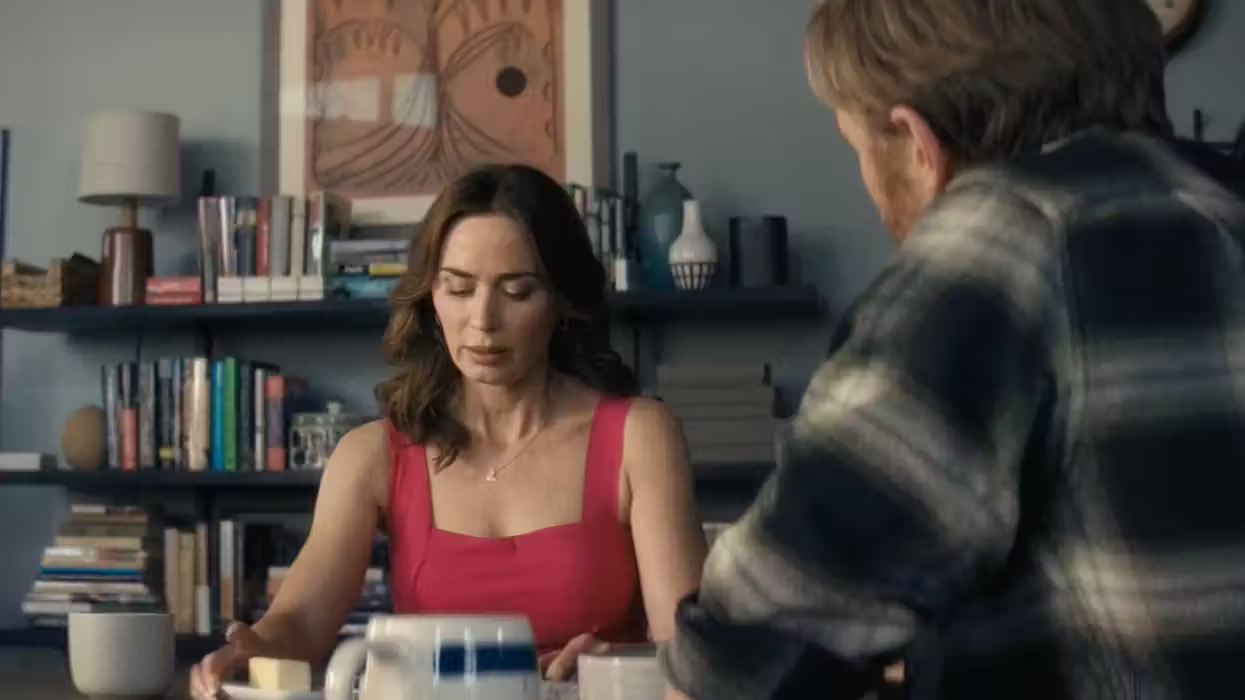
In a recent video essay, he builds the idea out of an early scene from Steven Spielberg's Disclosure Day. In the scene, Emily Blunt's Margaret argues with Jackson (Wyatt Russell) about whether to leave their city while the news of a nuclear scare plays in the background. Margaret is making breakfast—toast.
None of this really moves the plot forward. It's all texture, the small stuff of ordinary life, and Sakurai said modern movies leap so fast into the plot that texture is usually the first thing that gets lost. At the end of this scene, the aliens come in direct contact with Margaret.
Look, whatever you might think of this film (I personally didn't care for it and I do think parts of this scene are oddly blocked), there's a really great lesson to learn from it.
What We Mean by "Toast"
Toast is just the mundane business of being alive on camera, named for Margaret and her breakfast we see in Disclosure Day. If you think of it in these terms, you'll start to see toast everywhere.
At the beginning of Insidious, Patrick Wilson bites a waxy apple and mutters that it isn't even real. Kids pass a carton with a lid that won't stay tight. Rose Byrne's character is on the phone, trying to reach a human being.
In James Wan's $1.5 million haunted-house hit, a family simply moves through a normal morning before anything supernatural shows up. We watch how these people live. What they eat, how they needle each other, and through that we are asked to fear for them.
If characters are just standing around, or if they're just walking and talking for the sake of it, you're missing toast.
The Choices Are the Character
What does the character's toast (or choice) reveal? Wheat or white? Butter or margarine? A toaster or a toaster oven? None of it is probably scripted plot (unless it really, really matters), but all of it is character.
The same logic applies to every prop and gesture you give someone. A person who eats standing over the sink is not the person who plates their, um, toast, and sits down.
When you decide what a character does with their hands during a dull task, you're deciding who they are, and you do it without exposition.
Small Stuff Sells a World
Sakurai's framing is that modern films sketch the outline of a world and never color it in. The textures are the real, everyday moments.
David Fincher is the patron saint of this, and we've broken down how he'll run a single shot dozens of times until an actor stops performing and simply looks like they belong in the room.
Those details start to register as choices the character is making. What do they eat, how do they carry a bottle, does the beer slosh when it hits the table? Brad Pitt spends the entire runtime of Ocean's Eleven eating something to the point that it almost becomes a running joke.
These are the moments your brain uses to decide a world is real. If you take them out, you're left with plot alone and people just moving through beats.
- YouTube www.youtube.com
A First Act Full of Toast
Some films build a whole act out of toast. Barbarian opens with Tess (Georgina Campbell) arriving at a double-booked Airbnb in the rain, wrestling with an empty key box and warily sizing up the stranger (Bill Skarsgård) already inside.
We get long, patient, ordinary minutes before the film becomes a wild nightmare for the character. She needs to use the bathroom. He brews tea. They wash the sheets, then have to make the bed. All that patience (and character development) is exactly what makes the horror hit later.
We've written before about how a strong opening should drop us into a character wanting something and running into a snag, and toast is the raw material for that.
But Toast Is Also Conflict
This is where I'd push slightly further than Sakurai's point. He points out toast as human, everyday realism, and it is. But look at the clip he pulls from Ti West's The Innkeepers, in which a woman struggles to cram an oversized trash bag into a bin, the camera staying on her as she fails, adjusts, tries and tries, and finally wins.
That reads as texture, but it's also a tiny conflict, with an obstacle, a struggle, and a small victory, all playing out on their own little stakes and completely detached from the main plot.
One of my favorite examples is tiny. In Jurassic Park, Alan Grant can't fasten his helicopter seatbelt when they're landing on the island. Everyone tries to help him. Nothing works. Finally, he knots the two ends together in a huff.
Sam Neill once said the moment was never symbolism, just a man who resents the modern world. That's a mountain of character work pulled from a two-second moment.
- YouTube www.youtube.com
The trash bag won't fit. The seatbelt won't fasten. The apple is fake. On and on. Each one is a miniature drama, which is what makes them so useful. String enough of them together and they escalate. Which is something we always want.
The character who can't get out the door on time in scene one is the same character whose whole world detonates by the finale. Small trouble teaches us how to care about the big trouble coming.
You Can Add It on the Day
The best part, if you're working without a big budget, is that toast is nearly free.
All you need is a prop, which could be anything, and a few seconds of screen time. Although I'd suggest thinking this through at the script stage, a director can invent it on the day.
Give an actor a small task and let the ordinary friction of doing it play out on camera, as that particular character would attack it. You don't need expensive gear to make something feel real, and this might be the cheapest tool in that kit.
So next time you're blocking a scene, give your character something tiny to struggle with. The options are endless, whether it's a shoe that won't stay tied, a stuck drawer, a dog who's had an accident, a phone call that won't connect, whatever. Then you'll see how much more of a living, breathing world you get for almost nothing.