I share a very intimate creative relationship with Jack Torrance’s manuscript, which had nothing but 18 pages of “All work and no play, makes Jack a dull boy” —just a single sentence, written over and over again. It was in my early days of filmmaking (sometime in 2018), and I was penning a psychological thriller centering on a pair of twin sisters. I kid you not, the opening to my screenplay about the twins had the exact same scene (not the same quote, though) as in Stanley Kubrick’s The Shining. In my scene, one of the twins is sitting in a dark room, scribbling intensely on her notebook. As we finally see the pages of the notebook, we see it’s the same sentence, written over and over again, across pages.
That being said, this was way before I ever watched Stanley Kubrick’s The Shining. So you can imagine my feelings when I watched the film (I’m still smiling cheek to cheek as I write this).
Naturally, writing this article, decoding the typewriter scene is a literal honor for me. So let’s dive right in (because clearly I’m the best person for this one).
The Story
Kubrick’s The Shining (1980), an adaptation of one of the most celebrated Stephen King novels by the same name, follows Jack Torrance (Nicholas Cage), a former writer and recovering alcoholic, and his family as they head to an isolated hotel for the winter after Jack is offered a job as a caretaker. Ignoring literal warnings about the place, Jack takes up the job, tempted by the opportunity to pursue his real passion, writing. Instead, a sinister presence drives him into violence, with Jack set out to hunt down his own family, just like the former caretaker, Charles Grady.
The Scene And Its Relationship With the Narrative
In the beginning, the changes in Jack are too subtle to notice, especially if you’re someone who’s seeing him every day, like his family. But, soon, the symptoms become too evident to ignore. Since they moved into the Overlook Hotel, Jack is sleepless, isn’t able to focus on his writing, and is constantly irritable.
At the same time, unexplainable things are happening to the family when they are alone in the hotel, including paranormal attacks on his son, Danny. One day, when Danny is visibly injured, Wendy confronts Jack about their well-being and safety. The conversation escalates into a quarrel, where Wendy accuses Jack of hurting his own kid. This particular point in the story, although positioned much earlier than the typewriter scene, has a deep relationship with it.
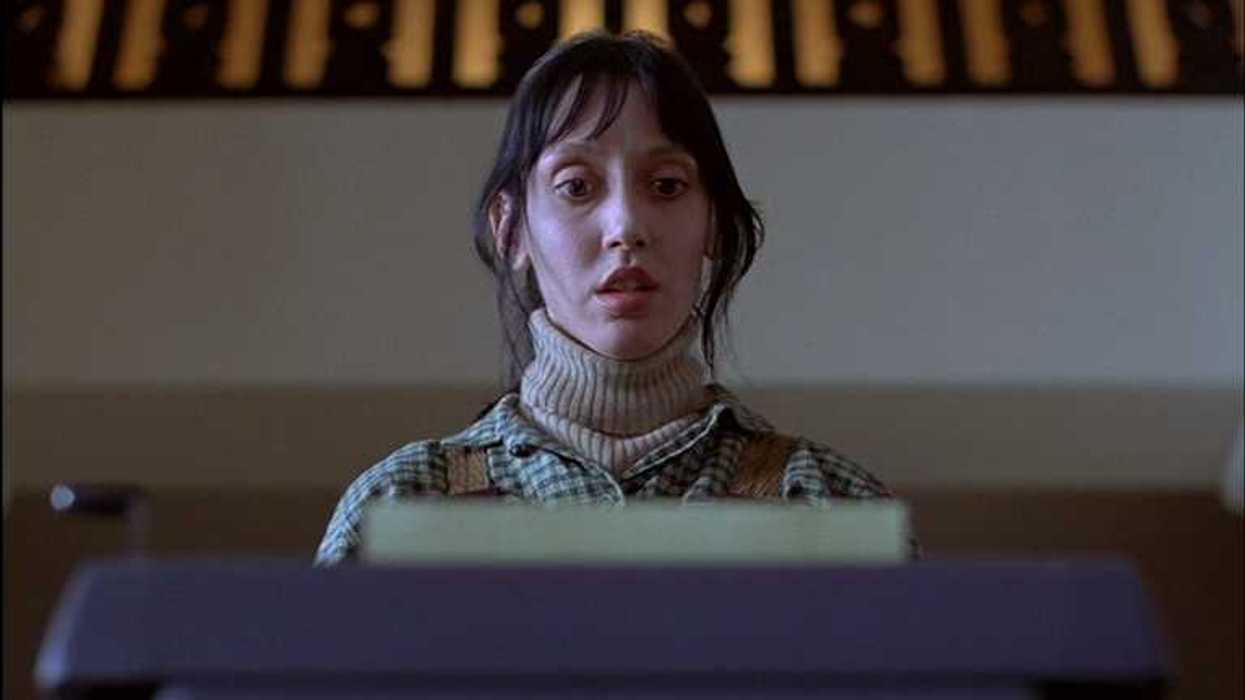 The Shining (1980)Source: Warner Bros., Columbia Pictures
This moment in the film marks the first crack in the trust between Jack and Wendy. Traditionally, a father is both a provider and a protector, but in this moment, Jack has clearly failed. As the mother and the wife, Wendy has nobody else to turn to to keep her son safe in this isolated and unknown place. While in her mind she feels betrayed, her heart knows that something is wrong with Jack.
After this scene, Jack subsequently fails and disappoints Wendy, as the sinister entity continues its attacks on the family, now through Jack. Finally, one day, Wendy decides to leave with Danny, whether Jack agrees to come with them or not. Armed with a baseball bat, keeping Danny close to her, Wendy begins looking for Jack when she spots his unattended manuscript on his writing table, next to the typewriter. Curious, she picks it up to read, and what she sees freezes her blood.
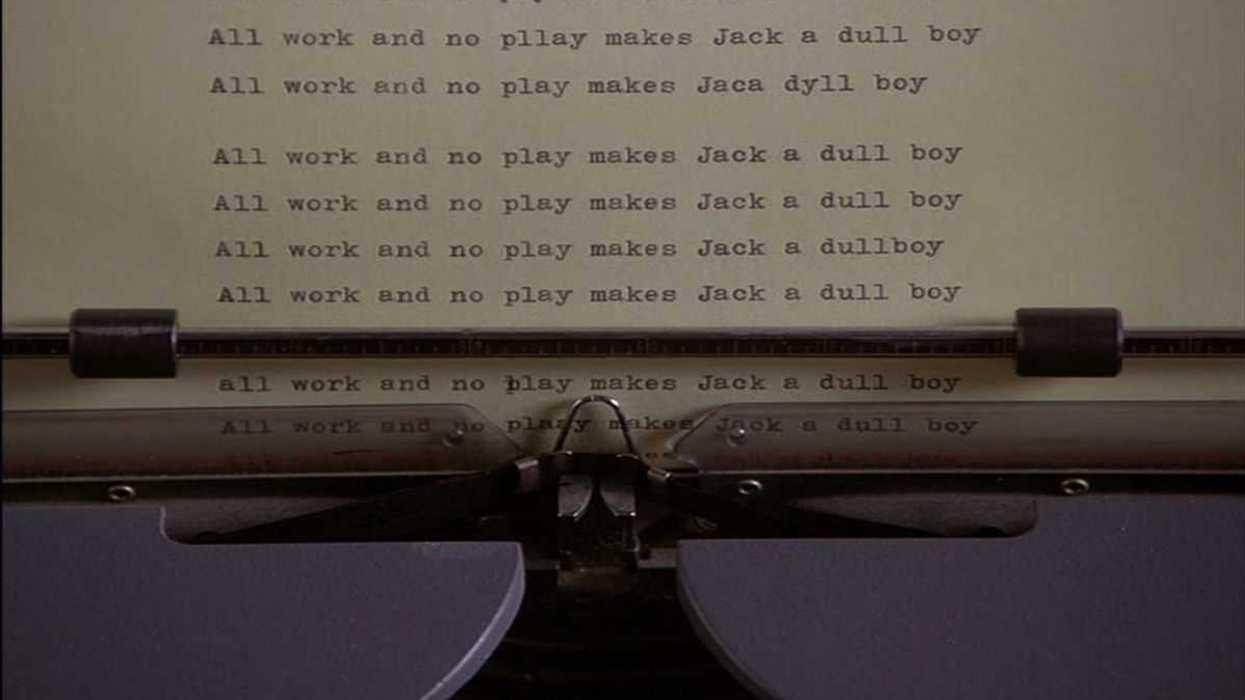
“All work and no play makes Jack a dull boy” —page after page filled with a single sentence. The writing is hardly perfect—instead full of typos both in spelling and alignment, such as “dullboy” with no space about 30 times, “poay” instead of “play”, about four times, and more. As she finishes skimming through the pages, a sarcastic voice startles her, “How do you like it?” It is Jack.
Significance Of the Quote And The Visual Appearance of The Manuscript as a Motif
While the quote quite literally means that work-life balance is important, its traditional implication isn’t of direct relevance to the narrative; rather, it serves as an indirect allegory. I like to think that since the quote has the word “Jack” in it, it immediately becomes impersonal to the protagonist, with his name being Jack, while continuing to remain catchy and relatable for the world. At the same time, it eerily fits into the narrative, although according to the literature, there’s no apparent relationship between the two.
If you collate the pictures of the pages of the manuscript, visually, it would look like the above. The lack of symmetry and presence of chaos, right in the alignment of the text, speak volumes about Jack’s mental state. At the same time, the endless typos continue to depict his mental wreckage and physical paranoia. This is even more so because if you closely inspect, not all typos in the text are governed by logistics, such as the position of keys on the typewriter, etc. Some of them are clear signs of anxiety and hurry (to be blunt and a layman, borderline insanity), like missing out the K in Jac multiple times, capitals in the middle of the sentence, extra letters here and there, and more.
But one of the most striking typos that must be analyzed is on the 17th out of the 18 sheets, where Jack has typed, “All work and no play makes Jack an adult boy.” Considering how the letter ‘T’ is not directly adjacent to ‘L’ on the QWERTY keyboard, it raises suspicion as a typo. Also, since Kubrick is known for his attention to detail, I’m not sure this would have been there without his approval, especially since no other typo all over the manuscript is similar to this one. Do you think it's more like a foreshadowing of the fact that Jack is not alive in reality, and is rather living on through his clairvoyant son’s body, the adult boy? Since Kubrick ends the movie with the picture where we see Jack in a vintage group photo hanging in the Hotel Overlook lobby, with Jack right in front, surrounded by patrons. The photo is dated 1921, about 60 years ago.
What do you think about this typo on the 17th page? Let us know your views in the comments below.
- Were the Events in 'The Shining' All in Wendy’s Head? ›
- Watch: What Makes 'The Shining' So Incredibly Disturbing? ›
- Why That Bear Performed Fellatio on That Guy in 'The Shining' ›
- Why Did Kubrick Change 'The Shining' Against Stephen King's Will? ›
- There's a 'Shining' Prequel You'll Never Get to See ›
- Seriously Exhaustive Analysis of 'The Shining' Shows Kubrick's Inversion of King's Novel ›
- This New Book on 'The Shining' is Blowing My Mind | No Film School ›