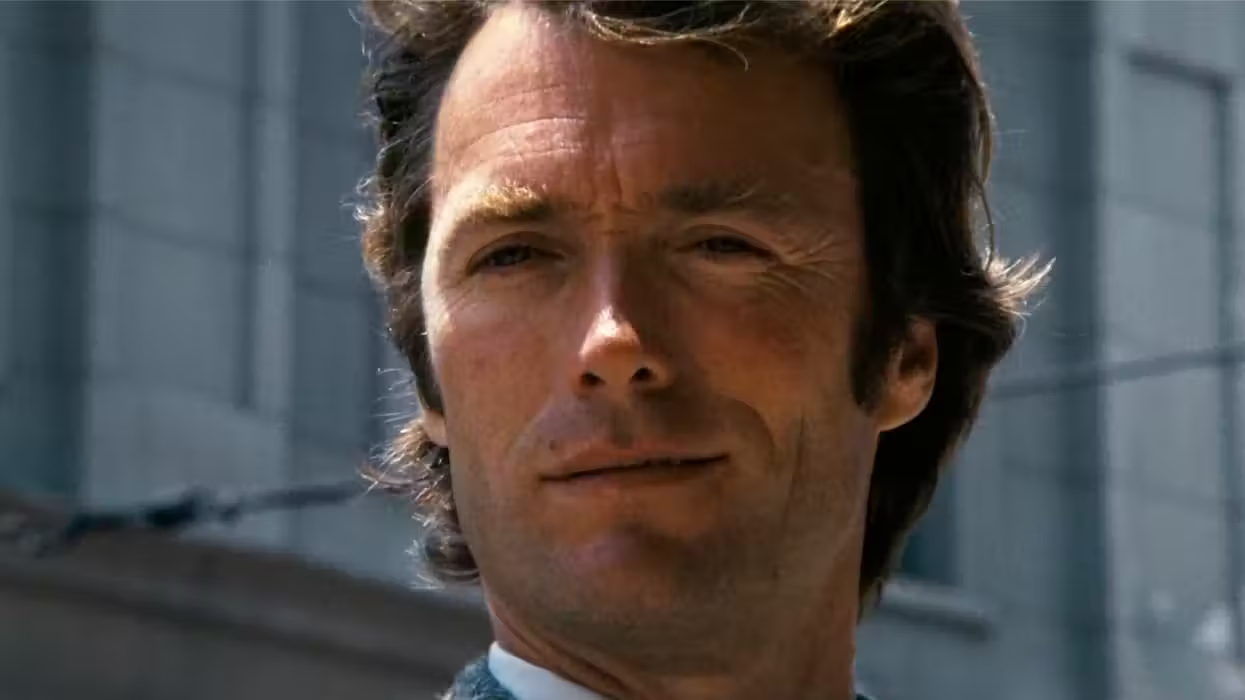
"Do ya feel lucky, punk?"
You probably can't imagine these lines coming from anyone but the iconic Clint Eastwood. But it turns out that a whole Rolodex of Hollywood's finest leading men came this close to portraying Inspector "Dirty" Harry Callahan of the SFPD.
Frank Sinatra. John Wayne. Robert Mitchum. Steve McQueen. Burt Lancaster. George C. Scott. Paul Newman. Each of them passed, for reasons ranging from physical injury to politics to plain old ego.
The man who would go on to define the role (and arguably reshape the American action film) was somewhere around pick number five or six. And at least one of those previous offers spent years wishing he'd made a different call.
- YouTube www.youtube.com
Harry Was Almost Played by Old Blue Eyes
Frank Sinatra was the original frontrunner for the role.
In an interview for Alec Baldwin’s podcast Here’s the Thing, director William Friedkin revealed that he’d spent months developing the project with Sinatra in mind (via Yahoo).
Film critic Ty Burr's book Gods Like Us: On Movie Stardom and Modern Fame points to a wrist injury Sinatra sustained during The Manchurian Candidate that made it difficult to handle the film's signature .44 Magnum comfortably. So Sinatra was out.
Once Sinatra was no longer in the running, Friedkin left to do The French Connection instead. Dirty Harry started making the rounds. And surprisingly, nobody was especially eager to pick it up.
Everyone Had a Reason to Pass
The rejection list reads like a who's who of 1970s Hollywood machismo, which makes it all the more interesting that so many of them said no. Per Collider, Lancaster and Scott reportedly couldn't get past the violence. McQueen had already played a rogue cop in Bullitt and found the politics of the character too far right for his taste. Newman declined for similar political reasons but, according to Far Out Magazine, pointed the producers toward Eastwood on his way out.
Mitchum, one of Hollywood's toughest tough guys, was harshest of all (via Salon):
“Somebody says, ‘We really want you to do this script.' And I say, 'I'd need an awful lot of money in front to do that one.’ And that never seems to be a problem. The less I like the script, the higher my price. And they pay. They may pay in yen, but they pay. Not that I’m a complete whore, understand. There are movies I won't do for any amount. I turned down Patton and I turned down Dirty Harry. Movies that piss on the world. If I've got $5 in my pocket, I don’t need to make money that f*cking way, daddy."
Clearly, these were not timid actors. The fact that so many of them recoiled at Harry Callahan tells you something about what kind of role this actually was on the page.
It was a morally ambiguous character that made people uncomfortable, a classic antihero who operates outside the law while ostensibly serving it.
Wayne Said No... and Then Said He Was Wrong
Wayne's stated reason was a matter of pride. According to John Wayne: The Man Behind the Myth by Michael Munn, he reportedly bristled at being handed what he saw as Sinatra's leftovers (via ScreenRant).
But the fuller picture, per TCM, is that he was already committed to other projects and simply didn't make room for it. The irony is that Wayne was actively looking to branch out of Westerns at the time, and a maverick cop chasing a serial killer through San Francisco was as close to a modern Western as Hollywood was producing in 1971.
According to Carolyn McGivern's biography John Wayne: A Giant Shadow (via Showbiz CheatSheet), Wayne came to regard the decision as a "terrible mistake," asking himself, "How did I ever let that one slip through my fingers?"
The film, eventually directed by Don Siegel, grossed $36 million domestically and was preserved by the Library of Congress in 2012 as culturally, historically, and aesthetically significant.
The Feud Was Already Brewing
The Wayne-Eastwood dynamic didn't exactly improve after Dirty Harry came out. Their professional relationship was prickly even without the casting snub at its center. They were two very different visions of what American cinema should be doing, playing out in real time.
After Eastwood directed and starred in High Plains Drifter, Wayne sent him a letter objecting to the film's portrayal of the West. In a 1992 Los Angeles Times interview with critic Kenneth Turan, Eastwood said:
John Wayne once wrote me a letter telling me he didn’t like High Plains Drifter. He said it wasn’t about the people who really pioneered the West. I realized that there’s two different generations, and he wouldn’t understand what I was doing. High Plains Drifter was meant to be a fable; it wasn’t mean to show the hours of pioneering drudgery. It wasn’t supposed to be anything about settling the West.
Eastwood's reaction was essentially, "We're not making the same thing."
Wayne's West was idealized and heroic. Eastwood's was brutal, revisionist, and morally complicated. Dirty Harry sits right at the fault line between those two sensibilities. It has Wayne's iconography (the tough loner, the big gun, the code of honor) fused with something darker and more cynical beneath the surface.
You could make a case that Wayne would have sanded that second part down to suit his own sensibilities. We'll never know.
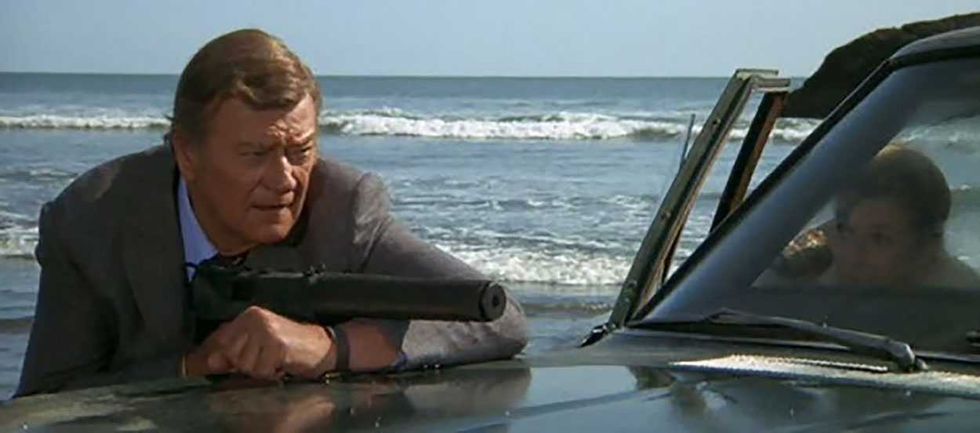 McQ Credit: Warner Bros.
Wayne Made His Own Version
Rather than move on, Wayne essentially tried to build a version of what he'd passed on. After watching Dirty Harry become a cultural phenomenon, he had his production company develop McQ, a maverick cop thriller set in Seattle.
Per TCM, Wayne had never once played a police officer in his entire career up to that point. There had been sheriffs, marshals, soldiers, outlaws with a code, yes, but not a cop. McQ was a direct attempt to get into that territory.
It was also a script that Eastwood had already passed on.
In Conversations with Clint: Paul Nelson's Lost Interviews with Clint Eastwood, 1979-1983, Eastwood said, "I know. In fact, one of them was originally written for me: McQ. I passed on it."
Wayne followed it with another cop film, Brannigan, in 1975. Neither one landed.
Casting and Risk
The story of Dirty Harry's casting is a useful one for anyone who works with actors or who is an actor. Casting is often treated as a logistics problem. Who's available, who's bankable, who will the studio approve? But Dirty Harry's journey to the screen is a reminder that an actor's relationship to a character's moral complexity is just as important as any of that.
The most perfectly cast roles in film history often look inevitable only in hindsight. At the time, this was a script that a half-dozen major stars ran from. Eastwood didn't need the character to be clean and bought into that dirty cop fully. Wayne, by contrast, seemed uncomfortable with the grayer aspects of McQ, even when he was chasing the same audience.
The iconic roles that almost went to someone else are full of cases where the eventual star leaned into exactly what made their predecessors flinch.