In an era dominated by visual effects and digital imagery, cinematographer David Kruta prefers to tackle the challenge of making everything feel real.
For Orion, a psychological science fiction movie directed by Jaco Bouwer, Kruta faced a unique creative challenge: how to tell a story rooted in amnesia and deceit when the images must tell the whole story? Oh yeah, and almost the whole thing is confined to just one room.
Kruta drew inspiration from Cold War Brutalist architecture, Francis Bacon's warped portraiture, and classic Tarkovsky-era vintage glass, to accentuate the film’s world.
He also mastered Unreal Engine, coupled with practical effects that cleverly make us feel like what's happening on screen is totally grounded.
Let's dive in.
- YouTubewww.youtube.com
No Film School: Hi David! How did you and director Jaco Bouwer develop the visual language of Orion, and what choices were key to establishing the film's atmosphere and tone?
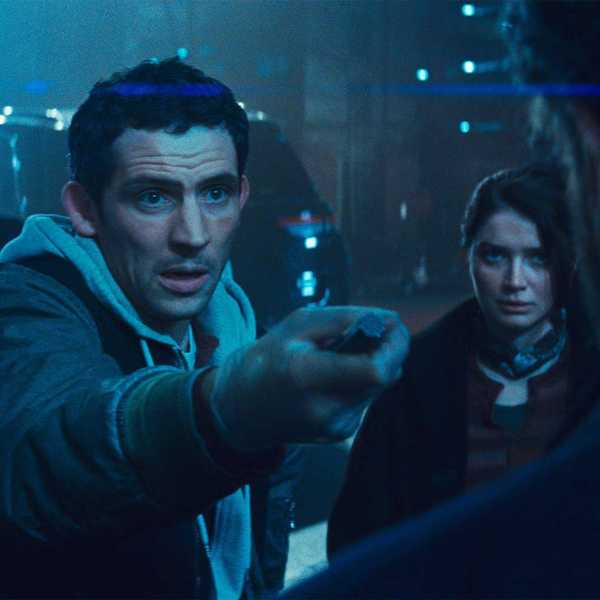
David Kruta: Orion is a chamber piece about amnesia, deceit, and identity. The characters are lying to each other, or perhaps not remembering, and we never know which. Jaco was clear from the start that the film is about communication: how we reach each other, and the lies we tell. He spent a lot of time cutting lines, so the images had to say what the dialogue no longer did. We looked at the contemplative end of science fiction, films like Solaris, Stalker, 2001, Alien and Annihilation, and we looked at painters like Francis Bacon, František Bílek, H.R. Giger, Ken Currie. The rule we arrived at was that every choice had to be double-edged. Every lens, every angle, every camera move had to feel as though it might be telling the truth, or might be lying to the audience.
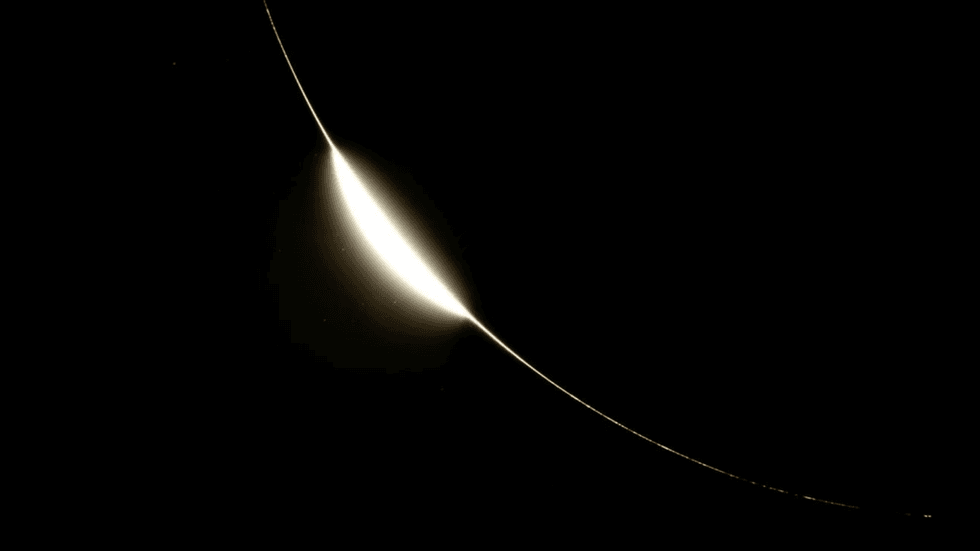
We also needed a way to show the alien's communication. It speaks through electromagnetism, a force you can't see, so the job was to make the unseen visible. That became a way to externalize the doubt at the center of the film.
For atmosphere and tone, the most important thing was my relationship with Mike Conte, our production designer. Mike designed every set in Vectorworks; I brought them into Unreal Engine, and we lensed and lit them before anything was built. Aaron Fuoco, my gaffer, had full 3D scans before he stepped on set. Mike began with rounded corners, something like an iPhone crossed with Star Trek.
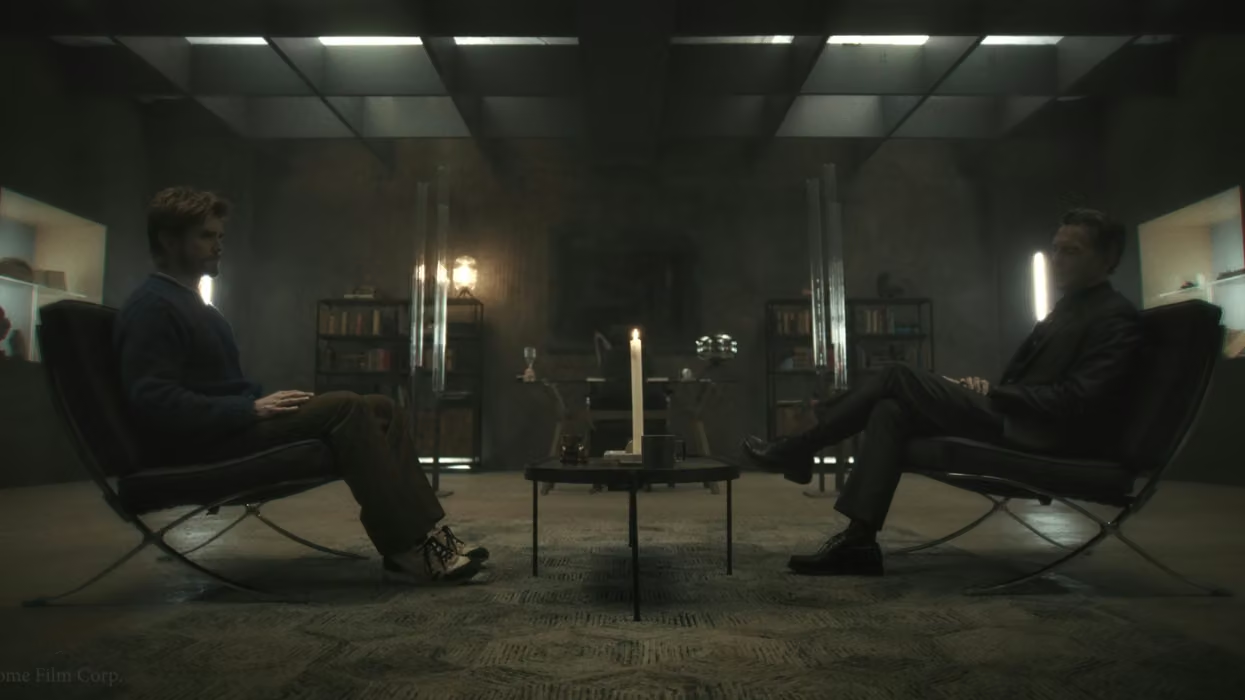
Once we saw it in Unreal, we kept simplifying until we were left with concrete, large sources of light, and big brutalist shapes. My family is from Czechoslovakia, a country known for its beauty, but it lived under communist rule for about forty years, and the regime filled it with brutalist structures and imposing statues. They're meant to make you feel small, like a cog in a machine and not an individual. I'm not sure our sets were actually that big. I think the architecture just makes them feel that way.
NFS: Memory and perception play a central role in Orion. How did you use visual techniques to reinforce the story's ambiguity without giving too much away?
DK: What makes a person is not their possessions, or their job, or the way they dress. It's their memory. So if you have no memory, who are you? Apollo is trying to answer that, and the visuals are meant to keep you guessing. You can't tell whether you're looking at a real memory, a false memory, or a lie.
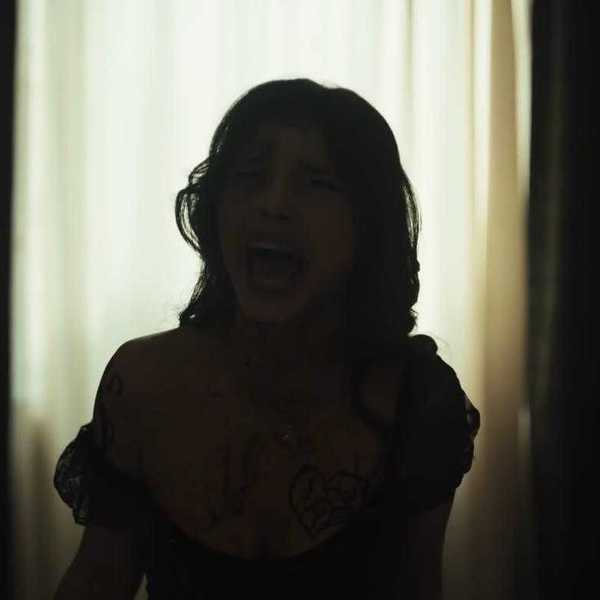
We designed different looks for the different parts of the film. Most of it is 2:1 spherical. The flashbacks are 2.39, shot on Lomo Square Fronts, the same series Vadim Yusov used on Tarkovsky's Solaris. They're tactile and dreamy at once — they remind me of what it feels like to experience déjà vu.
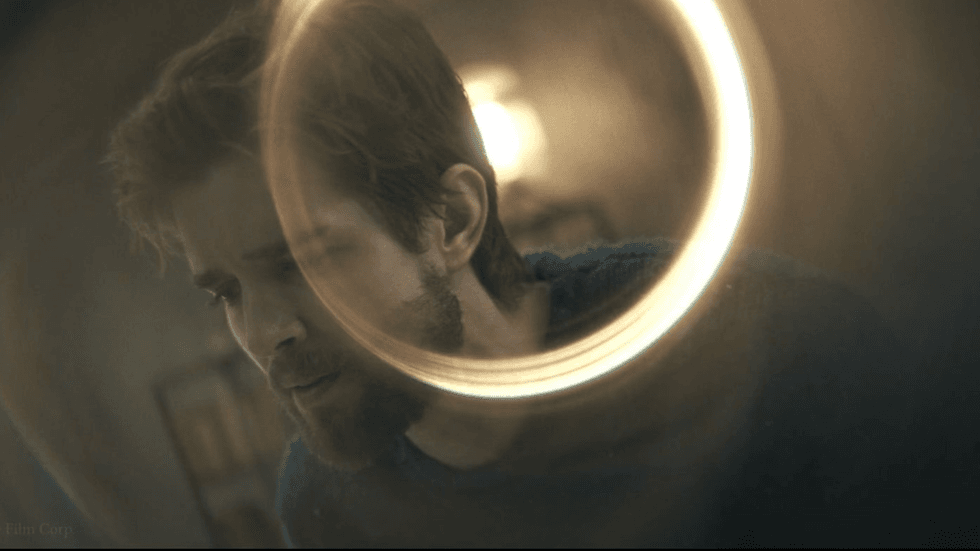
We often shot into Mylar, hung loosely off a C-stand so it could be tapped or caught by a fan. It behaves like a mirror that warps, so his face smears and stretches across the frame. I was inspired by Francis Bacon, particularly the faces.
When the format changes, you start asking questions. If this isn't seen through the same lenses and the same perspective as the rest of the story, is it real? Is it invented? Is it a memory? The whole point is that we don't know.
 'Orion' Credit: Blue Harbor Entertainment
NFS: What was the most challenging sequence to shoot in Orion, and how did you solve the creative or technical obstacles it presented?
DK: The biggest challenge was that two-thirds of the film takes place in one room. For most of it, that's two people at a table: Andrew McCarthy as Jim, the interrogator, and Drew Van Acker as Apollo. We had to keep the camera, the coverage, and the lighting alive the entire time, while holding the suspense of characters who may be lying or may not remember.
One answer was to let the camera become the alien. The idea is that it's in the room with them, watching, so we wanted the camera to feel as though it were drifting around Andrew while he worked on Apollo. We put the Canon 50mm f/0.95, the “Dream Lens”, wide open on the BuckShot, a mini manual Technocrane built by Scotty Buckler. I moved the boom wherever felt right, David Quateman framed on the wheels, and my 1st AC, Michael "Moose" Belardi, pulled focus at distances down to half an inch from his face. The drift in and out of focus was the look we wanted, and Moose was determined to fight it. It turned into a game between us. It was a brutal pull, and he refused to miss.
The other was showing how the alien communicates. That had always been planned as VFX, and I asked Jaco: what if we try it for real? For the liquid, I used bass transducers, the device inside a gaming chair that makes it shake. Whatever you attach one to becomes a speaker, so we tuned each surface, and I cued frequencies from my phone during the take. We called them thumpers, after Dune.
For the alien itself, I built a small lab beside the stage and worked with ferrofluid and electromagnets. It was better than leaving it to post, because the actors had something real to react to, and Jeff Spangler, our VFX supervisor, ended up building the alien on top of that footage. The film went on to win Best Visual Effects at FilmQuest. I was DP on the film and received the special effects supervisor credit for that work. Nothing in the design or production used AI.
NFS: Looking back at your career, which projects have most shaped your approach to cinematography, and how has your visual philosophy evolved?
DK: A few. Concussion mattered because of the story. The subject was timely, it meant a lot to people in marginalized communities, and it carried a positive message and a well-written character arc. Because of all that, it went to Sundance.
The Last Thing Mary Saw was my first film back after a hiatus from features, and it returned me to loving long-form narrative. It was an exercise in restraint. I treated every frame as a painting, and referenced only paintings.
Black Friday, with Bruce Campbell, was the biggest film I had done at that point, and we shot it at the height of COVID, under every safety precaution, before there were vaccines. It was a hard shoot. Getting through it, and seeing the film turn out well and succeed, was a real reward.
The one that shaped how I work the most is a short, 12 Kilometers, which I shot with Mike Pecci about twelve years ago. It set me on a path of working with Mike and with others in the genre space. What I love about horror is that you can use images to portray the human condition, because it's externalized as monsters and creatures. That short is where we developed a visual language I still use today: old vintage anamorphics, complex blocking, and an insistence on getting everything in camera. Orion comes directly out of that. The Lomos in the flashbacks are the lenses I shot that short on, and the ferrofluid goes back to it as well. There's even an Easter egg in Orion: writing on a wall that, if you translate it, says this is the same dig site as in 12 Kilometers, thirty years later. It's almost a sequel in spirit.
Coming up, my film school was working as a DIT for Peter Simonite, ASC, and for Bradford Young, ASC. With Bradford, it was as though everything he said was poetry. Early on, I wanted more technical guidance than that. I cared a great deal about the numbers and the equipment. As my career has gone on, a more philosophical place is what I crave, and the work is now driven far more by emotion and feeling.
Mike and I are in prep now on They Like The Dark, for Scott Free, with Liam Hemsworth attached to star. It's been twelve years in the making, and the approach hasn't changed. The starting point is always: how can we do it for real? And if we can't do a particular thing for real, is there a creative way to portray it for real, as opposed to falling back on VFX or AI?
NFS: Having worked across features, commercials, and music videos, what skills have you carried between formats, and how has each influenced your approach to the craft?
DK: Each format teaches a different discipline. Music videos are a testing ground. There's less at stake, so they're where I experiment. When I want to try an unfamiliar set of lenses, a technique or a lighting idea, that's where it goes first. They give you room to go fully expressionistic, in the lighting or in practical effects. It's where I get to play and explore.
Commercials are an exercise in collaboration. You have to be diplomatic, you have to handle people well, and you have to bring a vision while still delivering a product for a client. They sharpen planning, prep, and focus. The work rewards precision, down to the smallest detail.
Feature films are why I got into this business. I grew up drawing, painting, taking photographs, making little stop-motion videos, and telling stories. Civilization exists because of storytelling, and I think of filmmaking as the culmination of every storytelling ability we have developed as a species. What draws me to it is how many disciplines have to work together to create a single image and tell the story.
They all feed each other. An experiment from a music video might end up in a feature. The attention to detail and the prep from a feature might become the workflow on a commercial. And the one creative idea we couldn't do on the commercial stays in my back pocket for the next music video.
NFS: As founder of the popular Cinematography Salon Podcast, you speak to many talented peers across your craft. Is there a particular lesson or insight from an episode of your show that has carried over into your own work?
DK: I'm the founder of Cinematography Salon rather than a co-host. I've been a guest on some episodes and hosted others, but these days the show is in the hands of Jared Levy, a wonderful DP and a good friend, who has a real gift for it and loves doing it.
What matters most to me is why the Salon exists at all. I grew up poor and had to make my own opportunities. I didn't go to film school. I applied to Emerson and was rejected, which lit a fire under me to go and work on every shoot I could get into. I told myself that if, in four years, I was better off for having done that than for having gone to college, I would have succeeded.
Years later they invited me back to judge their cinematography program. But it meant learning much of this on my own. The Salon began about ten years ago as a place for my friends and me to share what we knew and help each other, and it grew into something far larger. The ethos hasn't changed: no gatekeeping, and the knowledge is free. There's a desperate need in this industry for something in the gap between your film school years and the point where you're established, joining a guild or the ASC. That gap is where the Salon tries to live.
As for an insight, it isn't one line from one guest. It's that everybody forges their own path, and everyone has their own approach. The biggest takeaway for me is to be true to who you are, and to hold your own opinion and perspective, because that's what you bring to the work.
 'Orion'Credit: Blue Harbor Entertainment
NFS: What practical advice would you give aspiring cinematographers looking to develop their visual storytelling skills, especially without access to large budgets or extensive equipment?
DK: The practical list is short, and you've probably heard it before: learn Unreal Engine, which is free if you have a computer; shoot in available light and learn the time of day; use atmosphere; shoot constantly, stills included; and don't be precious about cheap tools. On Orion, the alien's point of view is a filter I bought online for under twenty dollars and taped to the matte box.
Then there's getting in the door. I do subscribe, a little, to "annoy your way in." In other words, send the messages, see films at festivals, go to the mixers, say hello to people. And be someone people are glad to see on set. Passion and kindness go further than technical ability alone, although you need that too.
But what I really believe is that it comes down to perseverance. This takes a long time. It's a long game, and the only thing I know that will carry you through it is knowing who you are and what you have to say. That work can start on day one.
Everything you've lived through ends up in the image. I come from a place where you couldn't say what you believed. Czech culture had found other ways to speak long before the communists, going back to Kafka and the absurd, and under communism it turned to surrealism, because when you can't speak plainly, you speak in images. My dad played in an underground band and made paintings that were illegal because they didn't serve the party. I grew up around that, around people who made art at real risk. It's why I reach for paintings before films, and why I'm drawn to making the human condition visible.
So pay attention. Tune in to what's around you and notice what other people walk past. Learn your own emotional life, your creative side, your soul, well enough to draw on it, so that what you feel ends up in the frame and serves the story. When I was starting out, I wanted technique. What I want now is the philosophy, and I think that's what lasts.
NFS: What have you learned about building a sustainable career as a DP, and what do you wish you'd known when you were starting out?
DK: I haven't figured that out, and I'm not sure anyone really has. This is a feast-or-famine business, and I'm as subject to that as anyone. There are stretches where the work is hard to come by and stretches where it all arrives at once, and you don't get much say in which.
What I can speak to is what has kept me going. Part of it is staying open: to different experiences, to different ideas, and to the work that takes you out of your comfort zone.
The other part is the best advice I was ever given, from Peter Simonite: always trust your gut. That part has never been wrong. It isn't always pleasant to trust it, but it's right.
What I wish I'd known when I was starting out is to look for a mentor early, and to spend far more time learning from them. I've had people who guided me here and there, but I never had one person over the long term, and I had to work a lot of it out alone.
That's why I believe so strongly in supporting each other as artists and in taking part in the community. Nobody does this alone for long. If you're a cinematographer, come find us at Cinematography Salon and say hello. Orion is in theaters now, and keep an eye out for They Like The Dark.