The world of audio fiction is in a golden age, evolving far beyond traditional radio plays into blockbuster-level, sonically rich experiences. A prime example is the ambitious audio drama Star Trek: Khan, a prequel that dives deep into the complex origin story of the iconic, genetically engineered villain.
But how do you score a story built for the ear, not the eye? How do you create a cinematic feeling without a single visual cue?
To find out, we sat down with composing brothers Marcus and Sam Bagala. Their work spans film, theater, and high-profile audio dramas like Harley Quinn and The Joker: Sound Mind. They are uniquely positioned at the forefront of this evolving medium.
We spoke with them about the unique intimacy of audio, how the podcast workflow is breaking down the "stratified" and rigid post-production pipelines of film, and their "Shakespearean" approach to scoring the tragic downfall of one of sci-fi's greatest antagonists.
Let's dive in.
- YouTubewww.youtube.com
NFS: You’ve both worked across film, theater, and now audio fiction. What excites you most about the possibilities of storytelling through podcasts and audio dramas?
Marcus Bagala: I think something that podcasts do really well is create a sense of intimacy between the listener and the subjects of the podcast. This is most common in narrative non-fiction (think Serial) where a host is essentially talking directly to the listener, and something that I think something that smart audio-dramas writers do (Like Kirsten Beyer) is take advantage of listeners' familiarity with that format and use it to create intimacy with the characters in the story.
It may be a bit of a trope at this point, but creating story opportunities for characters to voice their inner monologues can lead to some real magic, and it’s something that is sort of unique to the format… The scenes where we got to hear from Khan or Magiver’s internal POV, in their own words, are some of the most powerful and emotionally resonant scenes in the show. These are moments where a character is discovering something about themselves or coming to terms with a difficult truth… that emotional depth and complexity is like composer catnip for us and is really rewarding to score.
Sam Bagala: Podcasts and audio dramas leave the listener to create the visuals of the story they are seeing in their heads. And those visuals can really look like so many different things according to each individual, which is the really fun & beautiful part. The human voice by itself has so much power (especially with actors like Naveen Andrews and Wrenn Schmidt at the helm) - so when you add in sound design and score…you really do get that intimate sense that Marcus was talking about. The technology that is available for audio & music production is mind-blowing. There are infinite possibilities to create interesting things…
NFS: Are there any trends you’re seeing, or even helping shape, in how composers are being integrated into the podcast development process earlier on?
MB: I think because podcasts are still a relatively young art form, there’s not as much of an entrenched sense that there’s a “right” way to do things. In film and TV projects I’ve worked on, the score is almost universally the last stop before the final mix… and that was very much not the case for Khan.
When Secret Hideout/Paramount and CBS were looking for a production partner for this project, Fred Greenhalgh (the director) asked me to compose a piece of music to accompany the pitch that encapsulated how he was thinking Khan could be embodied in audio. Amazingly, that demo just stuck to the project… There are major echoes of that early piece in the show as people are hearing it now. The fact that we were able to have creative consensus about what Khan should sound like SO early in the process was a gift that kept on giving.
SB: I think the earlier composers are brought on to the project, the easier it is to figure out what the actual role of music will play in the project. It relates to all the other storytelling elements in such a big way (dialogue & sound design). So the more you can have an understanding of what the performance & pacing of the actors is like, the overall arc of the story, and the role that sound design plays (which changes drastically between scenes - intimate vs. action)…you can begin to fill in the spaces with music in ways that will complement, stay out of the way, and also elevate the overall story. Those early conversations with the director and sound designer are important to establish rapport, workflow, and the overall vision of how the three elements will interact (dialogue, sound design, and music). With Marcus’s very first demo, and then the demos we wrote a little later, which helped us create our tonal palette and some of our main motivic material, as well as gave the rest of the team a taste of how music could be used in the project. It’s always an ongoing dialogue.
MB: I’d also add, because of the way podcast workflows have evolved, a lot of us working in this industry are multi-disciplinary artists. Composing is my passion, but I’ve worked both as a producer and a sound designer on other pretty high-profile fiction pods, and a lot of them were alongside Dan Brunelle, our sound designer for Khan (and Dan also happens to be an excellent musician and composer himself).
Dan and I’s close working relationship and a shared sense of workflow gave us a lot of freedom to work collaboratively in a way that isn’t really possible in the more stratified world of film and TV.
If you’re familiar with the post-production process, our process looked a little like a dub session, where every department is bringing the final elements together for the final mix, but the key difference is that the “dub” started much earlier, and each department involved had some amount of authority over the timeline of the episode. If Sam and I needed a little extra space between scenes to let music play out, Sam and I were empowered to make those edits to the episode in the master session. Similarly, if Dan needed to shift music this way or that to make a sound design element work, we trusted him with those adjustments.
Podcast people have a reputation for being a little insane about pacing, and it’s totally earned (I can say that because I’m one of them), but I also think it’s kind of a superpower. Hearing how proper pacing can affect a dialogue edit or having music hit at JUST the right moment can have a big impact on how a show feels. Our post-production team workflow really enabled us to take advantage of that.
NFS: Do you each take on specific roles when composing, like one focusing more on orchestration, another on sound design, or melody? Or is it a fully collaborative process from start to finish?
SB: It’s fully collaborative from start to finish in that we are working hand-in-hand in daily dialogue for a year’s time about the specific and general requirements of the score. Marcus did such an incredible job creating a vision for the score in his initial theme, which really set the groundwork, as far as approach, instrumentation, harmonic language, and a central motif. From there, we built out another 6-7 demos to capture different feels of the show - dangerous jungles, spaceships preparing for takeoff, a love theme, telepathic aliens, etc.
That initial work helped us figure out our workflow, hone in on instrumentation/orchestration choices, develop more themes, discuss plugins/software/mixing… all those things we love to geek out about.
Then, when it came time to score individual episodes, we’d divide up the episodes between us and then go off to do our work individually, which includes all the jobs - composing, arranging, orchestrating, and mixing a cue from start to finish. Despite me being in Philly and Marcus in NYC, we are able to send each other our work through Slack so that we can share thoughts & feedback about the music in real time.
MB: I think Sam really nailed this, not much I can add here!
NFS: Do you have any musical or storytelling influences that played a role in shaping your approach to Star Trek: Khan? Either from the sci-fi genre or beyond?
SB: Absolutely. Marcus and I very early on did a deep dive into the music of Star Trek, which has an incredible legacy of great composers and scores. Of course, we revisited The Wrath of Khan, but we also spent some time with the new Trek scores, maybe most specifically what Jeff Russo has been doing.
We put together a playlist of scores that looked outside of Trek as well - some scores we listened to include Hans Zimmer’s “Dune” score, Sarah Schachner’s “Prey” score, Nicholes Britell’s “Andor” score, and Ramin Djwadi’s “Game of Thrones” score… to name a few. Because Khan is not part of Starfleet, we were given an opportunity to explore something outside of the musical palette that we often associate with Starfleet. A lot of the scores that we referenced have a common theme that was relevant for us, which is… battling and surviving a dangerous, unknown world.
MB: Beyond looking to the wealth of inspiration from past trek scores, I think we clocked early on that this was a story that was ripe for thematic development. There’s such a rich, Shakespearean nature to the way that Nicholas Meyer, and then Kirsten and David, chose to shape this story, and that gave us a lot to work with.
We found not so much tonally, but method-wise, Howard Shore’s score for The Lord Of The Rings to be hugely influential. The way he used themes to both support and, in some cases, enrich the storytelling was something we took a lot of cues from.
We felt it was important to musically track Khan’s transformation from the complex, but ultimately hopeful leader we meet in Episode 1, to the broken and vengeful man that we meet in Star Trek: Wrath of Khan.
As we were working on the episodes, we’d sit down every week and talk about themes, “here’s where we introduce the hopeful Khan theme” or “here’s the turn where we introduce his villain theme, but a diminished version”, “Here’s the love theme… and here’s where love becomes sorrow”.
I think eagle-eared listeners will pick up what we’re doing with the themes, and even those who don’t, my hope is that alongside the stellar acting performances, our music enhances the emotional journey that they’ll go on with Khan and his followers.
NFS: What are you most excited for listeners to experience when listening to Star Trek: Khan?
SB: I’m excited for listeners to be taken on a journey - both sonically & emotionally. Nicholas Meyer, Kirsten, and David have written an incredibly compelling story that has a lot of depth and complexity relating to so many different scopes of human experience - love, loss, betrayal…you name it.
MB: Empathy! Khan is ultimately a villain, and I don’t think the writers set out to tell us anything different, but I think what they’ve done is given us a heartbreaking and beautiful portrait of someone striving to be something more, and it’s a fascinating exploration of what went wrong there and how it might’ve gone differently.
And a game-changing audio-only experience! I’m not exaggerating when I say that this is a show that I think is pushing the limits of what this genre can do, and I think it succeeds. I’m so happy it’s out in the world, and other folks get to experience what we’ve been living with for the past couple of years.
NFS: What’s something unique or unexpected that each of you brings to the collaboration?
MB: Up until somewhat recently, the vast majority of my work as a composer was focused on documentary projects. Whether that is films, TV, or podcasts, I’ve been honing my storytelling skills as a composer on stuff that honestly just requires a level of subtlety that I don’t feel when working on fiction projects.
Khan’s score is not delicate by any stretch of the imagination… but earlier in my career, I had a really wonderful editor gently scold me for “editorializing” a subject's story with my music. That’s a lesson that I’ve taken into every project I’ve worked on since, non-fiction and fiction both. Being crystal clear about the intentionality of our music, what it’s doing here, and making sure we’re not imposing on the storytelling is something Sam is probably sick of hearing me talk about!
SB: I was super thrilled to play some piano for the show. George Takei requested that Sulu listen to Beethoven or Chopin in his quarters. I recorded the Adagio second movement of Beethoven’s “Pathetique” sonata, which you can hear in episode 5. I also recorded “Fur Elise” for the show. I majored in classical piano performance at The Boston Conservatory, so it’s always fun and rewarding when I can revisit that side of myself…
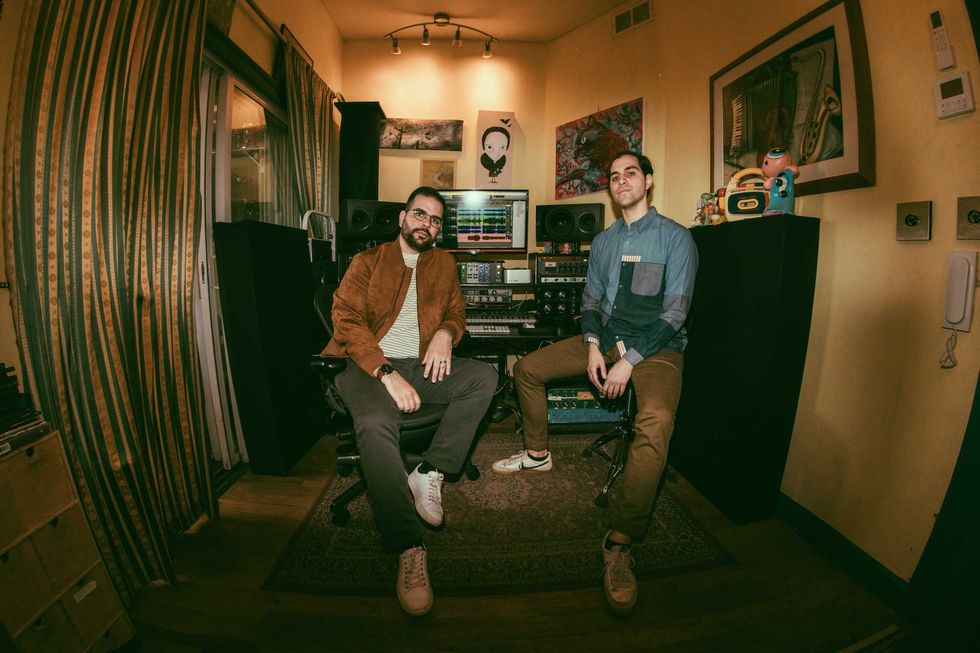 Marcus and Sam BagalaCredit: Savannah Lauren
NFS: Do you have any upcoming projects you can tease or talk about beyond Khan?
MB: A doc film that I scored alongside another collaborator of mine, Mark Baechle, and for which Sam provided additional music, orchestrations, and piano for, actually came to theaters the same week as Khan and is currently streaming History Channel. It’s called Clemente, and it’s about baseball legend and all-around inspiring human, Roberto Clemente. It’s a gorgeous portrait of Roberto, both as a player, but perhaps more importantly, as a person, and the impact he had on the people around him.
I’m also teaming up with Khan’s director, Fred Greenhalgh, for a very exciting one-off project with DC Comics that I think is being announced soon…
NFS: How has your creative process evolved since working on earlier projects like Harley Quinn and The Joker: Sound Mind or Narcosis?
SB: The more projects that Marcus and I work on together, the more I level up my skills! Marcus is an incredible collaborator in that he brings out the best in the people around him. We’ve been able to sharpen our process of working together with each new project, in that we can usually say less but communicate more clearly. The art of communication is key… and when you are brothers, you can cut through a lot of hubris and be honest about how to bring your best self to the project. Trust and respect are a big part of that.
MB: I think just to echo Sam, every project is a learning experience, and each new project is an opportunity to bring what you learned on the last project to bear. When you’re starting out, there’s an element of like… hanging on for dear life that we’re not dealing so much with anymore. So now that we’ve worked out the kinks in our workflow, we get to focus on the more ephemeral side of being a composer: trying to forget about the music and zero in on becoming the best storytellers that we can be.