
The American Film Institute’s iconic 100 Years… 100 Movies list, which ranks the greatest films of all time, was originally published in 1998 and revised in 2008. While plenty of respected classics fell off the list after that revision, including Guess Who’s Coming to Dinner, My Fair Lady, Patton, Fargo, and Frankenstein, one of the movies that appeared in both versions was Alfred Hitchcock’s 1954 thriller Rear Window. In fact, it barely budged at all, originally appearing at No. 42 and later landing at No. 48.
The fact that it has managed to remain a stalwart classic over so many years is due to a number of factors that help it stand out, even among the bulk of Alfred Hitchcock’s legendary filmography.
Rear Window Makes its Limited Location Into an Asset
Rear Window succeeds because of the way it navigates a somewhat experimental premise with aplomb. The plot (which is based on the Cornell Woolrich short story "It Had to Be Murder") follows photojournalist L. B. Jefferies (James Stewart), or “Jeff,” stuck at home with a broken leg. While entertaining himself by spying on the neighbors he can see outside of his apartment’s… rear window, he begins to suspect one of them of murdering his wife.
Although the movie features characters who can come and go from the apartment, including Jeff’s girlfriend Lisa (Grace Kelly) and his detective friend Tom (Wendell Corey), the action takes place entirely within a single room of Jeff’s apartment, with only a few momentary exceptions. The audience is either privy to what’s going on inside the room or what can be seen from the vantage point of the window, keeping them at an arm’s length from the action.
This technique is being used in order to put viewers in Jeff’s headspace of being able to perceive the action without being able to participate in it directly. While it could have made the movie feel boring and limited, Hitchcock instead uses every tool at his disposal to make it intensely engaging. In addition to the lively editing of Rear Window, one of the most important tricks he uses is harnessing the power of production design.
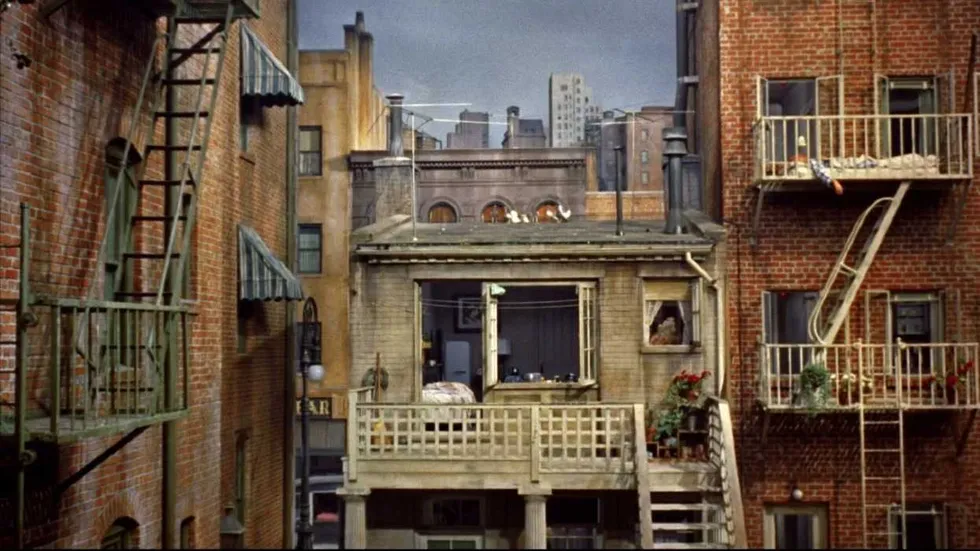
The massive indoor set representing the Greenwich Village courtyard (overseen by art directors Joseph MacMillan Johnson and Hal Pereira) was the largest ever built at Paramount at the time, and every inch of it was used to make the movie come alive.
 ‘Rear Window’ (1954)Credit: Paramount Pictures
The way that multiple apartments can be seen at once, all of them occupied by characters who are constantly moving and interacting, makes the set feel like it’s teeming with life. It’s so rich with detail that every glimpse is compelling and activates the eye, preventing the movie from ever feeling stuck in one place.
However, the viewer can’t see everything, and that is what helps make the movie so compelling. Whenever a character - especially the dastardly salesman Lars Thorwald (Raymond Burr) - steps out of view of the window, neither Jeff nor the viewer has any idea what they are doing, forcing them to search the frame for every possible minute detail it can give them.
Basically, both the character and the viewer are given a limited perspective on an unlimited world, and that dichotomy keeps the film feeling entirely immersive and irresistible, from start to finish.
Rear Window Has Deeper Themes on Its Mind
While the aesthetic of the movie is endlessly compelling, it would nevertheless be completely empty without the delicate work done by John Michael Hayes’ screenplay. On top of the work that the limited perspective of the story does with engaging the audience, it is effortlessly worked into the overall themes of the story.
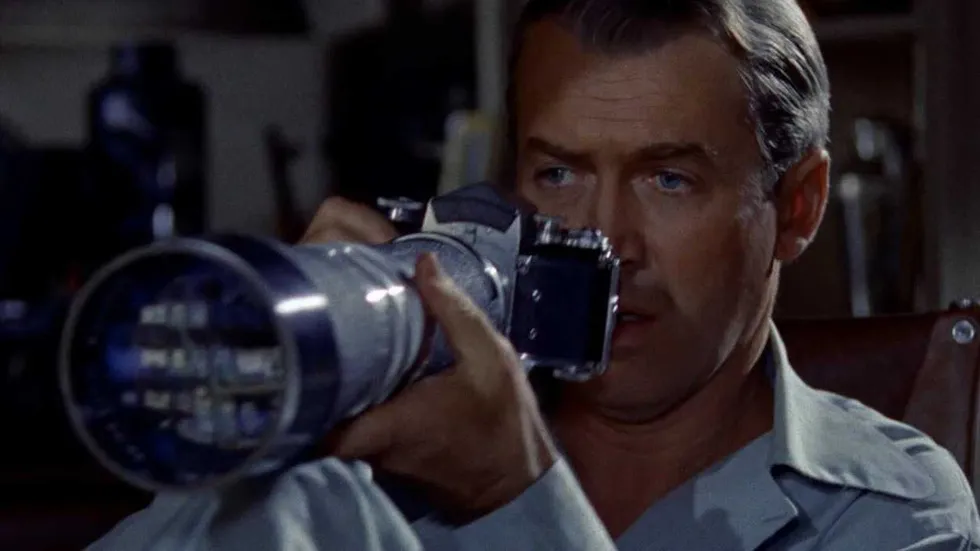
The first, and most foregrounded, theme is that of voyeurism. Jeff’s relationship to the people outside the window is detached, as he is simply watching them to pass the time, in the process becoming more and more engrossed in their lives. However, the dangers of detached voyeurism become quite apparent during two key scenes at the end of the movie. The first is when Lisa enters Thorwald’s apartment and Jeff is powerless to stop her from being attacked. The second is when Thorwald spots Jeff and comes over to his apartment, breaking the imaginary wall that made Jeff feel separate from (and perhaps even above) the violent humanity on display in the courtyard.
 ‘Rear Window’ (1954)Credit: Paramount Pictures
Jeff’s eye, and where it is directed, is also massively important to the key romantic throughline of the movie. In addition to the thriller plot, the romantic subplot between him and Lisa involves him being afraid to commit himself and tie himself down to a life in New York with Lisa, rather than the adventurous photojournalism career that led to the injury that has trapped him in his apartment in the first place.
Every apartment that Jeff spies on over the course of the movie forces him to examine the various ways that romantic love can go wrong or right. Whether it be the vicious violence of Thorwald’s marriage, the amorous antics of a newly married couple, the winsome loneliness of a middle-aged neighbor, or the flirtatious escapades of a social butterfly, every window offers a glimpse into a potential future for Jeff’s love life.
Therefore, voyeurism is both destructive and instructive, and intertwines all of the disparate threads of the story into one neat package.
Rear Window’s Legacy Lives On
Even outside of its landmark filmmaking and rock-solid screenplay, Rear Window is a classic in every sense of the word. First of all, it was appreciated in its own time, by critics, audiences, and the industry.
It earned rave reviews, including landing at No. 5 on the list of the Top 10 films of the year published by the legendary French magazine Cahiers du Cinéma, and eventually grossed $37.9 million against its $1 million budget, making it the fifth highest-grossing movie of the year in the United States (behind just The Egyptian, The Glenn Miller Story, The Caine Mutiny, and White Christmas). It also went on to be nominated for four Academy Awards (for Best Director, Best Screenplay, Best Sound, and Best Cinematography - Color).
In the ensuing years, it has continued to capture the imagination of both filmmakers and film lovers. It was added to the United States National Film Registry by the Library of Congress in 1997, received a remake starring Christopher Reeve and Daryl Hannah in 1998, and has landed on many Best Of lists in addition to AFIs, including ones put out by Time Out, Empire, the Writers Guild of America, and Sight & Sound.
 ‘Rear Window’ (1998)Credit: ABC
Rear Window has inspired many other films (from the Brian De Palma-helmed Body Double to the Shia LaBeouf thriller Disturbia) and even lyrics by Lady Gaga (the line “Want you in my rear window, baby, it's sick” from her chart-topping single “Bad Romance”) and Taylor Swift (who told Entertainment Weekly that watching the movie during COVID quarantine is part of what inspired her to write from other characters’ perspectives in her album Folklore). However, it wouldn’t have been able to achieve any of these many accomplishments if it weren’t for the fact that Alfred Hitchcock and his cast and crew were dedicated to making the movie as immersive and viscerally exciting as possible, and pulling out all the stops to make it so.
In addition to this breakdown of the movie as a whole, the No Film School archives contain a number of articles about specific elements of the Hitchcock classic, including a closer discussion of four of Hitchcock’s cinematic techniques that he put to use on-screen, the epic paintings that inspired Rear Window, and more.
- 19 Times Hitchcock Played “Where’s Waldo” in His Own Movies ›
- Check Out Alfred Hitchcock's Final Appearance at AFI ›
- The Best 11 Alfred Hitchcock Movies Ranked ›
- What Does It Mean for a Film to Be 'Hitchcockian'? ›
- 3 Main Directing Lessons From Alfred Hitchcock ›
- What Was Hitchcock's Favorite Movie He Made? ›
- How Alfred Hitchcock Used Visionary Cinematography ›
- How Different Is ‘Rear Window’ From the Original Short Story? | No Film School ›