The Ending of 'Spartacus', Explained: The Meaning Behind "I Am Spartacus"
The movie finishes on a downer but there's hope in that long road away from Rome.
'Spartacus'
With all the talk of sword-and-sandal movies lately, I thought we should cover one of my favorites of all time, Spartacus.
It's a movie directed by Stanley Kubrick, who only got the job at the time because Kirk Douglas fired the original director, Anthony Mann.
The story behind the movie is fraught with fun facts, such as Kubrick disowning the final cut due to creative friction with Douglas and screenwriter Dalton Trumbo.
But even though things were nuts behind the scenes, Spartacus stands as one of the most culturally significant historical epics ever made.
You have all the fun of Technicolor, action set pieces, and radical themes at its core, making it a movie that has stood the test of time.
Today, I want to unpack the plot, examine the surprising final sequence, and break down what the ending of Spartacus truly means.
Let's dive in.
- YouTubewww.youtube.com
The Plot of Spartacus
This is a very long movie, but we'll give you the highlights.
It's the 1st century BCE, and we meet Spartacus (Kirk Douglas), a Thracian slave working in a Roman quarry. The work is hard and unfair and exploits the old and weak around him.
Spartacus refuses to be pushed around by the guards, and he is finally purchased by Lentulus Batiatus (Peter Ustinov) to be trained as a gladiator in Capua.
He's good at that and quickly rises in power, with the other gladiators liking him too. This leads him to Varinia (Jean Simmons), an enslaved woman assigned to him. Sparatus falls in love with her, and they become romantically intertwined.
Spartacus assumes this will be his life, and he will be killed in the ring until Roman patrician Marcus Licinius Crassus (Laurence Olivier) visits the gladiator school and pays for two pairs of gladiators to fight to the death for entertainment.
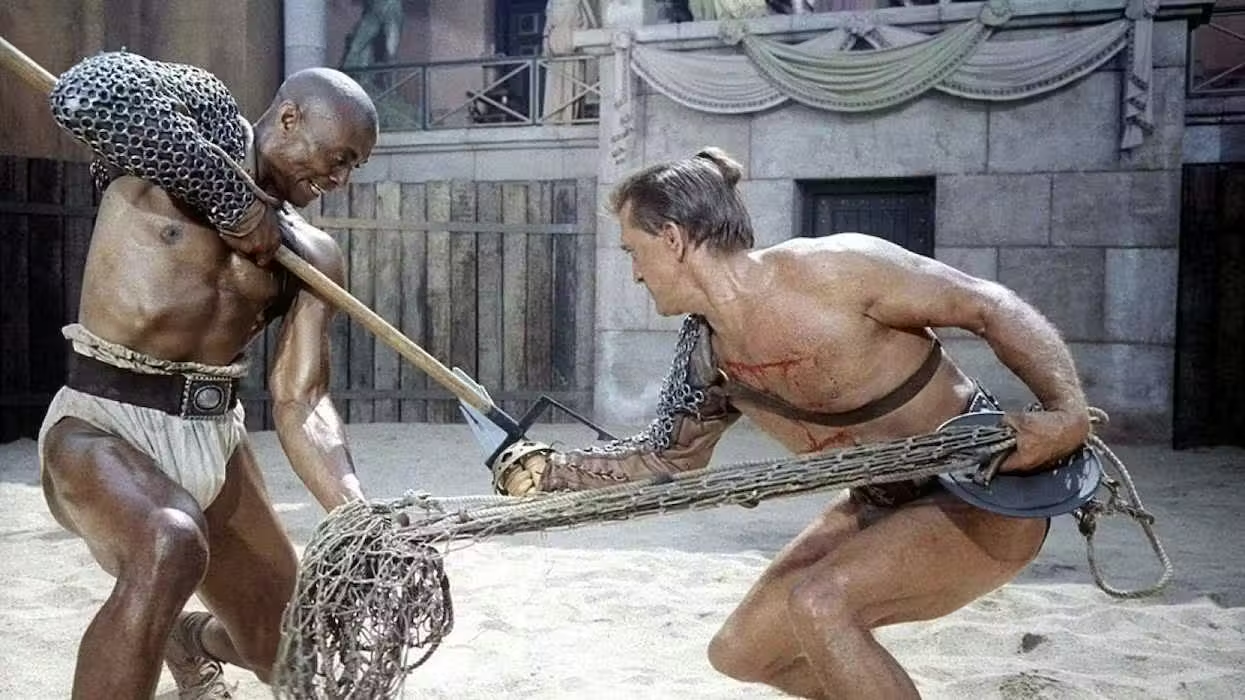
The fighters are Spartacus and his friend, Draba.
After a fierce battle, Draba refuses to kill Spartacus. When they demand he does it, Draba takes his trident and throws it at the Roman elites before being struck down.
Everyone sees this display of bravery, and it changes them, including Spartacus.
He leads a revolt of all the gladiators, and they're able to kill all the guards and escape into the countryside with a bunch of the slaves as well.
His band of warriors starts small, but as they free more and more people, it grows into an army of willing warriors tired of being pushed around by the Roman government.
Spartacus seeks to lead his people to the coast, where they hope to hire Cilician pirates to ship them safely out of Italy.
Meanwhile, in the Roman Senate, Crassus uses the growing slave uprising as leverage to consolidate power over his political rival, Gracchus (Charles Laughton).
The End of Spartacus
Unfortunately, the pirates betray Spartacus. They take money and leave him cornered with three converging Roman armies led by Crassus, Pompey, and Lucullus all bearing down on them.
Spartacus's army is destroyed, and he's captured, along with his family and a few other surviving members of his army.
Up until this point, Crassus has no idea what Spartacus looksl ike, so they have no idea if they have captured the right guy or if he's alive.
So he threatens the survivors with crucifixion if they don't identify Spartacus.
And in an all-time famous scene, Spartacus stands up to claim his identity and face execution. But before he can finish speaking, his loyal friend Antoninus (Tony Curtis) jumps up and shouts, "I'm Spartacus!" One by one, every surviving slave stands and proclaims, "I am Spartacus!"
This rebuttal from the slaves angers Crassus, so he condemns all 6,000 of them to be crucified along the Appian Way leading into Rome.
But in the chaos, Crassus recognizes Spartacus and Antoninus from seeing them earlier in the movie. So he pits those two against each other and forces them to fight to the death. He promises them that the winner will be crucified.
Spartacus kills Antoninus so he doesn't have to be put on the cross. And Spartacus is then sentenced to be crucified on the road.
Meanwhile, Gracchus is moved by what he's seen, and helps Spartacus's widow, Varinia, escape Rome with her son, so they will not suffer the same fate as her husband,
As they walk on the Appian Way, she spots Spartacus hanging on a cross near the city gate. She holds up their son to him and tells him that his son is free and will grow up knowing who his father was. Spartacus gazes down at them, gives a soft nod of acknowledgment, and dies as Varinia rides off into the distance.
- YouTubewww.youtube.com
The Ending of Spartacus Explained
I know all of that kind of sounded like a downer, but there's so much thematic meat on the bone in this movie.
It's not just an action movie about an uprising; it's about how your action carries onward through history. And it's about the legacy you leave behind after a life well-lived.
Sure, on paper, Rome wins, and Spartacus loses.
But in actuality, Spartacus won the only thing Crassus could never have: the love and devotion of the people.
And he never gave in to Crassus. No matter how much energy, money, and power Crassus used, he could never own Spartacus.
When the slaves chant "I am Spartacus!", Spartacus is transformed into an indestructible idea, one of free men and women who would eventually disrupt and topple rulers like Crassus.
When Spartacus sees his wife and free son, he understands this is his happy ending, not dying on the cross.
Spartacus and the Hollywood Blacklist
So, one thing I think many people don't realize is that this movie was made in real time in reaction to the Hollywood Blacklist, which was outing suspected members of the communist party and ending their careers.
In fact, writer Dalton Trumbo was on that list and had people coming after him, trying to run him out of town.
He was one of the "Hollywood Ten," a group of filmmakers blacklisted by the House Un-American Activities Committee (HUAC) for refusing to name names during the Red Scare.
Well, Kirk Douglas didn't like that very much and stood up. He used his immense star power to ensure Trumbo received full screen credit under his real name for writing Spartacus.
When the slaves on screen refuse to name Spartacus to save themselves, it acts as a direct critique of the real-world cowardice displayed during the McCarthy era.
The people watching them over when it came out were faced with their own transgressions.
You even get Spartacus crucified, like Jesus, dying for the sins of the others so that men and women in Rome can be free.
Summing It All Up
Spartacus is one of those great movies that changed the course of history just by being brave enough to confront what was happening in Hollywood at the time.
It owes its bravery to its main characters and has endured because of the story's fortitude and thematic depth.
That's what makes the ending so powerful.
Let me know what you think in the comments.