Film Quote of the Day: The 'Spartacus' Line That Turned Solidarity Into a Battle Cry
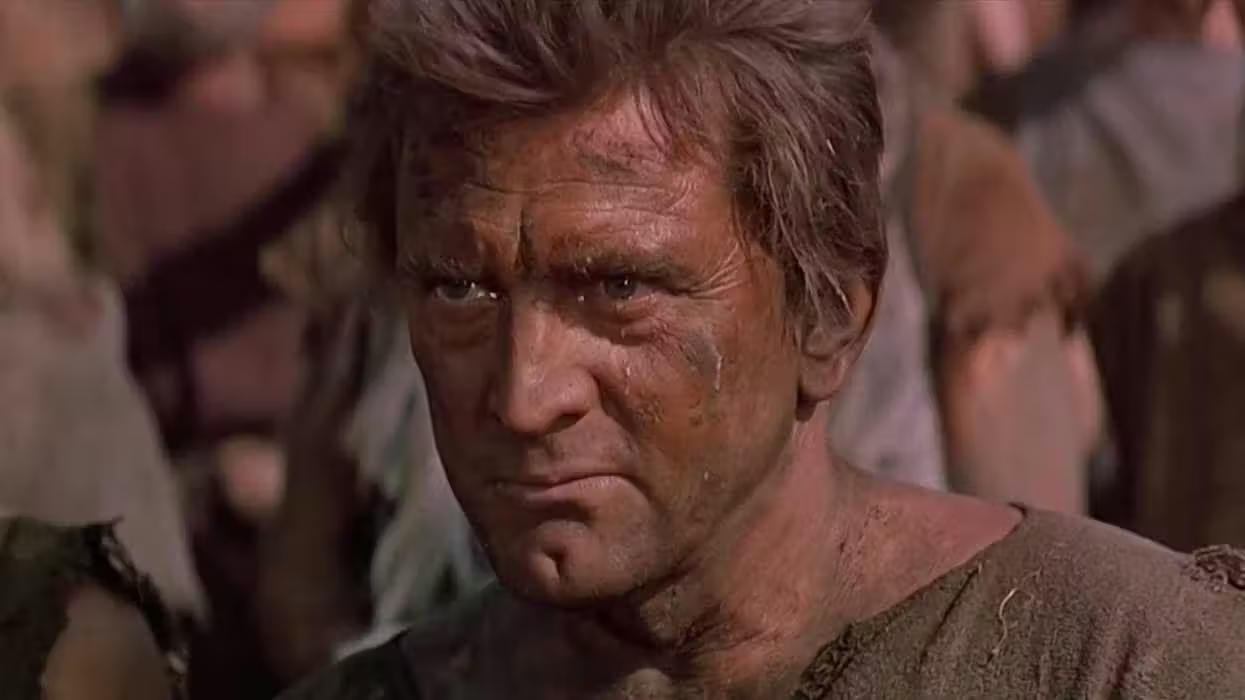
"I'm Spartacus!"
'Spartacus'
You might be stunned to find out that one of the most emotional moments in a 1960 historical epic almost didn't happen.
You've probably guessed already, but I'm speaking, of course, of the climactic scene at the end of Stanley Kubrick's Spartacus.
This famous line actually belongs to a crowd. "I'm Spartacus!" It's often misremembered by most of us as "I am Spartacus." In the film, it is repeated by dozens of men who know it will get them killed. It's a strange thing to build a heroic moment around because it's a line the hero barely gets to say. In Spartacus, the moment tells you everything about the man at its center by refusing to let him speak for himself.
Kubrick thought the moment was overly sentimental, and even called it "a stupid idea," per Kirk Douglas' memoir, I Am Spartacus. Douglas later revealed he had to argue with Kubrick to even get it in.
Let's look at the scene more closely.
- YouTubeyoutu.be
The Scene
By the end of the film, the slave rebellion is finished. Spartacus' army has been crushed by the Roman legions, and the survivors sit in the dirt as prisoners, waiting to learn their fate.
A Roman herald rides up with an offer from the general Marcus Licinius Crassus. Their lives will be spared, he tells them. They will escape crucifixion… on one condition. They have to point out which man among them is Spartacus, dead or alive. Because Rome doesn't even know what he looks like.
Spartacus, unwilling to watch thousands die when he could just give himself up, starts to rise and do just that. He barely moves before Antoninus, the young singer played by Tony Curtis, leaps to his feet at the same time.
"I'm—" Spartacus begins.
"I'm Spartacus," Antoninus says, interrupting him.
Then the man beside him stands. "I'm Spartacus."
Then another, and another, until the whole defeated army is on its feet, each of them claiming to be the one man Rome wants to kill. The offer of mercy dissolves in the noise.
Crassus gets his answer, in a way. He can't find Spartacus, so he condemns all six thousand of them to be crucified along the road to Rome. They chose death over giving up their leader.
What the Line Reveals About Spartacus
We spend three hours following Spartacus, and then, at the biggest moment, the film gives a simple, defining line to everyone else. His character gets revealed not by what he does but by what he has inspired these people to do. If you can measure a man by the size of the sacrifice he motivates, then this is enormous.
If you're trying to create a protagonist like this, look at the qualities that make a hero people will follow. Leadership is what makes others stand up and risk potentially everything. Spartacus earns the loyalty at the gladiator school, in the revolt, and on the long march toward freedom. This scene is the payoff to his leadership.
It also works because we've watched him lose. We start to care about a character based on what they stand to lose, and by this point Spartacus has lost the war, his freedom, and nearly his family. When the men rise to protect him, they're guarding something they believe should outlast all of them. He's stopped being a single slave and become the idea of resistance itself. Rome has lost, even if they kill all of them.
How the Scene Works
This scene is, on the surface, all about repetition. By the end, it's the same couple of words, over and over, gathering force with each voice that joins.
Repeating a phrase to build momentum is a rhetorical move as old as speechmaking, and here it turns a single act of courage into an avalanche. The first "I'm Spartacus" is a gut-punch. But as the scene continues, and more and more join in, the gut-punch becomes a wave of deeper emotion.
It also works because the scene understands its villain. Crassus wants a name, and naming is his whole method — the Roman order runs on identifying people, sorting them, owning them. The most effective antagonists press exactly where the hero is most exposed, and Crassus has found the pressure point. The slaves' answer is to make the name useless by giving it to everyone.
And notice how the film uses its ensemble. Spartacus is the main character the whole cast orbits and the reason the story moves forward, but this scene has the crowd carry the finale.
The typical version of this moment might give a hero like Spartacus a big, rousing monologue about what he believes and why he rebelled. This scene shows unity instead, spoken by characters we've mostly never met.
And when we get that shot of Spartacus shedding a single tear for those around him? Oof. It hurts more than dialogue could express.
You don't need your hero to explain the point when the people around him will willingly die to make it.
The Poetry Behind the Camera
There was drama behind the scenes, too. Spartacus was written by Dalton Trumbo, one of the "Hollywood Ten," or writers and directors who were blacklisted during the Red Scare. In Trumbo's case, he was also jailed for refusing to name names to the House Un-American Activities Committee.
For years he wrote under pseudonyms because no studio would put his real name on a film.
Douglas, who produced Spartacus and starred in the title role, chose to credit Trumbo openly, under his own name. It was a real risk, and it helped crack the blacklist's hold. Director Otto Preminger made the same move on Exodus that same year.
This is a movie about men who refuse to name their leader to save their own skins. It was made by a team openly refusing to honor a blacklist built entirely on forcing people to name names.
The defiance on screen and the defiance behind the camera are poetically mirrored. Whenever people stand together and dare the powerful to punish all of them, an iron grip can be broken.