“May the force be with you”, a simple sentence that transcended its origins in Star Wars: Episode IV - A New Hope, directed by George Lucas, to become one of the most enduring and unforgettable catchphrases in all of film history.
First said by General Jan Dodonna in Star Wars: Episode IV - A New Hope, this line served as words of encouragement to Rebel pilots before the attack on the Death Star. It was a Jedi blessing that quietly echoed ancient religious greetings, such as the Biblical phrase “The Lord be with you”. Over nearly five decades, these words have confidently made their way through pop culture, becoming a universal shorthand for inspiration and encouragement.
So, what makes this line legendary? And how did it transform from a catchphrase to a cultural code?
Let’s jump right in and explore.
What Makes This Line Legendary
Before we discuss how “May the force be with you” became a legendary Star Wars line, we should explore the very basics of what makes a movie line endure. To begin with, a line has to serve its purpose in the moment during which it is said. This line does that perfectly well by being uncomplicated, straightforward, and acting as a binding “force” amongst those who utter it.
This line is said at a moment when inspiration is the need of the hour. Motivation feeds on inspiration, and “May the force be with you” encourages, inspires, and motivates. In fact, the line comes across less like a dialogue and more like a benediction. Without consciously thinking about it, a movie audience can form associations between the moment a line is uttered and the emotionality of the scene.
While this line is said many times across different films, a common thread connects each utterance. Every repetition occurs during a moment of uncertainty, departure, or at a time when encouragement is needed to pull everyone together. Each one of these moments inspires characters and audiences alike, deepening our association between the words and the emotions of the scene.
When this happens, while the purpose of the line within its on-screen moment remains important, the line itself finds a newer, deeper meaning simply because of how high its emotional resonance becomes. A few simple words that never explain themselves unnecessarily bring warmth, irony, reassurance, and meaning at a time when the characters and the audience crave it.
The Star Wars saga carefully “saves” this line for important moments not only based on the plot but also on its emotional core. The line is deployed tactfully, and it is never overused, which ensures that the audience awaits the next utterance instead of getting irked by its repetitiveness.
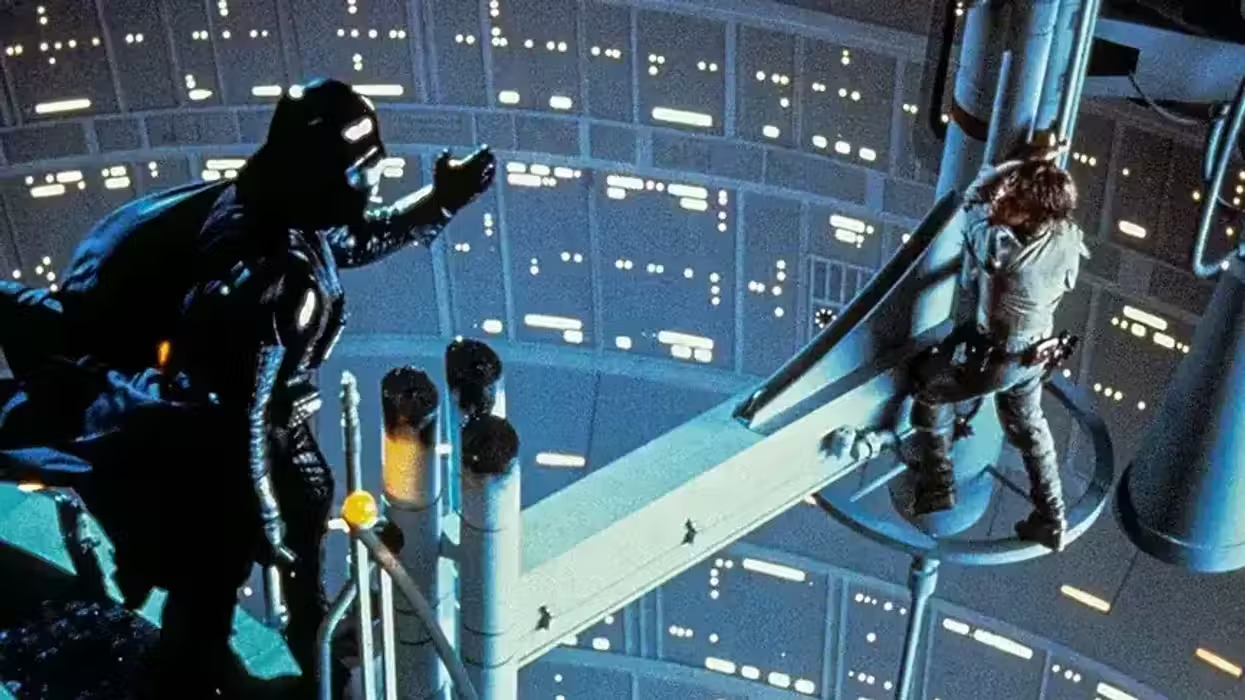
 'Star Wars: Episode V - The Empire Strikes Back' Credit: Twentieth Century Fox
From A Catchphrase To A Cultural Code
What starts as a line that is repeated to motivate and inspire soon becomes a shared language between characters who yearn for the same future. Behind the obvious motivational aspect of the line is a strong foundation of what is essentially a blessing.
For a line to become a cultural code, its application is likely not be limited to the scene or the movie alone. “May the force be with you” is certainly a sentence that is meant to encourage and motivate, but deep down, the line is also rooted in spirituality. While this may be due to its strong associations with “Lord be with you”, the reasons for the line’s spiritual nature are actually multifold.
The word “May” instills hope, not just for the person saying it but on behalf of the person it is said to. It creates a sense of a powerful entity that the person uttering the line hopes is on the side of those they are addressing. It is a deeper, more meaningful way of wishing someone luck.
“Be with you” is the part of the line that is both spiritual and philosophical. While we are accustomed to the concept of the “force”, “Be with you” paints a picture of backing, support, and accompaniment by the force. Even though this line is said quite often to a large group of people, it creates a strong personal bond with each one of them, especially because of the words “be with you”.
A line doesn’t just become a cultural code by intention, but through deep meaning, purpose, and its ability to inspire and motivate all of us who are far drawn from the cinematic universe of Star Wars. “May the force be with you” is not just a movie line anymore. It has been adopted by those who’ve watched and loved the Star Wars saga, making it as much their own as of the characters themselves.
What We Can Learn About Writing Lines That Endure
We could learn countless lessons from “May the force be with you”, a simple yet unforgettably enduring line. But let’s try to distill it down to three important lessons.
The Power Of Simplicity
Complex ideas might be attractive to writers often, but the power of simplicity is undeniable. This line doesn’t just use simplicity to its benefit; it preaches through simplicity. For a line to endure, first and foremost, it must be memorable. For it to be memorable, it needs to be simple.
Universal Nature Of Meaning
“May the force be with you” works perfectly well within the context of the moment in which it is said. But this doesn’t stop the line from being universally applicable. The line’s emotional core isn’t hidden. It’s out in the open, making it easy for audiences to adopt it into their own lives and color it with their own meaning.
Repetition And Restraint
This line has been repeated many times across films and television shows. Why then, do we still wait for the next time it will be said? Because while it does repeat, the creators are aware of restraining themselves from overdoing the repetition.
Summing It Up
“May the force be with you” isn’t just the most memorable line from the Star Wars universe; it is one of the most memorable lines in the history of cinema. The line serves a deeply meaningful purpose and remains applicable throughout the saga’s fictional universe and to a great extent in all of our lives.
Which is your favorite quote from the Star Wars saga? Tell us in the comments.
- The Story Behind Han Solo’s “I Know” — and Why It Became a Star Wars Legend ›
- “I’ve Got a Bad Feeling About This” — How a Running Joke Became A ‘Star Wars’ Tradition ›
- “You Were the Chosen One!”: The ‘Star Wars’ Line That Broke The Jedi Myth ›
- How George Lucas Bet on Himself—and Won Big with 'Star Wars' ›
- How One Line From 'The Mandalorian' Became a Pop-Culture Creed ›
- The Hidden E.T. Cameo In ‘Star Wars: The Phantom Menace’ You Probably Never Noticed ›