Andy Weir’s beloved sci-fi novel Project Hail Mary seemed like one of those projects that would never live up to expectations on the big screen.
But Lord and Miller aren't cowards, and when Earth needed them to make a movie about mankind clinging to hope and forming a bond with another lifeform to save the entire universe, they stepped up.
So, how do you bring a movie like that to the big screen?
Well, you need a lot of VFX, even if you plan to do a lot of things practically as well.
The film relies heavily on the emotional bond between astronaut Ryland Grace and his extraterrestrial counterpart, Rocky.
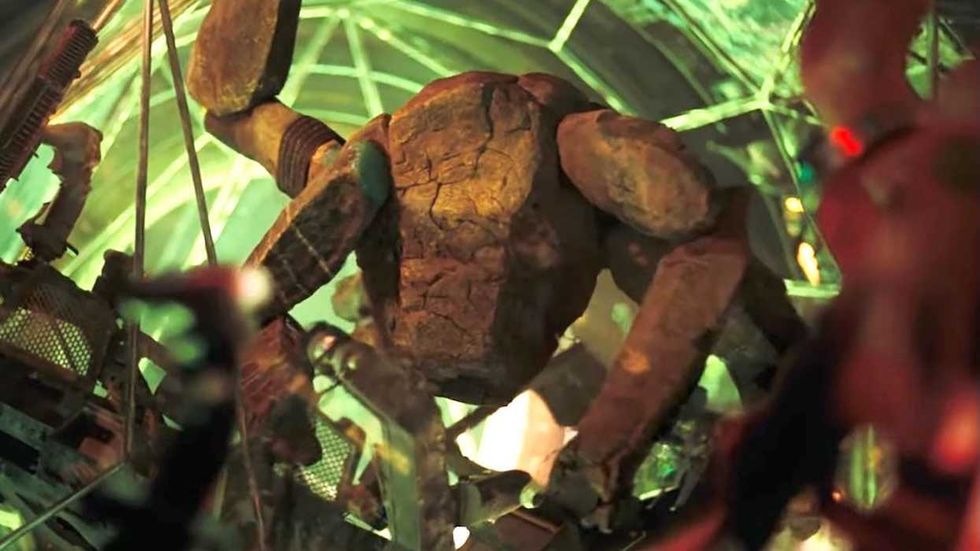
To make that relationship feel real, directors Phil Lord and Christopher Miller, cinematographer Greig Fraser, and production designer Charlie Wood worked with both experienced puppeteers and the team at Framestore to help Rocky come alive.
The whole team did a Q&A with Art of VFX, and I wanted to bring some of the highlights to you.
Let's dive in.
- YouTubewww.youtube.com
Grounding Sci-Fi in Tangible Physics
Andy Weir novels are so fun because they make every situation feel both grounded and plausible. In order to get the story right on screen, that meant every aspect had to feel tangible to wise audiences.
Before cameras rolled, Framestore ran simulations to ensure the ship's environments and Rocky’s signature spherical transport behaved according to real-world physics, even when those physics had to bend slightly for narrative clarity.
"Prior to the shoot, I ran simulations on how the “gravity” would shift as the ship moved to and from its spinning centrifugal mode and the forces that would be on the ship during the “fishing trip”... For example, to make Rocky’s ball roll believably, it was important to understand the dynamics of how it would move without actually needing to simulate it. We 3D printed mini versions of the ball so animators could play with and see how it rolled. I think it’s important to strike a balance between physical accuracy and the creative license necessary for effective storytelling," said Stuart Penn, VFX Supervisor in London.
Acting Without a Face
The transcendent thing about this movie was that we're falling in love with a little alien who has no face. I thought this was super bold in the book, and seeing it on screen and making sure they kept it was a leap of faith for the audience.
But it wasn't easy.
Rocky’s entire emotional arc had to be communicated through posture, timing, and subtle mechanical gestures.
Plus, you had to translate Rocky's iconic verbal tics from the page to the screen and get us to laugh with and at him without expressions.
"Because we are animating in CG, that gave us really subtle control like no other to move him around, sometimes very, very little. In the scene where Rocky realizes Grace is on a one-way trip and Rocky eventually offers his fuel, this scene was a great testament to fine detail and how little movement can be so effective. The famous word from the book, “Question,” was another idiosyncrasy we brought on to his performance. Tapping with one leg was something we utilized across the show; even when he is hanging in the habitrail, that was his signature movement," explained Senior Animation Supervisor Arslan Elver.
 'Project Hail Mary' Credit: Amazon MGM Studios
Solving the Xenonite Barrier Nightmare
Another creative part of the story is that Grace and Rocky exist in radically different atmospheres. So how do you bring these two together and build an environment where they can be side by side and hang out?
"Grace and Rocky can’t breathe the same air. In nearly every shot that had a barrier between them. Compositing Rocky behind practical, transparent set pieces was a huge challenge. The habitrails, the ball, and tunnel walls were all complex transparent objects. You can’t just slap a mask on these to layer Rocky into the plate... We were the first project to use our new Houdini lighting pipeline. We developed complex layering and rendering strategies focused on maximizing the use of our physical renderer to produce accurate refractions and reflections," noted Bob Winter, VFX Supervisor in Montreal.
These composites make sure the lighting in all the rocky scenes is consistent, and it helps us understand his little shell he travels in as well. Again, this is all small stuff that lets us buy into the believability of the world and grounds it.
Pre-Production Synergy
Almost all of Project Hail Mary's visual cohesion comes down to alignment between departments before anyone stepped foot on set.
This is the kind of collaboration we preach on this site, and the biggest lessons I think filmmakers of every level can take away from this movie.
You have to know what everyone on your team is doing.
DP Greig Fraser dove deep into the VFX in an American Cinematographer interview I'll link the video below.
But he says, "From day one, all of the choices that were made early on in VFX and all the way through the process led to incredibly good results."
The emphasis is brinfing on bringing the DP in to pre-viz the movie early; Framestore was brought in to work with the art department to create the world so they could work through the story on volumetric stages. And as that is happening with real mo-cap artists in real sets, the DP can plan lighting scenarios based on what's happening.
So when you finally roll, you have a close-to-final result in camera that feels grounded, and then they just have to polish it.
You have photorealistic science fiction for everyone to play with.
This interview between American Cinematographer and Fraser brings even more insight into how they approached the VFX.
Summing It All Up
As you can read, it takes a massive collaborative effort to make a movie like this come to life. From the directors, writers, DP, VFX, production design, and post, all of them needed to be on the same page to ground a story in a world we see as hopeful but realistic.
The end result will be in conversation as they roll out the Oscars this year.