One of the movies I find myself constantly rewatching is Project Hail Mary. I feel like it perfectly adapted Andy Weir's amazing book and brought it to life on the big screen.
Directors Phil Lord and Christopher Miller teamed up with Oscar-winning cinematographer Greig Fraser, ASC, ACS (Dune, The Batman), to make something that was not just a crowd-pleaser but also had all the tech heads humming all year thanks to its epic visuals.
To me, it really had its own original style and short space in ways we haven't really seen before.
So, how did they do it without relying on traditional green screens or sterile digital environments?
Let's dive in.
- YouTube www.youtube.com
Shifting Aspect Ratios
One of the cooler things about Project Hail Mary is that the screen size changes to fit the scene. Not all the time, but as we detailed in our coverage on No Film School, aspect ratios serve a critical storytelling role in distinguishing Ryland Grace’s lost memories on Earth from his lone journey aboard the Hail Mary.
Here's a breakdown of how the aspect ratios guide the narrative in different parts.
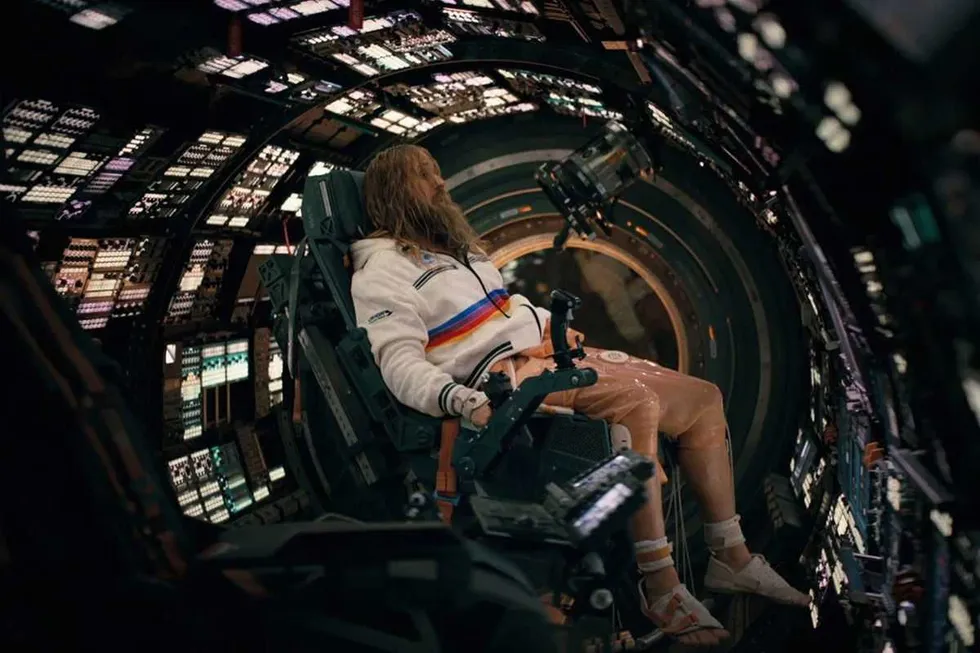
- 1.43:1 (IMAX 70mm & Dual Laser): Reserved for grand space sequences. This fully immerses the audience in the vast vertical scale of space and the orientation-defying architecture of the Hail Mary. I hope they do a re-release for awards in IMAX again.
- 1.90:1 (IMAX Xenon & Single Laser): Used for expanded vertical space sequences in digital IMAX theaters.
- 2.00:1 / 2.39:1 (Earth & Flashbacks): Grounded scope framing utilizing anamorphic squeeze for Grace’s earth-bound memories. This is a direct contrast to the claustrophobia of Earth’s impending doom and the open void of space.
Camera Package & Technical Specifications
Okay, now that we know the philosophy behind why certain scenes look a certain way, let's talk about the tools that the amazing cinematographer Greig Fraser used to get that feeling on screen.
Fraser paired digital cinema sensors with an eclectic mix of modern and vintage glass to get the images to look the way he wanted.
You can get detailed breakdowns on Filmmakers Academy, but here's a cheat sheet.
| Spec Category | Details & Gear Used |
| Primary Cameras | ARRI ALEXA 65 (Main Unit), ARRI ALEXA Mini LF (B-Camera / Specialty Rigs) |
| Lenses | Custom ARRI 2.2 Anamorphic (Vertically De-Squeezed), Atlas Mercury & Atlas Scope (1.5x), Viltrox Epic (1.33x), Luna Zoom, ARRI Heroes T.One, and IronGlass Helios vintage re-housed lenses |
| Negative Format | ARRIRAW (6.5K) & ARRIRAW (4.5K) captured via Codex recording systems |
| Cinematographic Process | Large-Format Digital Capture with Anamorphic Squeeze; Mastered to 4K Digital Intermediate (DI) |
| Exhibition Formats | 70mm Film Prints (Horizontal, Kodak Vision 2383) & Digital Cinema Package (DCP) |
Practical Effects and In-Camera Magic
One of the most powerful parts of Project Hail Mary was how they avoided the use of CGI.
Rather than relying on blue or green screens, Fraser and VFX Supervisor Paul Lambert opted for blackouts and practical lighting techniques.
They made everything Ryland Grace did feel tactile. He was really punching buttons, making things, feeling lights cross his face, and stepping into shadows.
This visceral quality also made the spacewalks scarier and more dramatic. You had this realistic natural lighting, reflections on space suits and glass visors, and then a black background or a bright green from the distant star to really make our characters pop.
We can go deeper on these techniques, too.
 'Project Hail Mary' Credit: Amazon MGM
1. Infrared Pink Bokeh Trick
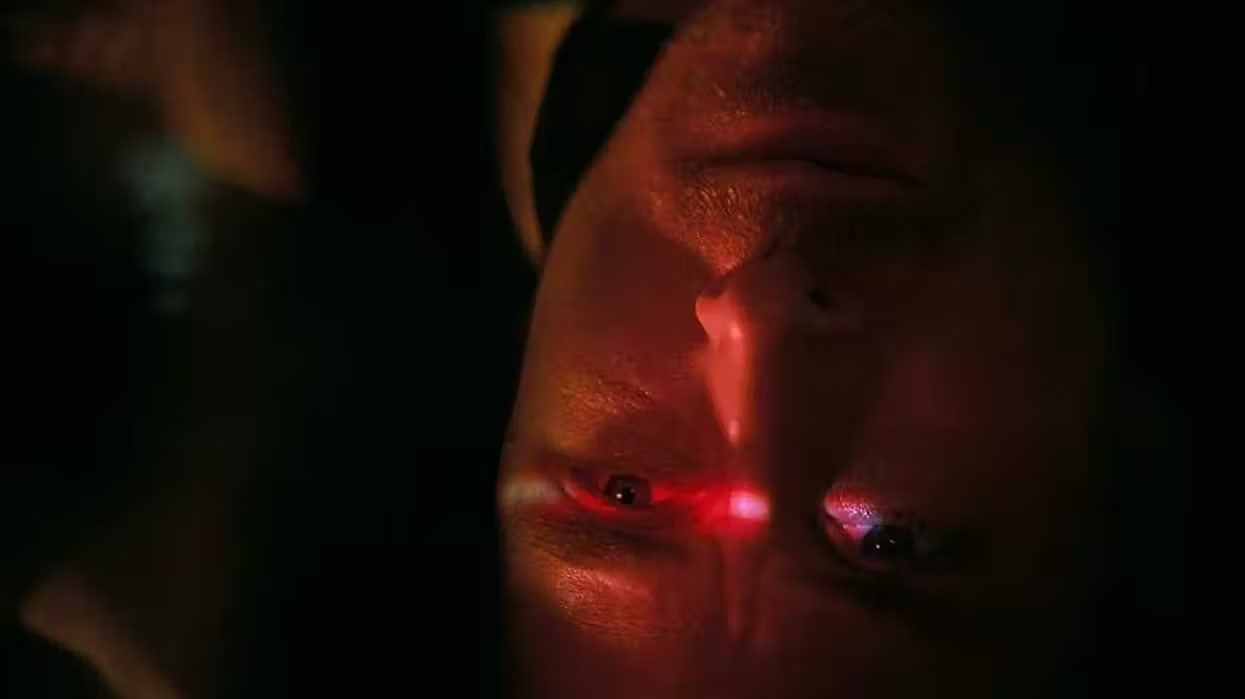
As Lord and Miller shared during an IMAX breakdown we covered on No Film School, Fraser rigged two Alexa 65 cameras on a single crane, modifying one by removing its optical low-pass/infrared filter.
They surrounded Ryan Gosling with a wire-mesh rig embedded with invisible, blinking IR lights, allowing the modified camera to detect light invisible to the naked eye.
Yes, this is sceince-y and nerdy, but the effect gave us that glowing pink bokeh in camera. It really feltl ike we were thousands of light-years away with this character.
2. Physical Water Rigging
To capture the disorientation of fluid environments without relying on CGI overlays, Fraser shot handheld through a custom glass-and-funnel rig while crew members poured water across the panes.
That means when the cameras rolled, real water refraction was introduced into the shot during live takes. Imagine cutting for a leak?!
You had a camera assistant operate the glass panes in sync with the camera move.
3. Circadian Lighting & Centrifuge Rigging
Much of the ship's interior was shot creatively as well. Fraser avoided cool white sci-fi lighting. That's actually when I began to see his genius. It would have been so easy to shoot this boring. But the story demanded it feel a little futuristic.
So he switched up what we would expect.
For the tunnel sequence, Fraser built pixel-mapped tungsten rigs that let him rotate their synthetic sunlight in real time, so it would reflect off the characters.
Fraser developed an automated circadian lighting system with shifting color temperatures that would reflect the time of day inside the cabin.
So you had cool blue mornings, warm evenings, tungsten night tones.
This was crucial to showing the passage of time in both the montages and the journey, so we understood how long Ryland was in space and the process of solving a problem that spanned days, weeks, months, and years.
For the spinning centrifuge, they used three concentric semicircles of Creamsource Vortex LED fixtures, programmed to simulate shifting sun angles across multiple windows simultaneously.
Summing It All Up
All of this stuff is so complex. And look, as a writer, I could only understand half of it, and I am trying to learn the other half in case I want to direct and have a conversation with a cinematographer and not look like an idiot someday.
But it shows that this movie was created by creative people willing to experiment. These are not just the top of the craft, but people who are not afraid to challenge themselves again and again to achieve the best results.
And it all shows up on the screen.