How Back to the Future III Pulled Off Its Most Dangerous Stunt
Go behind the camera to see how the crew built, filmed, and perfected the thrilling train climax of Back to the Future Part III.
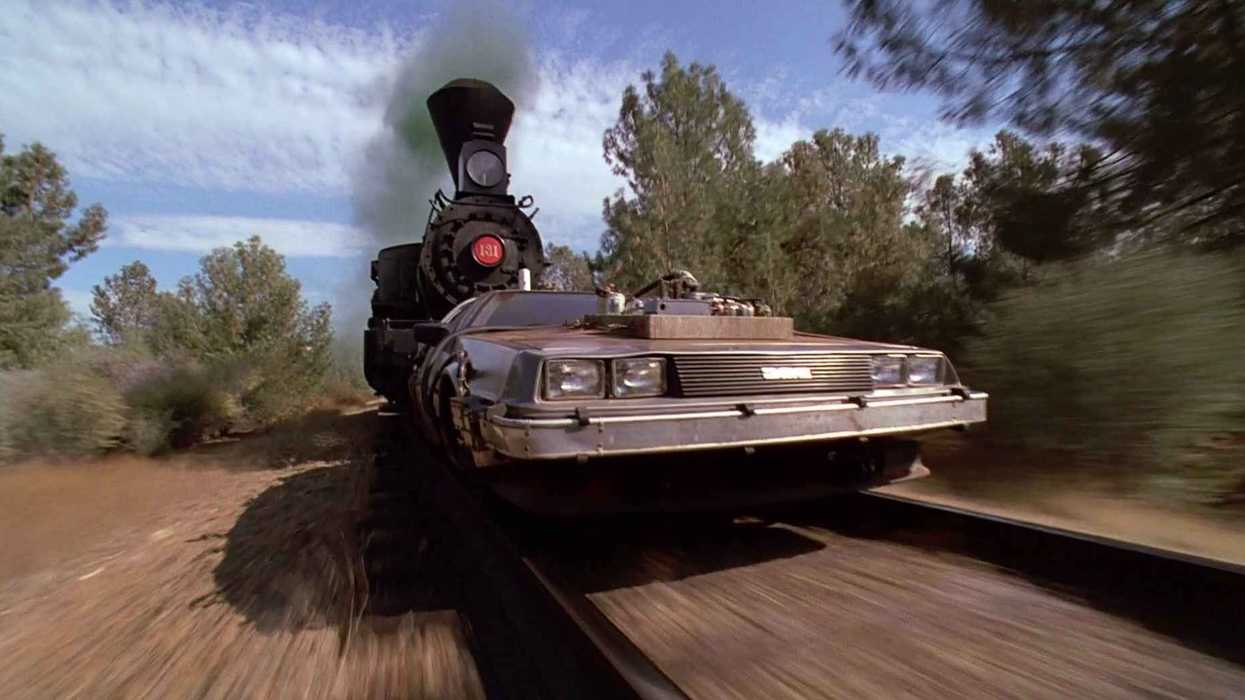
Back to the Future—Part 3 (1990)
By the time Back to the Future Part III (1990) rolled into theaters, the trilogy had already bent time, rewired timelines, and parked a DeLorean into cinema history.
And yet, Robert Zemeckis and Bob Gale weren’t done. They wanted one last, pulse-pounding set piece to send Marty McFly (Michael J. Fox) and Doc Brown (Christopher Lloyd) home.
The answer? A high-speed steam locomotive barreling toward a half-built bridge, with the DeLorean strapped to its nose like a passenger from hell.
It was the perfect mix of Old West grit, sci-fi stakes, and hair-raising spectacle. See it for yourself.
Back to the Future III train crash sceneCredit: Universal Pictures
Now, don’t just assume it was one of your “shoot it on a green screen” days at the office. The train crash finale was one of the most ambitious—and dangerous—practical effects sequences of the decade. We’re talking real locomotives, real destruction, and a crew that had to choreograph chaos with the precision of a Swiss watchmaker.
The question is: how did they pull it off without wrecking the budget, the set, and themselves?
The Concept: From Script to Storyboard
Origins of the Idea
The seeds for the train climax were planted early in Bob Gale’s drafts. By the third film, the DeLorean had already been struck by lightning and zapped between centuries—it needed a final, outrageous send-off. Gale and Zemeckis zeroed in on a steam train for two reasons: historical authenticity (1885 Hill Valley had no paved roads or sports cars) and pure cinematic danger. A train is big, noisy, and unstoppable—exactly what you want for a do-or-die finale.
The Old West setting also gave the writers a neat way to mirror the series’ theme of “old meets new.” Marty’s futuristic car clashing with a roaring 19th-century locomotive was kinda cool, and it also made the audience feel the stakes. In a place without hoverboards or electrical lines, how do you hit 88 mph? The train was the only logical and most dramatic answer.
Pre-Visualizing the Crash
Once the concept was locked, production dove into storyboards. Every camera angle, every stunt beat, every splinter of wood had to be mapped out. The biggest concern was—of course, money—but also safety. A real train weighs hundreds of tons, and unlike a stunt car, you can’t just slam the brakes and reset.
Budget-wise, there was no “redo” button. If they crashed the locomotive, that was it—it had to be the money shot. Zemeckis and his team worked closely with stunt coordinators and effects supervisors to ensure that every explosive, derailment ramp, and camera rig was placed for maximum impact with minimum risk.
Building the Beast: Designing the Locomotive & Set
Constructing the Steam Engine
The locomotive seen in the movie was a real working steam engine modified for filming. Engineers collaborated with the art department to create a machine that could look authentic but also perform some physically impossible stunts. This meant adding hidden speed controls, detachable couplings, and reinforced sections to survive the violent sequence.
The production, instead of renting a train, built its own stunt locomotive. Certain parts were reinforced with lighter materials so they’d break in predictable, camera-friendly ways. It was part history lesson, part mechanical daredevilry.
The Tracks & Canyon Set
The canyon setting—Shonash Ravine in the story—was a blend of real California landscapes, a purpose-built stretch of track, and old-school matte paintings. Some of the bridge shots weren’t a bridge at all but miniature models filmed at Industrial Light & Magic (ILM).
Because the final crash involved the train plunging into the ravine, safety was the number one priority. The “bridge” was a controlled set piece designed to collapse exactly as planned, with the real train stopping just short of the edge during live-action shots. The deadly drop? Pure Hollywood illusion.
Filming the Chaos: Stunts, Practical Effects & On-Set Challenges
The Stunt Work
Michael J. Fox and Christopher Lloyd were game to do as much as possible, but certain moments—like Doc’s leap from the train to the hoverboard—were handled by doubles. The standout stunt was the horse-to-train jump, which involved a professional rider timing the leap to a moving locomotive.
Even the “simpler” shots required precision. Actors had to hit marks while the train moved at dangerous speeds, and camera operators were strapped into rigs bolted to the cars. One mistimed cue could mean scrapping expensive footage—or worse, risking injury.
The Crashing
They crashed the locomotive model—not the real train—in the scene. The sequence where the locomotive derails and plunges into the ravine was done in one go with a purpose-built engine and bridge model at ILM. The real full-size train was only driven to the edge for live shots—everything after that was meticulously scaled miniature.
Controlled derailment meant guiding the model train with hidden ramps and explosives so it “behaved” for the cameras. Once it fell, multiple high-speed cameras captured the wreck from different angles, ensuring editors had all the multi-angle shots they needed.
Near-Disasters
While no major accidents occurred, there were moments that made the crew’s pulse spike. One early test run of the train’s speed control went faster than planned, forcing crew members to scramble off the track. It was a reminder that even with planning, a live locomotive is no toy.
Movie Magic: Enhancing the Crash with Special Effects
Miniatures & Matte Paintings
ILM’s team extended the canyon with matte paintings and built a detailed miniature bridge to match the on-location shots. The miniature train was an exact replica of the real one, down to the rust patterns, so the audience wouldn’t spot the switch.
Composite Shots
By blending live-action footage of the actors with the model shots, editors created seamless transitions. This old-school compositing was frame-perfect—audiences rarely realize they’ve switched from a real locomotive to a scaled one mid-shot.
Sound Design
The crash’s impact came as much from the ears as the eyes. Sound designers layered actual steam train recordings, breaking wood, and slowed-down car crashes to give weight to the destruction. Alan Silvestri’s score was timed to sync perfectly with the train’s final moments, heightening the tension beat for beat.
The Final Cut: Editing & Audience Impact
Editing was all about pacing. Zemeckis trimmed the scene to maintain a rising tempo—cutting from close-ups of the characters to wide shots of the train bearing down on the bridge. Test screenings confirmed the audience’s reaction: they were on the edge of their seats.
Over time, the sequence has been cited as a high-water mark for practical effects in Hollywood. It’s the kind of scene that works because it’s physical, dangerous, and shot with a mix of planning and raw spectacle—things you can’t fake with pixels alone.
The Crash’s Lasting Legacy
The train crash in Back to the Future Part III went beyond being a flashy finale and became a masterclass in blending story, stunt work, and craftsmanship. Zemeckis and his crew pulled off a sequence that feels real because, for the most part, it was. Today, when action climaxes are often rendered entirely in CGI, this scene stands out as a time capsule of what happens when filmmakers risk complexity for authenticity.
So the next time you revisit the trilogy, watch closely during that final run to the bridge. You won’t be only watching Marty and Doc dashing through time—you will be watching one of cinema’s greatest practical stunts thunder toward immortality.
- Go Behind The Scenes Of The 'Mission: Impossible - Final Reckoning' Airplane Stunt ›
- Why Did a James Bond Stunt Require $70K Worth of Coca-Cola? ›
- Learn How to Master These Eight Stunt Tricks ›
- 11 Modern Tech Gadgets 'Back to the Future Part II' Got Exactly Right | No Film School ›
- ‘The General’ and the Silent Cinema’s Costliest Stunt ›
- ‘Back to the Future Part II’: A Satire on Franchise Excess ›