‘Back to the Future Part II’: A Satire on Franchise Excess
A holographic shark gag in Back to the Future Part II (1989) turns into a sharp prediction of Hollywood’s sequel obsession and franchise overload.
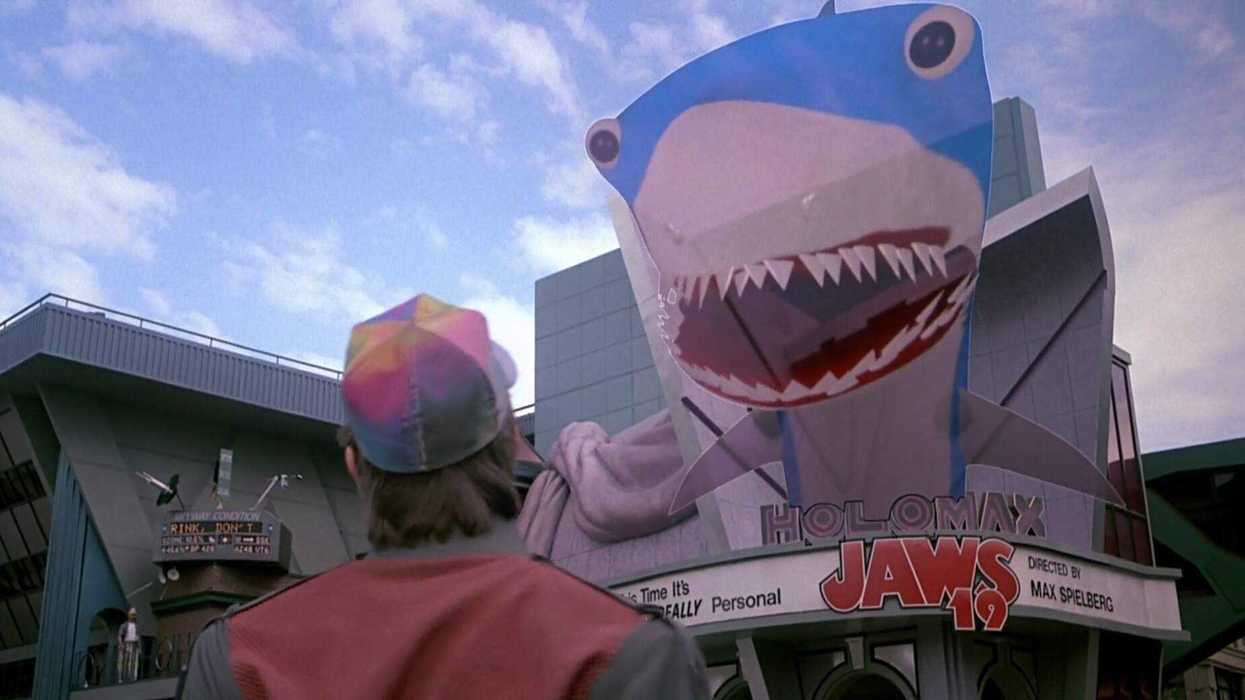
‘Back to the Future Part II’ (1989)
Usually, when a great white shark lunges onto its prey, it’s a great jump scare for the audience. While that actually happens in Back to the Future Part II (1989), it doesn’t come off as an edgy, jerky moment. Well, it’s a sci-fi comedy, and it’s a funny scene, so it’s understandable.
And yet, this amusing moment stirs up a different feeling. Well, not so much a feeling as a thought. It makes a snarky comment on something that has become a staple of today’s movie culture. The culture that thrives on relentless sequels. The sequels that thrive on spectacle. And the spectacles that are driven by only one thought, the blockbuster.
If you have ever seen a sugarcane juicer, you might know how the operator squeezes it repeatedly to extract everything the poor stalk has got. Over the last few decades, something similar has been happening in Hollywood. Filmmakers take one idea, and if it is decently successful, they stretch it, then some more, and more, and it goes on. They milk it for all its worth.
And this holographic shark gag puts its funny finger on this “exploitative” nature of Hollywood. It captures the franchise fatigue of the ‘80s—oh yes, it was setting in during the ‘80s itself. The Village Voice critic J. Hoberman called it “Sequelitis,” a wordplay on diseases such as hepatitis and bronchitis. He called it an “illness” of relying on safe, proven hits rather than taking risks on original ideas.
The gag hinted at “Jaws 19,” as in the 19th film in the Jaws franchise, playing at the Holomax Theater. And, with this insinuation, the movie accidentally mapped out the next thirty years of “blockbuster” history. 19 movies with the same topic and same premise; imagine the lack of imagination in the futuristic world.
While it was a mocking gag in Back to the Future, it has become a reality today. Thankfully, on the scale of 1 to 10, our absurdity is yet to hit the “19” mark, but the spirit of Holomax hovers around us. And this scene remains one of the most accurate cultural predictions in sci-fi history.
The “Jaws 19” Moment
In 1985, Dr. Emmett “Doc” Brown (Christopher Lloyd) returns from the future and implores Marty McFly (Michael J. Fox) to come with him to 2015. Marty’s son, Marty Jr. (Fox), is apparently going to get himself involved in a robbery and end up in jail for 15 years, leading to further circumstances that eventually destroy the McFly family.
When they travel into the future, in the year 2015, Marty has his first look at the technologically advanced society. Flying futuristic cars, “No Parking” signs replaced by “No Landing” signs, hoverboards that literally hover, a completely mechanized car-servicing facility, and a movie theater that’s now showing “Jaws 19.”
As Marty is lost in amazement, the Jaws theme starts to play, and a holographic shark appears from the theater in the background and pounces on him. Marty shrieks in horror, but the shark turns out to be a hologram. Marty gathers his composure and mutters, “The shark still looks fake.”
“Jaws 19” as a Prediction of the Franchise Culture
From Jaws to Jaws 19: Sequel Escalation
When Back to the Future Part II hit the screens in 1989, the franchise culture was in full swing. For example, look at the number of sequels by 1989: James Bond (16), Friday the 13th (8), Halloween (5), A Nightmare on Elm Street (5), Rocky (4—the 5th came in 1990), and Jaws (4).
The hyperbolic gag of “Jaws 19” is simply pushing that trend to a humorous extreme. The idea was to suggest that the studios return to the same property, not because the story demands it, but because the selling value of the “name” is still intact.
The “Max Spielberg” Credit: Meta Commentary on the Industry
If you look closely, you can see the (fictional) director's credit on the theater reads “Max Spielberg”—Steven Spielberg’s real-life son. It’s a funny jab, but it points to a future where Hollywood is literally a family business. In the movie’s fictional future, Max is also making movies, but nothing original or new. He is simply stretching the tried and tested legacy of his father’s classic to a breaking point.
The movie’s tagline says, “This time it’s REALLY REALLY personal.” That means it was perhaps just personal a while ago, it got really personal a few sequels ago, and now it’s REALLY REALLY personal. That’s how Apple sells iPhones, with minuscule increments but marketing them as “revolutionary.”
Visual Gimmicks and the Quest for “Real” Fakes
From Holograms to Immersive Cinema
The “Holomax” was how the director imagined the 2015 version of the futuristic IMAX and 3D experience. It’s 2026, and we still don't have hologrammed sharks jumping out of movie theaters and onto the main street. And yet, you can attest to the industry’s obsession with “event cinema." There are VR experiences, and there are 4D theaters that have jerking seats that spray water and blow air and whatnot.
The bottom line is that today, the goal is the same as the movie predicted: using tech to distract viewers from the fact that the story is a retread.
“The Shark Still Looks Fake”
When Marty says, “The shark still looks fake,” he is cracking a meta-joke at the expense of a notoriously glitchy Bruce, the mechanical shark, from the original 1975 movie. This quip is also a veiled prediction of the unease and revulsion that we feel today towards the CGI effects that just don’t hit the mark. There is a word for that unease; it’s called "uncanny valley.”
Today, 37 years after Back to the Future Part II, we go to watch movies that spend millions of dollars on visual effects for a single scene, and we still share Marty’s feeling: “It still looks fake.”
Conclusion
The topic of this article wasn’t a scene; it was a passing moment inside a scene. Just a few seconds long. And yet, this moment was packing quite a few insights, and it had a lot to say about how we make and see films.
What should we take out of this? It’s the quiet acceptance that Hollywood has (and will) never let go of a concept if there are even a few drops of juice left in it. It will stretch the concept into ludicrous territory; advanced technologies will create increasingly hollowed-out and flattened visuals and create innovative gimmicks just so that you show up.
Hollywood has spent decades trying to make its shark look real, and yet here we are, swimming in the sea of familiar fakes.
- 'Back to the Future' Writer Bob Gale Shares Timeless Screenwriting Advice ›
- This Mistake in 'Back to the Future' Has Bugged Fans for Decades ›
- Why 'Back to the Future's Clock Tower Scene Is a Masterclass in Suspense and Payoff ›
- Did You Know: The DeLorean in ‘Back to the Future’ Was Almost a Refrigerator ›
- 11 Modern Tech Gadgets 'Back to the Future Part II' Got Exactly Right ›
- 13 Film Nerds Who Became Screen Icons ›
- 10 Greatest Sci-Fi Movie Characters to Ever Grace the Screen ›
- How Back to the Future III Pulled Off Its Most Dangerous Stunt ›