It was Kolkata, India, in the 1950s. A man was working in advertising as a commercial artist. While illustrating a novel by a new author, the man recognized its powerful visual potential and felt compelled to turn it into a film.
He gathered a small amateur crew and began shooting only on weekends, funding his film with his job at the advertising agency. Without any money or real support, the film was shelved multiple times, mid-shoot.
It took him two years and a bureaucratic sleight of hand to finally finish the film. In 1955, it premiered at Kolkata’s Basusree Theatre and made its international debut at the 9th Cannes Film Festival.
The rest is history. The film is Pather Panchali (Song of the Little Road), and the filmmaker is Satyajit Ray.
Satyajit Ray’s films are deeply rooted in reality. They tap into the most complex emotions and motivations while exploring society as a structure. His narratives are not only timeless but also immensely liberating—a walk through society's dingiest lanes to uncover bitter truths with utmost sincerity, compassion, and love.
In this article, let’s explore the best films by Satyajit Ray.
Best of Satyajit Ray Movies
Interestingly, despite being a celebrated author himself (who earned his livelihood through his writing), many of Ray’s films have been adaptations from the novels and short stories of renowned literateurs like Rabindranath Tagore, Bibhutibhushan Bandhopadhyay, and Munshi Premchand.
Here’s a list of the best films by Satyajit Ray that are a must-watch for every aspiring filmmaker.
Trust me, each one is a masterclass in itself.
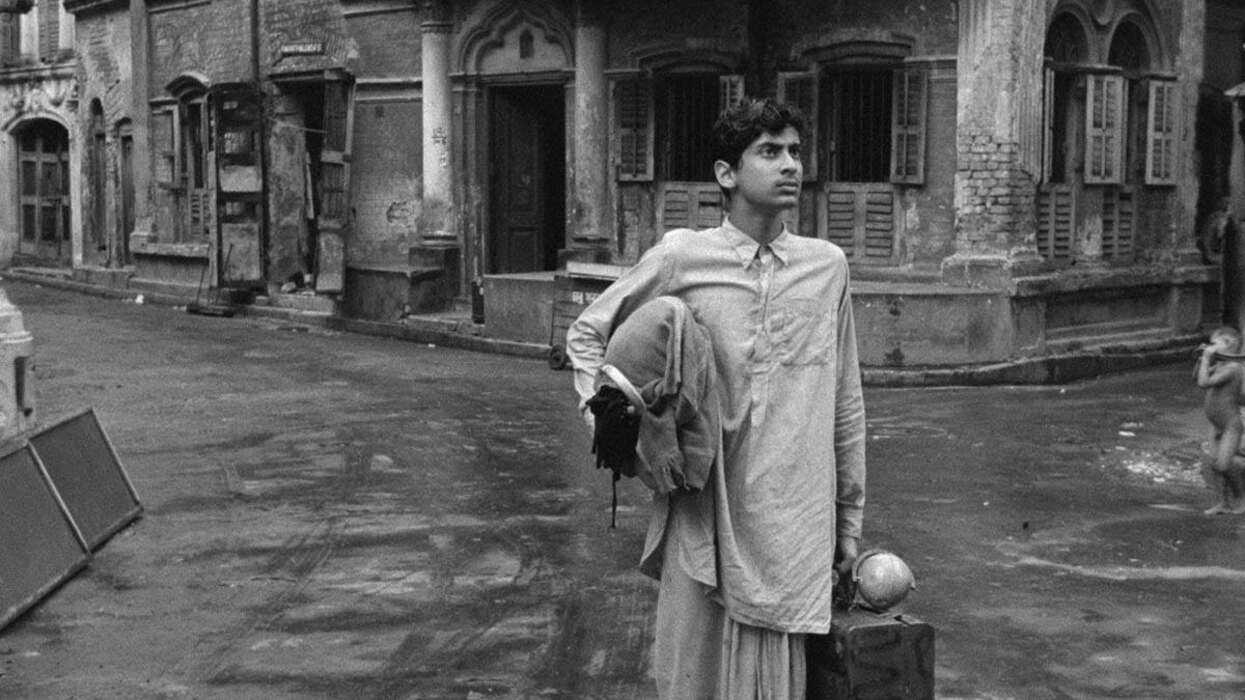
1. Pather Panchali (Song of the Little Road),1955
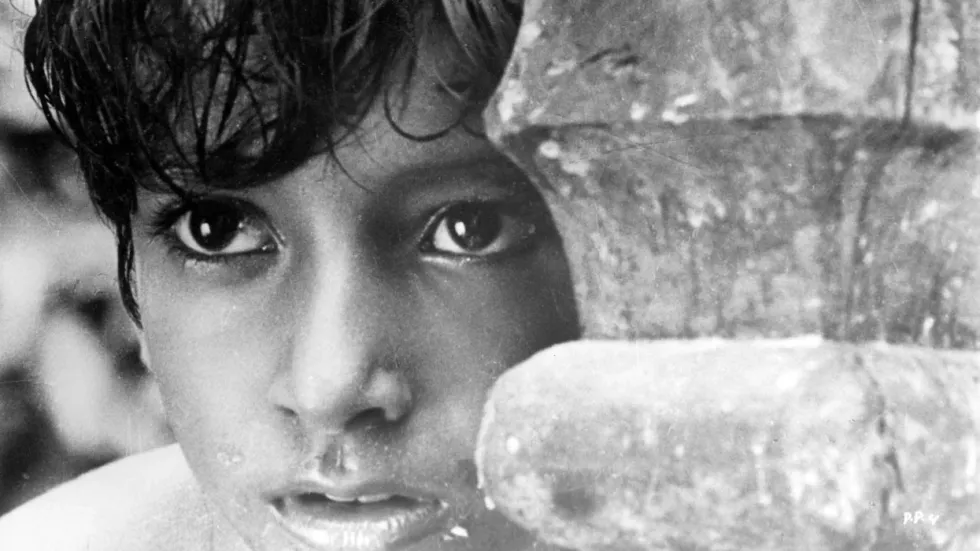 'Pather Panchali'Credit: Aurora Film Corporation
Ray’s first film and the opening of “The Apu Trilogy,” Pather Panchali, is set against the backdrop of rural Bengal. Harihar (Kanu Banerjee), a priest and teacher in the village, and his wife Sarbajaya (Karuna Banerjee), a simple housewife, live with their two children, Apu and Dugga, and their cousin, Indira (Chunibala Devi), at their ancestral house, in their native village in Bengal.
The family is impoverished but lives a dignified life. Desperate to make ends meet, Harihar leaves for the city in search of a job. But when he returns home a year later, seemingly prosperous and in control of his life, things have changed.
The film shifts between Durga and Sarbajaya's perspectives and ends from the POV of the youngest member of the family, Apu (Subir Banerjee).
The beauty of this film lies in its simplistic visual language—it not only paints a picture but does it in a way that transcends across cultures.
Panther Panchali ends on a note of harsh reality—a loss that will linger in their story forever. All this and so much more are presented in black-and-white visuals and a linear narrative.
Despite being Ray’s first film, the emotional nuance in every frame is transcendental. The production has many technical glitches due to resource limitations, but even then, it’s flawless in the truest essence of cinema.
Arguably, this is pure cinematic poetry—his best film for pure, unhindered storytelling. Pather Panchali is not an intellectual drama or a story for a niche audience. It is for everyone.
2. Aparajito (The Unvanquished), 1956, and Apur Sansar (The World of Apu), 1959
The next two films in the trilogy follow Apu through the intimate nuances of a man’s life, in different phases, as he grows up.
In Pather Panchali, Apu was just 10 years old; in Aparajito, the teenager (now Pinaki Sen Gupta) grows up to become a fine adolescent (now Smaran Ghoshal).
In Apur Sansar, we witness Apu’s (now Soumitra Chatterjee) growth as a provider, a husband, and a father.All three films are masterpieces, but Pather Panchali is my favorite.
3. Charulata (The Lonely Wife), 1964
Another black-and-white film by Ray, this is a technical masterpiece—from the narrative to the presentation, everything is spot on. Charulata is the name of the lonely wife, the protagonist.
Adapted from Rabindranath Tagore’s renowned novella Noshto Nir or The Damaged Nest, the film is a beautiful rendition of two of the most complex human emotions—love and loneliness.
Charulata (Madhavi Mukherjee), a lonely housewife of a newspaper editor, Bhupati (Shailen Mukherjee), falls in love with her cousin-in-law Amal (Soumitra Mukherjee), who shares her love for literature.
The story is even more emotionally delicate, since in Bengali culture, it's natural and expected of a married woman to share a bond of friendship and companionship with her cousin-in-law, especially since they’re usually peers.
The film is set in 1870s British India, and every sequence is filled with allegories and symbolism—be it the production design, background score, songs, dialogue, or costumes. The narrative is vulnerable, and Ray's presentation of a female character is fresh and real.
There’s no way a film lover should miss Charulata.
4. Aguntuk (The Stranger), 1991
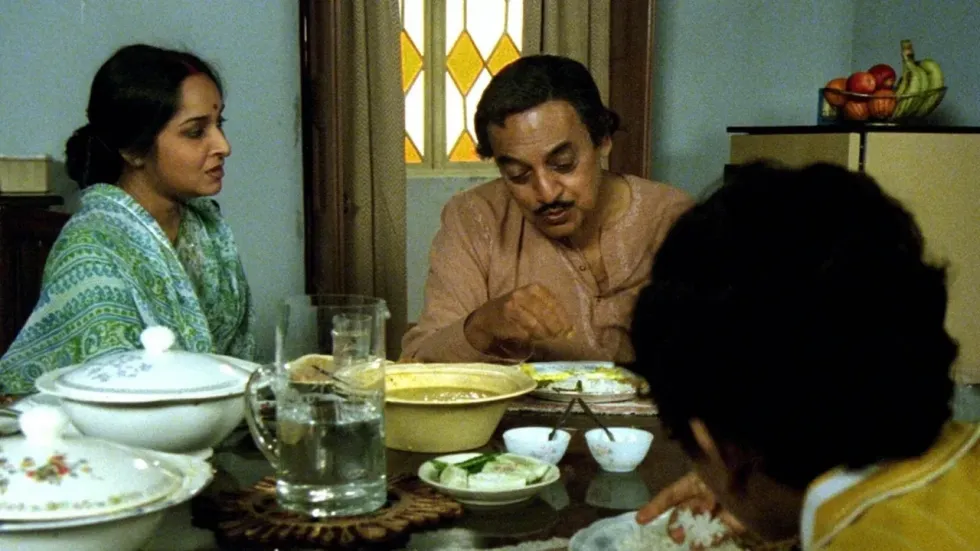 'Aguntuk'Credit: Artificial Eye
Ray’s films have always highlighted socio-political aspects, be it Pather Panchali, Ashani Sanket (Distant Thunder), or Mahanagar (The Big City).
Aguntuk is an attempt to voice everything that he believes about man and society directly.
The story is simple: Anila Bose (Mamata Shankar), a resident of South Calcutta, receives a letter from a long-lost uncle, Manmohan Mitra (Utpal Dutt), informing them that he’s coming over to stay at their house for a couple of days.
Despite being skeptical about the man’s real identity, when he eventually does show up at their door, Anila decides to welcome him into her home out of sheer politeness.
The story is a profound opportunity to discuss identity, faith, trust, religion, nationalism, art, science, literature, and travel. In the backdrop of a living room discussion, the filmmaker beautifully depicts the complexities of the human mind.
5. Goopy Gyne Bagha Bayen (The Adventures of Goopy and Bagha), 1969
Both as an author and a filmmaker, Ray had made it a point to create content for the kids, too. Goopy Gyne Bagha Bayen may be for kids, but when it was released in 1969, even adults flocked to the theaters.
The film packed houses in Bengal for a record of 51 weeks. At the time, it was Ray’s most commercially successful film. Adapted from the short story by the same name, written by his grandfather, Upendrakishor Ray Chowdhury, this film is an utter fantasy. It launched nostalgia for more than two generations in Bengal, and it is a cult classic.
A poor farm boy with a penchant for terrible singing, Goopy (Tapen Chatterjee), is banished from his kingdom after he disturbs the king’s sleep. As he wanders in search of refuge, he meets a boy from another village, Bagha (Rabi Ghosh), who was also banished owing to his terrible drumming skills.
The two embark on a journey, continuing their “terrible” music, until one night, they witness a bizarre dance by the king of the ghosts (Prasad Mukherjee). The ghost king grants them three powers: teleportation, unlimited food, and unprecedented musical skills. Blessed by the ghost, the two arrive at Shundi to participate in a music competition. But unbeknownst to all, Shundi is under the threat of war.
What follows next is a hilarious turn of events, in which Goopy and Bagha manage to avert the war with their new magical powers and get married to the princesses of the kingdom. The film is a light-hearted political satire. Ray also composed all the music and songs in this film.
6. Devi (The Goddess), 1960
Devi was one of Ray's most controversial films. For the first time, he directly challenged Hinduism. Protestors even tried to get the film banned and prevent its international release, but eventually, the film made it to the screens and won a government award, the President's Silver Medal for Best Feature Film in Bengali.
Set in the 1860s rural Bengal, at a time when women in Bengal were married off at a tender age, young Doyamoyee (Sharmila Tagore) lives with her in-laws after her marriage. Her husband, Umapada (Soumitra Chatterjee), pursues his academics in Calcutta. Her father-in-law, Kalikinkar Roy (Chhabi Biswas), an aging patriarch and widower, is an ardent devotee of the Goddess Kali.
All is well until one day, Kalikinkar dreams that his youngest daughter-in-law is a reincarnation of Kali. Things take a nasty turn when, blinded by his faith, the old man starts worshipping Doyamoyee as a god.
Over his five-decade career, Satyajit directed 36 films, including shorts and documentaries, each one a stunning piece of art. But to call him merely a filmmaker would be an understatement. The man was also an author, advertiser, illustrator, calligrapher, composer, and even a cinematographer in the later part of his career—Satyajit Ray personified art.
Did you know that the original negatives of Apu's trilogy were severely damaged in a massive fire set off by a nitrate explosion at Henderson's Film Laboratories in South London in 1993?
The negatives had just arrived from India and were on their way to LA for preservation when a fire damaged many of Ray’s films. However, the Academy decided to preserve everything and slowly restored the negatives over a span of 20 years. In 2015, the trilogy was rereleased in 4K with subtitles.
Akira Kurosawa once said, “To live without seeing [Ray’s] films means existing in the world without seeing the sun or the moon.”
Let us know which of these you’ve seen!