5 Lessons from 5 of Steven Spielberg's Favorite Films
The movies Spielberg keeps coming back to.
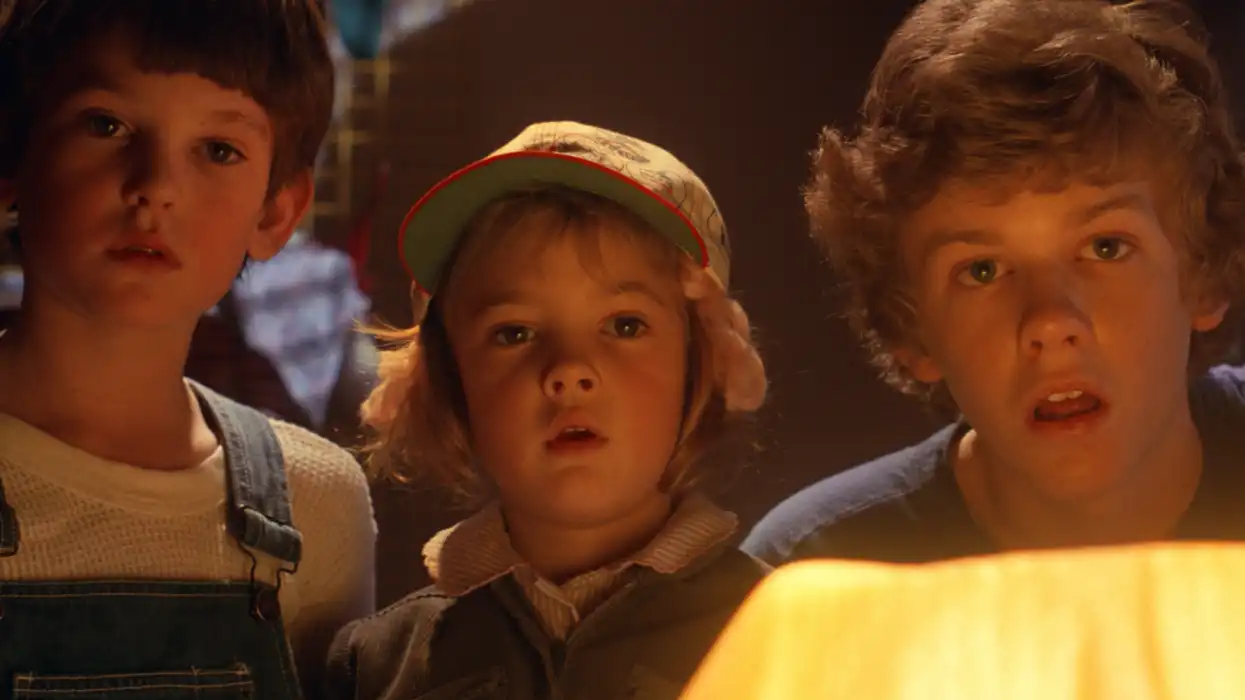
'E.T. the Extra-Terrestrial'
Steven Spielberg's Disclosure Day hits theaters June 12, which means the man is top of mind right now. And when we think about Spielberg, we think about a career that spans Duel to Schindler's List to Jurassic Park without a decade of coasting. But what keeps him going?
He recently said he still watches Lawrence of Arabia once a year on 70mm just to "stay humble." And he once told NPR:
I didn't go to film school. And I was self-taught, but I had great teachers. You know, all my influencers were the directors and the writers of the movies I was watching in theaters and on television. And my film school was really the cultural heritage of Hollywood and international filmmaking, because there's no better teacher than Lubitsch or Hitchcock or Kurosawa or Kubrick or Ford or William Wyler or Billy Wilder or Clarence Brown. I mean, Val Lewton.
This self-education produced one of the most prolific and commercially successful careers in Hollywood history, including three Academy Awards and films that have collectively grossed billions.
Spielberg has been vocal over the years about the specific films that shaped him, and in some cases, what they did to him.
We picked five of his many favorites to see what we could learn. Here's what he said, and what we can take from it.
Lawrence of Arabia
- YouTube www.youtube.com
Spielberg was a teenager in Phoenix when David Lean's epic opened. He wrote about the experience in an essay for Empire in 2021. "It was a swanky theatre with 70mm projection and stereophonic sound, and the loge-style seating in the smoking section would rock back and forward as you sat back in your chairs. But Lawrence of Arabia never gave me the chance to test how the chairs worked, as I sat bolt upright for the entire film."
He loves the contrast between the enormous desert battles and quiet character moments, the famous mirage scene alongside Lawrence's private identity crisis. Lean never let scale swallow the human story underneath it.
That tension between the huge and the personal runs through almost everything Spielberg has made. Think the shark in Jaws, the mothership in Close Encounters, the beach landing in Saving Private Ryan. Big moments land hardest when the audience already cares about the person standing in front of them.
"Certainly Lawrence of Arabia was the film that set me on my journey," he told AFI. "I look at that picture as a major miracle."
If you want to understand how editing choices serve that balance, the match cut that opens Lawrence (a blown-out flame dissolving into a desert sunrise) is one of the most instructive two seconds in cinema history.
Citizen Kane
- YouTube www.youtube.com
Spielberg has called Citizen Kane "an icon of courage." He told AFI, "I'm talking about the courage of the filmmaker—the audacity. It's about courage and audacity, and 'I'm making this my way.'"
Welles was 25 years old on his feature debut. RKO handed him total creative control, and he used it to invent techniques nobody had tried before, like deep focus photography, ceilinged sets, a non-linear structure that confused and irritated audiences in 1941.
Technical choices and storytelling choices are the same choice. Welles deepened the focus because the story demanded it. He showed ceilings because the space told you something about power. Every decision pointed back to the work. That's what Spielberg took from it.
The Godfather
- YouTube www.youtube.com
In the bonus features of The Godfather: The Coppola Restoration, Spielberg said, "I was pulverized by the story and by the effect it had on me, and I also felt that I should quit. There was no reason to continue directing because I would never achieve that level of confidence in the ability to tell a story such as the one I had just experienced. So, in a way, it shattered my confidence."
He was 26. Duel had come out the year before. And The Godfather made him feel like a beginner.
Being destabilized by someone else's film means you recognized something you didn't know how to do yet. Gordon Willis's cinematography alone was a lesson in how darkness can carry moral weight that no amount of dialogue can.
Spielberg went on to call The Godfather "the greatest American film ever made" at the 2025 AFI ceremony honoring Coppola.
Three years after watching The Godfather and wanting to quit, he made Jaws. If a film makes you want to be better, that's the film to study.
The Searchers
- YouTube www.youtube.com
Of all the films Spielberg returns to, John Ford's 1956 Western is the one he describes almost as a compulsion.
"I have to look at The Searchers," he told AFI in 2013. "I have to—almost every time."
He's drawn to Ford's relationship with the frame itself.
"I'm very sensitive to the way he uses his camera to paint his pictures and the way he frames things, and the way he stages and blocks his people, often keeping the camera static while the people give you the illusion that there's a lot more kinetic movement occurring when there's not. So in that sense, he was—he's like a classic painter, and he celebrates the frame."
The famous doorway shots in The Searchers tell you a great deal about Ethan Edwards' relationship to civilization. If you're a filmmaker thinking about shot design, the takeaway is to treat the edges of the frame as seriously as the center. Where you put the horizon line is a choice. What you leave out is a choice.
2001: A Space Odyssey
- YouTube www.youtube.com
Spielberg has talked about his first encounter with Kubrick's 1968 film in almost spiritual terms. In James Cameron's Story of Science Fiction on AMC, he said, "2001 had a profound impact on my life and my daily life. It was the first time I went to a movie and really felt like I was having a religious experience" (via Far Out).
Kubrick demonstrated that a film could bypass rational explanation entirely and operate on something more primal. 2001 is slow, abstract, and deliberately withholding. Almost half an hour passes before anyone speaks. It doesn't explain itself. It doesn't resolve cleanly. And it has never stopped resonating.
The lesson for filmmakers is that your audience is smarter and more patient than the industry tends to assume. Kubrick trusted them completely, and they rewarded that trust by returning to the film for six decades.