Kirk Douglas Had One Rule for Working with John Wayne
And it can tell us something about collaborating in film.
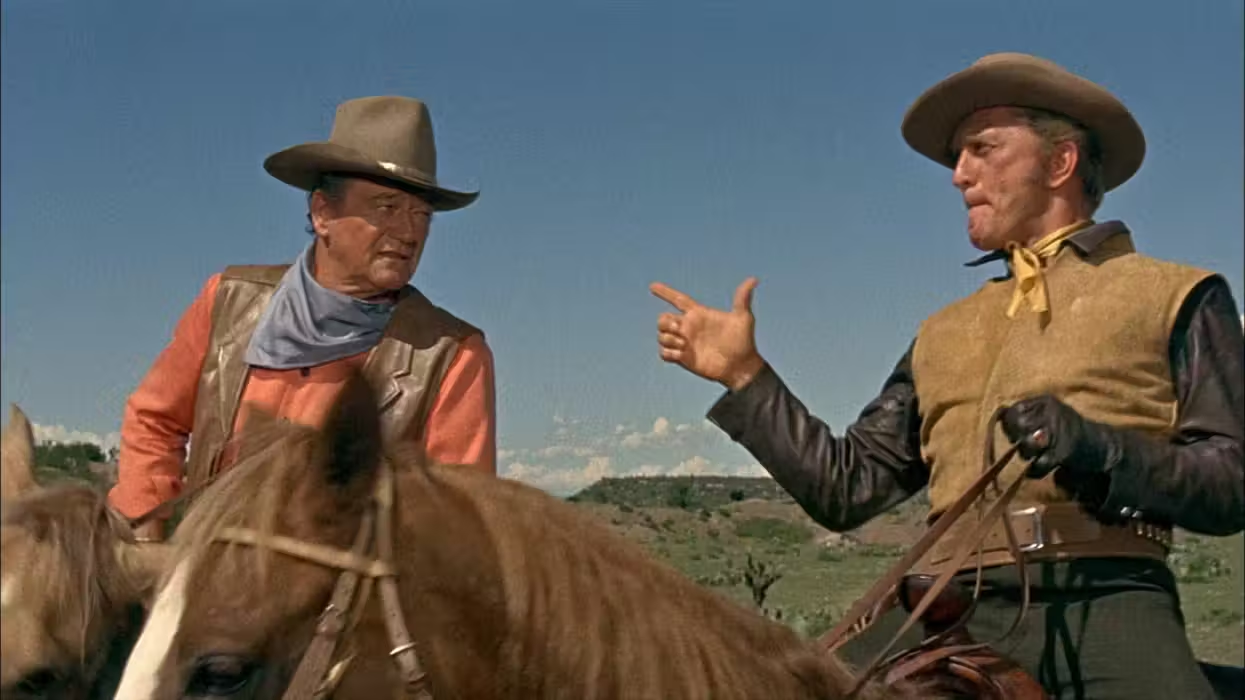
'The War Wagon'
On June 29, 1971, the inimitable Kirk Douglas sat across from Dick Cavett and, in the middle of a probing line of questioning, refused to take the bait.
Cavett had just read aloud from John Wayne's now-infamous Playboy interview (the one where Wayne made racist comments about Indigenous Americans) and pointed the question at Douglas, who had worked with Wayne on three films by this point and disagreed with him on what sounds like nearly everything.
Douglas' response was a model of restraint.
"I don't want to get involved in a conversation about John Wayne," he said on the show. Then he did something more interesting. He talked about what it actually looked like to work alongside someone whose worldview you found genuinely objectionable.
- YouTube www.youtube.com
Wayne and Douglas Should Not Have Gotten Along
The Douglas-Wayne political divide wasn't a minor difference of opinion.
Douglas, a liberal Democrat, was instrumental in breaking the Hollywood blacklist. His insistence that screenwriter Dalton Trumbo be credited under his own name for Spartacus helped crack open one of the ugliest chapters in the industry's history.
Wayne, meanwhile, was one of Hollywood's loudest anti-communist voices, a vocal supporter of McCarthyism, and a lifelong conservative Republican. These were not men who were going to find much common ground in their day-to-day interactions.
The tension had a specific on-set flashpoint. During production of The War Wagon, Douglas reportedly arrived late to set one day because he had been filming a campaign commercial for Edmund G. Brown, the Democratic Governor of California.
Wayne was said to be furious and made his own pointed statement by turning up late the next day, fresh from shooting an ad for Brown's Republican opponent, a fellow actor named Ronald Reagan (via The Mirror).
They had two other films under their belts by then (Cast a Giant Shadow and In Harm's Way). The political friction was apparently a constant.
How Did Douglas and Wayne Make It Work?
Working in film and TV is obviously highly collaborative, bringing together dozens to hundreds of people for a common goal. There's a pretty good chance you, like these two titans, will run into someone with perspectives that differ from yours.
Rather than let it blow up the collaboration, Douglas and Wayne developed a simple system, which Douglas described to Cavett directly as just... keeping their distance.
They didn't socialize on set. They didn't debate. Over the course of each film together, they made a point of having dinner exactly once. One carefully managed evening where they actively steered clear of anything that could ignite a real argument.
"Whenever we worked on a picture, we rarely—maybe we'll have dinner together one night during the whole picture," Douglas said on Dick Cavett.
After that, they kept things professional and got back to work.
It sounds almost comically disciplined, but it held. "We get along very well," Douglas told Cavett. "We never discussed politics."
The rule allowed them to deliberately decide that the differences didn't have to define the working relationship. For anyone thinking about how collaboration functions under pressure, this is a pretty clean example.
What Wayne Thought of Douglas' Choices
The restraint had limits.
Wayne was never shy about his opinions. Kirk was featured heavily in Conversations with Classic Film Stars by journalists James Bawden and Ron Miller, and he tells a story about Wayne critiquing one role (via Express). He cornered Douglas after a screening of Lust for Life, in which Douglas played Vincent van Gogh.
"Afterwards, he motioned to me to go out on the veranda with him, and he berated me! He said, ‘How the hell could you play a goddamn character like that?'"
When Douglas pushed back and said van Gogh was a fascinating character, Wayne wasn't persuaded.
"And Wayne said, ‘No, no. We should never play those kinds of weak, sniveling characters. I don’t ever want to see you in a part like that again! They have no dignity!'"
Wayne's theory of screen performance was essentially that an actor's job was to model dignity and strength, an idea that put him at odds not just with Douglas' choices, but with the morally ambiguous characters reshaping American cinema in the same decade.
Douglas' response said everything: "I'm an actor. He's a fascinating character."
What This Teaches Us
Despite all of it, the politics, the set confrontations, the lecture about van Gogh, Douglas kept working with Wayne. Wayne was actually the one who recruited him for Cast a Giant Shadow, calling Douglas in London to tell him there was a part he ought to play, per Far Out Magazine.
What held it together, Douglas told Cavett, was the professionalism.
"He's the first guy on the set. He's the hardest worker I've ever worked with."
In a context where personality conflicts can derail productions and poison sets, Douglas was watching a man show up, do the work, and take the job seriously, regardless of what either of them thought about California's gubernatorial race. That kind of on-set professionalism is important.
There's a tendency in filmmaking circles to treat personal alignment as a prerequisite, to assume the best collaborations happen between people who share sensibilities, politics, aesthetics, and worldviews. Sometimes that's true. It's great if you find a creative partner like that. But the reality is that you can't agree with everyone all the time.
The Douglas-Wayne working relationship shows that professionalism, applied with real intention, can hold a collaboration together across enormous differences.
The key is that both men had to choose it. They built a working relationship that didn't require agreement on anything outside the frame, and the result was three films, including one of the better Westerns of that era.
For directors and producers managing sets where personalities don't align (which is, let's be real, most sets) it's a useful model. You can't always control who people are off-camera. You can try to create the conditions in which the work comes first.
Douglas and Wayne figured that out by having dinner once per movie and keeping their mouths shut the rest of the time. There are worse systems.
- The Clint Eastwood Classic That Became John Wayne's Biggest Career Regret ›
- The Doorway to Nowhere: Why the Final Shot of ‘The Searchers’ Still Haunts Us ›
- The John Wayne Quote From a 1968 War Movie Classic That Redefined the War Genre (In a Bad Way) ›
- 10 Lines That Made John Wayne a Hollywood Legend ›
- The 'Hondo' Line That Defines the Western Hero ›