Inside Guillermo del Toro’s Secret to Filming Underwater Without Water
Uncovering how Guillermo del Toro shot underwater scenes without any water.
'The Shape of Water'
The Shape of Water was nominated in thirteen Oscar categories at the 90th Academy Awards and swept away four, including Best Picture and Best Director. At its core, it is a defiant middle finger to conformity, and had us rooting even for something that is seemingly absurd: the love story between a mute janitor and her “fish-man.” To me, this underwater love story is a magnificent genre-blending piece of cinema that stands as a powerful allegory for marginalized communities and societal outsiders.
The film is a testament not only to Guillermo del Toro’s visual genius but also to his technical acumen. Backed by a talented cinematographer such as Dan Laustsen and a celebrated VFX studio such as Mr. X, The Shape of Water is a masterclass in visual innovation and visceral storytelling. Take, for instance, the opening scene of the movie: an underwater scene shot without any water!
In this article, we’re diving deep into the behind-the-scenes of the opening scene in Guillermo del Toro’s Oscar-winning The Shape of Water.
The Opening Scene
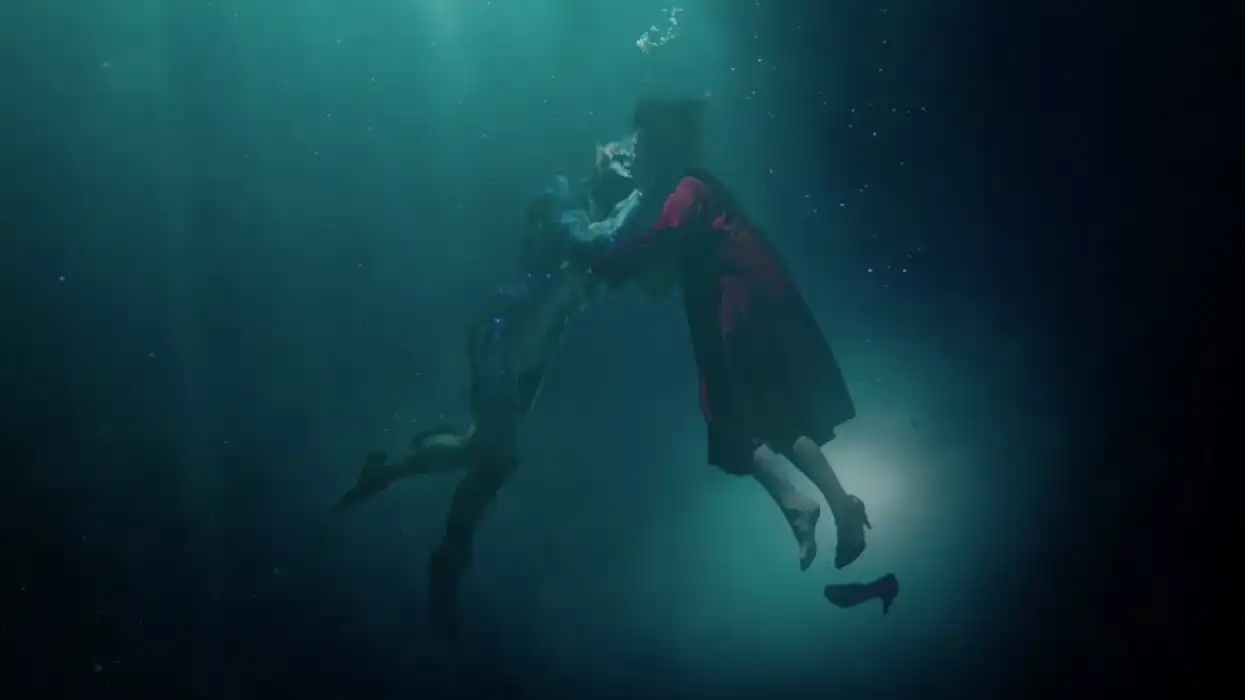
The underwater scene presents the opening credits. The screen fades in from black, and we are on a riverbed. The camera glides on, taking us towards an apartment, through a narrow passage. The apartment is dimly lit with the furniture floating around. The camera takes us through the apartment and stops near a bed that's also floating. On top of it, we see a woman (Sally Hawkins) fast asleep. As the camera glides past her, the bed slowly settles down onto the riverbed. We glide towards the side table, which has a vintage table clock and a lamp on it. The entire scene is backed by the voice-over of the Amphibian man (Doug Jones).
Behind the Scenes of The Shape of Water’s Opening Credit Scene
You’ll be surprised to know that only the scene where Elisa and her amphibious lover make love in her submerged washroom was shot underwater. The rest of the film used “dry-for-wet” techniques to create the illusion of being underwater.
What is the Dry-For-Wet Technique In Filmmaking?
A boon for filmmakers, this technique is used when shooting in water or underwater becomes a challenge. The technique involves creating an underwater simulation with the use of sound and atmosphere, further augmented to match realism with visual effects. Distinguished filmmakers such as James Cameron in Titanic, Peter Jackson in The Lord of the Rings: The Two Towers, Steven Spielberg in A.I.: Artificial Intelligence, John McTiernan in The Hunt for Red October, and John Glen in For Your Eyes Only, are just a few who have used this technique.
The Use Of The Dry-For-Wet Technique in The Shape of Water
The Shape of Water cleverly blends digital effects with dry-for-wet techniques to bring del Toro’s vision to life. Laustsen, in collaboration with Mr. X’s animation supervisor, Kevin Scott, planned the complete execution of the filming of the sequence.
- YouTube www.youtube.com
Quite a lot of research went into the sequence. At first, a few references were shot in Georgian Bay, and del Toro liked the outcome, but wanted the flexibility to design the motion of the swimming fish and underwater lake grasses like it was a dance. So, it was creatively decided to add these elements digitally.
Laustsen used smoke under beams of caustic light to simulate the water’s ripple effect underwater. According to Dennis Berardi, CEO of Mr. X, “Guillermo wanted to imply that the amphibious man can’t live in regular water. Therefore, we had that green organic water with the organic mass and debris that he needs to survive; that complicated the water simulation a lot because all of that stuff needed to move and swirl around and be displaced by the swimming motion of the amphibious man.”
Del Toro was even extremely particular about Elisa’s hair when she is submerged underwater. So, even her hair and its movements are digitally augmented. In fact, her hair was pinned so that it didn't show much in the shots. Later, the hair movements in her underwater scenes were carefully choreographed by the VFX team, strand by strand, to create a visual reminder of the underwater reeds. The VFX team did tons of photo surveys to understand Hawkins’ hair and worked in close collaboration with the hair and makeup team to groom her hair to match del Toro’s vision. They even ran a Houdini hair simulation algorithm to get it accurate. For the set, the floating props and set pieces were hung on monofilaments to create an illusion of levitation. Finally, particulates, bubbles, and fish were added to the sequence digitally.
The dry-for-wet technique is a boon for filmmakers when shooting underwater, as it can be cost-effective in some cases and definitely safer for actors. That being said, scenes requiring actual interaction with water, such as splashing, might be a little more challenging to render.
Have you heard of the dry-for-technique before, and would you use it?
- 5 Lessons From the Guillermo Del Toro Interview with the Coen Brothers ›
- Learn the "Art of Sound Design" from Guillermo del Toro's 'Pinocchio' Sound Designer ›
- Top Guillermo del Toro Movies You Need to Watch Right Now ›
- Guillermo Del Toro on Writing, Directing and the Essence of Being ›
- Guillermo Del Toro's 11 Rules for Becoming a Visionary Filmmaker ›
- Guillermo del Toro’s 4 Steps to Creating Memorable Movie Monsters ›
- Guillermo del Toro and Oscar Isaac Are Already Planning Their Next Film | No Film School ›