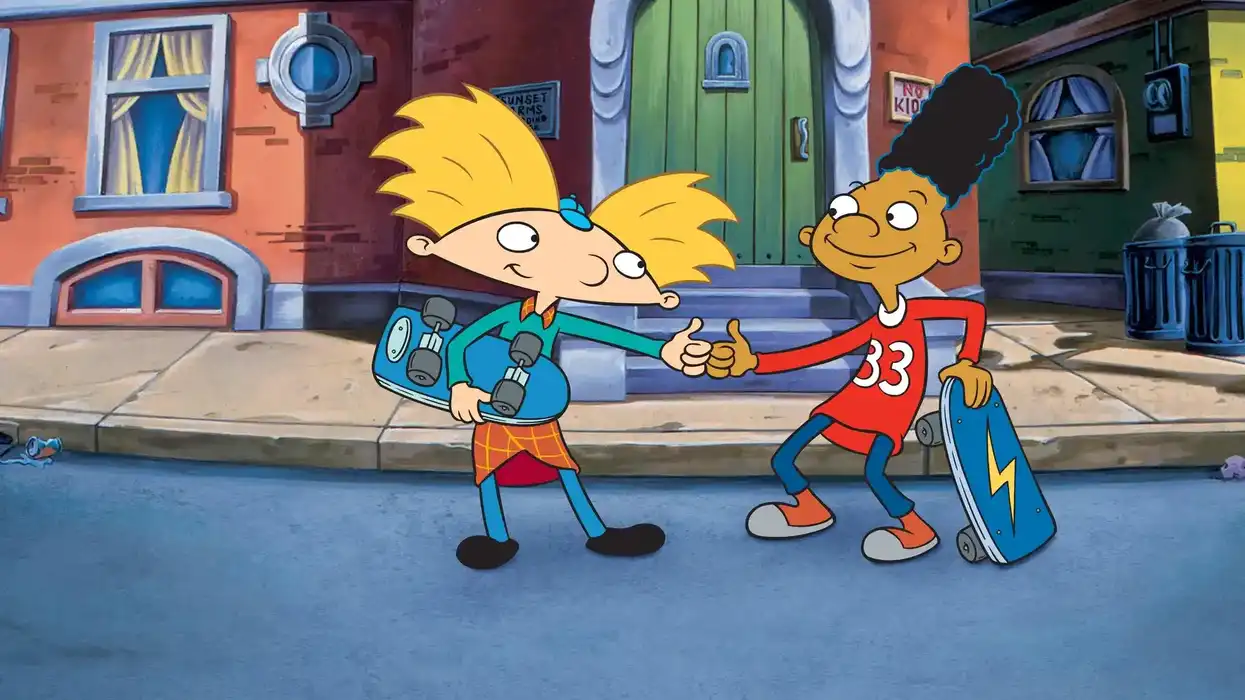
If you can instantly hum the smooth, city-block jazz of Hey Arnold!, you already know the work of Jim Lang.
For decades, Lang's compositions have given animated worlds their unique sonic heart, creating scores that are not just background music, but essential parts of the story's character and emotional core.
From introducing a generation to jazz with Arnold's stoop-kid chronicles to building brand new sonic palettes for Disney's Primos and the educational series The Weather Hunters, Lang has mastered the art of telling stories with sound.
But how do you create a distinct identity for a new series from scratch? What makes a score resonate with audiences decades later?
We sat down with Lang to discuss his creative process, the evolution of his tech toolkit, and the simple power of a good conversation in a spotting session.
Let's dive in.
- YouTubewww.youtube.com
NFS: When starting a new series like Primos or Not a Box, how do you go about creating a distinct sonic palette that feels true to the show while staying fresh across episodes?
Jim Lang: I really enjoy the task of creating a unique musical voice for every project. For animated shows like Not a Box or Primos, I work mostly in-the-box, so the first step in my process is often browsing for new sound libraries or plug-ins that might be useful. It’s a guilty pleasure — kind of like getting a new wardrobe for a world tour.
In the case of Not A Box, the brief was to avoid synth sounds and traditional orchestration, so I needed to find sounds that would do the jobs of traditional instruments. It was pretty challenging to find something to replace strings, for example.
I ended up using a sample of a whirly tube toy for those sustained tones. I also snuck a little Hammond organ in from time to time, but I was pretty good at sticking to a very limited palette.
For Primos, the opposite was true. Apart from the myriad influences that organically crop up in the storyline, the show was chock full of references to other shows and genres. Natasha Kline, the show’s creator, was constantly having to school me on this or that allusion that went over my head. (Apparently, there are a few holes in my pop culture consumption.)
NFS: Looking back, why do you think the Hey Arnold! score still resonates so strongly with audiences decades later?
JL: I’ve heard from so many young musicians over the years that Hey Arnold! was their first introduction to jazz, which is both humbling and a little surreal. I’ve never really thought of myself as a jazz musician, but in that score I was able to channel composers and players I grew up loving—Gershwin, Monk, Wes Montgomery, Stan Getz, and so many others. To know that little moments in the score sent people down their own path of discovering jazz—or even picking up an instrument themselves—is incredibly gratifying.
I’ve also received really touching emails from people who found Hey Arnold! during a rough patch in their lives. Sometimes it was family struggles, sometimes school, sometimes just feeling out of place. I like to think these folks experienced the show as a kind of surrogate family—where the cluelessness of some of the adult characters mirrored their own experiences, and where Arnold quietly modeled how to live with that. Never in a preachy way, just as a kid who was trying to do the right thing.
 Jim Lang Credit: Impact24
NFS: On a project like The Weather Hunters, what role can music play in helping young viewers both learn and stay emotionally engaged?
JL: The Hunter family (hence Weather Hunters) is at the heart of every episode, and the score plays a big role in supporting their sweet family dynamic. I lean a lot on the Wurly (Wurlitzer electric piano) and the B3 (Hammond organ) to underscore their interactions—and to land Al’s dad jokes. Their house also carries a sense of legacy: it once belonged to great-grandfather Wallace, who was a meteorologist for the Tuskegee Airmen. That history weaves its way into the music, too.
I like to sprinkle in little phrases and stings throughout the score to spotlight the science ideas. Lily, the young aspiring meteorologist, uses a special pair of glasses- her “Flex Specs” and tablet to track her observations, so I use a similar score for her interactions with the glasses and the images that pop up on her screen. At the same time, Al Roker—who created the show and also plays the dad—asked for some West African influences in the score to honor his ancestry. I’ve used that as a foundation for montage sequences and playful beats.
And then there are a few special episodes that call for something bigger—whether it’s evoking a strong sense of place or highlighting an extraordinary historical story. Those moments get the extra lift of a “big screen” kind of score.
NFS: How does your creative approach differ when composing a show’s main theme compared to the underscore that carries the story moment to moment?
JL: A major difference is that theme songs are essentially pop songs, so they can be really banging- no need to avoid the dialog! I don’t always get to do the theme song, but when I do, I like to make it sound like the rest of the score- so that people immediately identify it with the show.
If there are words in the theme song, one approach is to deliver a lot of information about the show: character names, plot information, and the like. Another approach is to just make the song fun and catchy. I think that is more my jam…
NFS: From your perspective, what do filmmakers and producers do that makes the composer’s job easier – or harder – when shaping the score for a project?
JL: One thing that comes to mind is spotting – the process of watching a piece with the director or showrunner and figuring out where the music should go and what it should be doing. Over the years, that practice has mostly disappeared from the projects I’ve worked on, and I really miss it. For one, having an actual conversation about the music tells me so much more than a page or two of notes ever could. Just a little bit of face time, with the chance to ask questions, is incredibly helpful in narrowing in on what the score should really be. And second, once the editors have laid in temp music, spotting gives me the chance to sort out which music is genuinely working for the director or producer, and which parts are just filling space, or maybe not working at all.
On Primos, for example, Natasha Kline had so much on her plate that spotting just wasn’t possible. Luckily, one of the editors, Andrew Sorcini, cut together this wonderfully detailed – and very funny – temp score that worked as excellent spotting notes. His choices and timing had a huge influence on the final shape of some of the wilder parts of the score.
What I love most about my job is the collaboration. When I get to work closely with one or two other creatives, that’s when the best ideas really come to life. On a series, it’s not often that I get to sit down with a showrunner or producer and watch a first draft together, so that’s where notes really matter. Good notes can make all the difference. Dete Meserve, our EP on Weather Hunters, is such a great example – her notes are always clear, thoughtful, and easy to put into action.
Of course, sometimes the notes come from a lot of different people, and they don’t always agree with each other. That can definitely be challenging. What helps me is trying to listen closely and stay true to my own instincts, figuring out what someone might be feeling (even if they can’t quite say it) and then finding a way to address it in the score that still feels right to me. With a little patience and openness, there’s almost always a solution that works.
 Jim Lang with the Moog Credit: Impact24
NFS: How has your use of technology (synthesizers, digital audio workstations, sample libraries, hybrid scoring) changed over your career? What tools do you still consider indispensable, and what have you adopted more recently?
JL: Well, for starters, I’m completely self-taught. Didn’t go to conservatory, and was pretty much unteachable as a piano student. But I do have a decent ear, and thanks to a great junior high choir teacher, I became the guy in my high school band who figured out the chords for the songs.
When I decided I wanted to write music for picture, keyboard synthesizers had been around for a while- I had been using a Jupiter 8 and a DX 7 on tour – but scoring was still being done in the way composers had set down music for centuries – with paper and pencil. Then the guitar player in the band I was touring with brought his Mac Plus along on the bus. I remember all of us crowding around and staring in amazement. At MacPaint, of all things…
At about the same time, I remember the issue of Keyboard Player magazine with the word MIDI on the cover. Wait – synths could talk to one another? And to a computer? That totally blew my techno-geek mind. I had always wanted to do what Stevie and Todd Rundgren did: record all the parts of the song that were playing in their head. And now with a Mac, some software, and a few synths, I could accomplish the same thing. Sold!
For me, the Macintosh and DAW software, starting with Performer and Sound Tools and moving on into Digital Performer, Pro Tools, Logic, and Ableton Live, were not only vital tools but teachers. For one example, the ability to see what I could play displayed as both piano roll and notation was revelatory. And even though the notation was very primitive, it helped me to understand music on the page in a way that made it possible to dive into texts about notation and orchestration and eventually to begin to experiment with orchestration on my own.
Over the years, the tools for making music with a computer have if anything, outpaced Moore’s law. For film scoring especially, the advent of multi-sampled orchestral libraries in the '90s and their progeny, performed by world-class orchestral players, has led to synthesized film scores that are indistinguishable from the real thing. All but the highest budget films routinely mix live and sampled orchestra cues, if indeed the budgets allow for live orchestra at all.
The most recent orchestral project I wrote was the 2018 sequel to the Hey Arnold! series, The Jungle Movie. About a third of that score was recorded with a live orchestra, but it is difficult to tell which cues are which.
The most recent tools I’m using and loving (I haven’t yet delved deeply into AI) are sample modeling instruments. These are digital instruments that generate sound based on an algorithmic model of the real instrument. They are very playable and expressive, and the results are much more seamless than what I have achieved with samples. I love using sample modeled trumpet, French horn, tuba, clarinet, bass clarinet, and violin for solo passages and on top of sampled sections.
- How The 'Ride or Die' Composer Uses Music to Terrify You ›
- How Composer David Naroth Brought Music to 'Searching for Amani' ›
- Risk It All For Creativity With Composer Nikhil Koparkar ›
- The Power of the Theme: Why Charlene Soo is Championing Melodic Film Music ›
- Scoring the Tension: An Interview with 'Dirty Hands' Composer Andrew Meehan ›
- "Cinematic Grime," Polyrhythms, and Primal Beats: How Composer Paul Saunderson Scores the Action | No Film School ›
- Why the 'Nimrods' Score Needed to Get Out of Green Day’s Way | No Film School ›