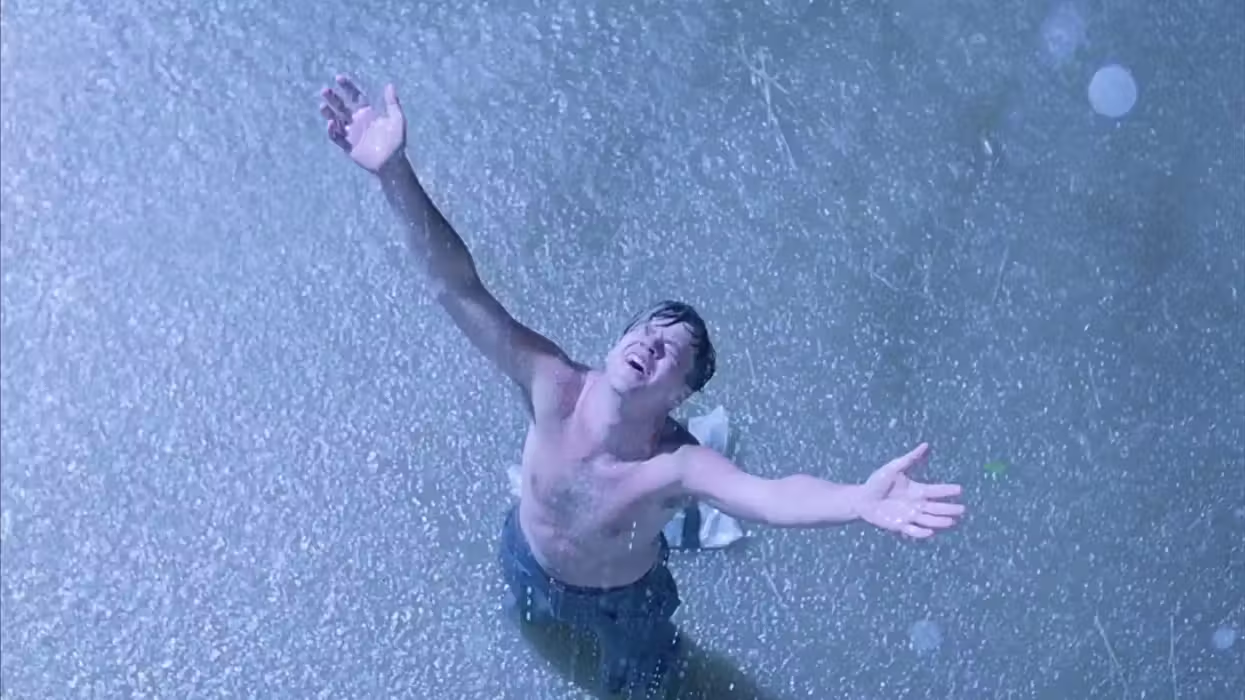
Chances are, if you want to make stuff, you want to work with actors. And let's just say they can be an intense bunch.
Don't get me wrong, I love actors, and I get excited about playing pretend with actors. And they bring a perspective unlike any other to a project as they try to get under a character's skin. Sometimes the questions they ask help you find story issues you never even considered. Sometimes they can help with physical things too, like blocking. Sometimes they have a lot of ideas.
And a recent interview with Tim Robbins is a great reminder of why that advice can be so invaluable.
Robbins recently sat down with GQ to break down his most iconic roles in a GQ "Iconic Characters" video covering Bull Durham, Mystic River, The Player, Silo, and more. There is a ton here, but my favorite part is probably the discussion about one of the best films of all time, The Shawshank Redemption.
Robbins talks about the script that turned him into a bodyguard for the material, a rehearsal disagreement he quietly won, and the trick of playing two emotional truths in one scene.
- YouTube www.youtube.com
"Frank Darabont wrote the best script I've ever read"
It's the thing every writer wants to hear. The actor loved your script. In the case of Shawshank, Frank Darabont wrote something based on Stephen King's novel that immediately hooked Robbins and the rest of the cast.
"Frank Darabont wrote the best script I've ever read," Robbins said. "Shawshank Redemption from beginning to end was nearly perfect. When I read it, I was, 'I'm in.' So, this is a first-time director. 'Well, I'll tell you what, let's get cinematographer approval.' And I was working with [Roger] Deakins on Hudsucker at the time when I was reading Shawshank Redemption. I gave it to Roger. He loved it."
Robbins used the "cinematographer approval" ask as leverage to bring in Roger Deakins, whom he was already working with on The Hudsucker Proxy. A DP with that much experience, he reasoned, could help Darabont as director if he got stuck.
"Roger and I and Morgan [Freeman], when we met, we all talked about how much we loved this script that Frank had written. We decided that we were going to fight for that script. If it was the producers that were going to try to cut days or scenes, we were gonna fight. Even if it was the director that was gonna get in the way of his own work, we were gonna fight."
By 1994, Robbins had a solid decade of work behind him. He'd appeared on TV and co-founded the experimental theater company The Actors' Gang in 1981, which he still runs. Then came a run of prestige work including Jacob's Ladder, The Player as Griffin Mill for Robert Altman (his hero), and The Hudsucker Proxy for the Coen Brothers.
He had leverage to spend, and he spent it deliberately. He knew what he liked and wanted and had the experience to back up those choices.
If you're a writer/director who might bristle at an actor exerting this much control over a project, just know it's probably not diva behavior but someone with the best interests of the project in mind. Sure, it can lead to tension (and there were reported creative differences on set), but honestly it would be weird to agree on everything on a creative endeavor.
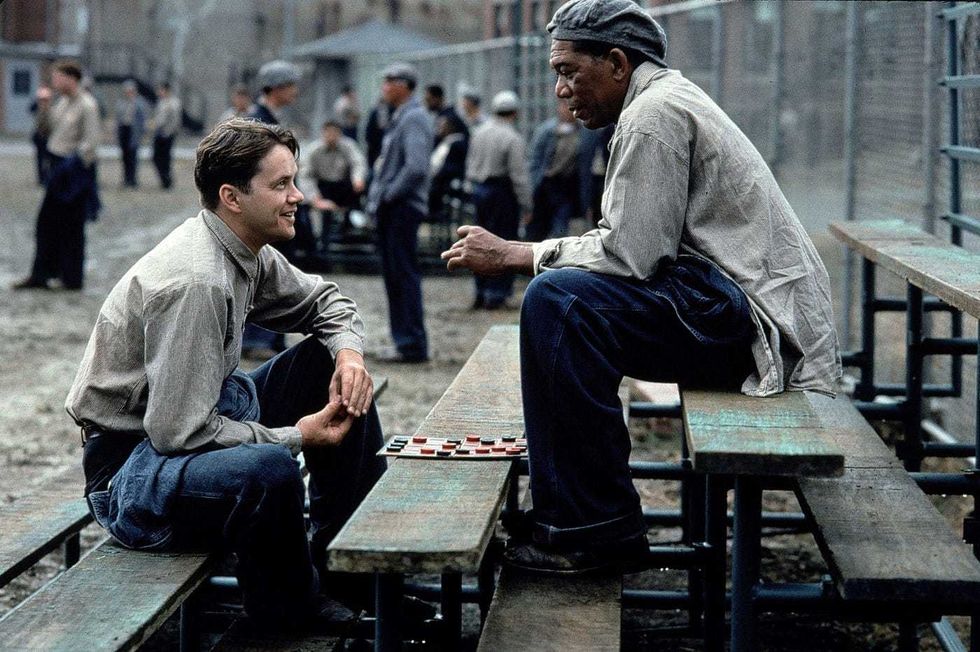 'The Shawshank Redemption' Credit: Columbia Pictures
How Actors Can Help with Blocking
In one pivotal scene in the movie, Andy tells Red he's planning something. It's the famous "get busy living or get busy dying" scene. First-time viewers fear Andy is about to commit suicide. Red, as a character, fears that too. But Andy is actually planning his escape.
Darabont blocked the actors wide and separate. Robbins felt the distance killed the intimacy.
"When we were in the first rehearsal for that, he had us about 10 feet apart. It's a small thing, but it's a big thing. And as an actor, you have to pursue the truth of what you believe is on the page. You have to trust that instinct sometimes. You look at a kind of way to get to that without the conflict. And there wasn't conflict."
The Darabont side of this exchange has been on the record for years. In a 25th-anniversary interview with Empire, Darabont said Robbins was "a very intellectual guy" who "needs conceptual conversation" before a scene, while Freeman was the opposite. Freeman told him, "I just need you to tell me when to stand, when to sit. And do I turn left, or do I turn right?"
Darabont called learning that difference midway through the shoot a "good lesson."
You can see the "10 feet apart" story from both directions. Darabont knew Robbins came in wanting to talk through a scene's intent, which is exactly what Robbins did when he pushed back on the blocking.
Robbins told GQ, "If I'm having a hard time as an actor getting to the truth 10 feet apart, it's kind of my responsibility to fight for what I believe the truth is. And the truth for me of that scene was very intimate, very quiet."
Sometimes a blocking choice or shot you love is a thing your actor can't perform.
Robbins frames it as advocacy through responsibility. He had to say something in service to the material. That's how directors and actors collaborate constructively.
Finding Emotional Truth
As mentioned, there's a ton of subtext in this scene. Andy knows something the audience (and Red) doesn't know. Robbins had to play both readings simultaneously.
"We kind of wanted the emotion that he was feeling at that time to work in the truth of, 'I love this man, and I'm not gonna see him again,' versus what the audience might think was, 'I love this man. I might not see him again because I'm going to kill myself.' Both those truths had to be told at the same time. And so now everyone's fearing that something bad might happen. Morgan's character feels something bad might happen. Nobody is suspecting that he's hiding a secret of a jailbreak."
That subtext lives in the writing but also has to come across visually and in performance. The character is holding one secret (escape), performing another emotion (goodbye), and the audience is reading a third (suicide risk).
All three land because Robbins picked the truest interior emotion, not the one closest to the plot mechanics. It requires a deep understanding of the material if you want to try to direct this in an actor. Try to find that emotional truth in every scene.
Learn more about Andy's character arc in Shawshank.
- Film Quote of the Day: The 'Shawshank Redemption' Line That Gave Us One of Cinema's Most Beautiful Metaphors ›
- The Secret Hero Blueprint Inside 'The Shawshank Redemption' ›
- The 'Shawshank Redemption' Line That Changed How We Think About Hope ›
- From Box Office Struggles To a Cult Classic: How Time Rewrote ‘The Shawshank Redemption’ ›