Film Quote of the Day: The 'Shawshank Redemption' Line That Gave Us One of Cinema's Most Beautiful Metaphors
And how you can use the same method.
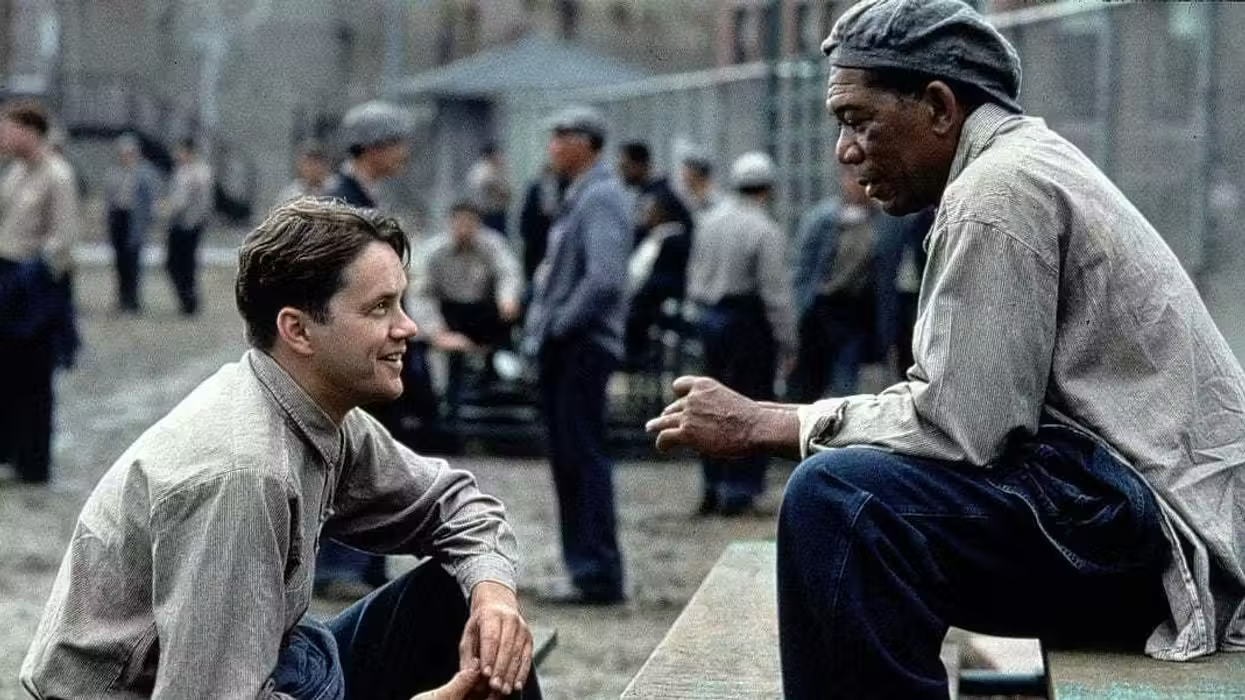
'The Shawshank Redemption'
Frank Darabont's The Shawshank Redemption has so many quotable and inspirational lines, despite being a story about a wrongfully incarcerated character suffering mental and physical abuse in prison. Hope is a good thing. Get busy living or get busy dying. A river of you-know-what.
But there's an underlying sadness to a lot of the characters, and one of the film's strongest lines is a bird metaphor, delivered by Morgan Freeman's Red at the moment the movie could have coasted to a happy ending on the thrill of a successful escape.
Andy Dufresne (Tim Robbins) is gone. He tunneled out through his cell wall in 1966 and left behind a muddy set of prison clothes and a rock hammer worn to a nub. Red is still inside.
Let's look at how he copes.
- YouTubewww.youtube.com
The Scene
After Andy escapes, he leaves behind many beloved friends, including Red. He becomes a legend in Shawshank, with the rest of the prisoners remembering him for his humor and kindness. Life goes on. We see Red adjust to life without Andy, including scenes in the cafeteria and on work duty at the prison cemetery. His voiceover reflects on the friendship:
"Sometimes it makes me sad, though... Andy being gone. I have to remind myself that some birds aren't meant to be caged. Their feathers are just too bright. And when they fly away, the part of you that knows it was a sin to lock them up does rejoice. But still, the place you live in is that much more drab and empty that they're gone. I guess I just miss my friend."
Red Is Still in the Cage When He Says It
This one sometimes gets misremembered as the film's closing narration, but it isn't. Red delivers it in the immediate aftermath of the escape, standing in a prison he has no reason to believe he'll ever leave. He's serving a life sentence, after all. The parole board has turned him down again and again. (The film's actual last narration comes much later, on a bus, and it's the word "hope" repeated.)
The voiceover at this point in the story, with Andy gone, strengthens its impact. A man on the outside describing a bird that flew the coop is just an observation. A man who is still behind the walls saying it is something else. Red is happy for Andy, but devastated too. He's celebrating and mourning at the same time.
Notice the deflation at the end, too. After all that soaring language about feathers and sin and rejoicing, Red states his feelings plainly. "I guess I just miss my friend." The speech reaches for poetry, and then he admits what it was really saying the whole time.
Darabont Planted the Bird Hours Earlier
Red doesn't invent the bird image in this moment. Darabont spent the movie building it.
Brooks Hatlen, the old librarian, keeps a crow named Jake in his coat pocket. He feeds it. He raised it. And when Brooks finally makes parole after decades inside, he takes Jake out to the yard and lets him go before he walks through the gate himself. Then Brooks steps into a world he can't survive, and we watch what happens to a creature released from a cage it had learned to need. We've broken down how Red's "institutionalized" monologue reframes Brooks.
Then there's the music. When Andy locks himself in the office and pipes Mozart across the yard, Red's narration reaches for a bird again.
"It was like some beautiful bird flapped into our drab little cage and made those walls dissolve," he says.
So by the time Red says some birds aren't meant to be caged, we've already seen a real bird imprisoned and released, and heard Red compare Andy to a bird once before.
- YouTubewww.youtube.com
A Metaphor Is a Payoff
Writers tend to treat metaphors as decoration or a way to make a line prettier on the page. But we're not about purple prose around here. We're about utility. Right? And a metaphor that is actually saying something and pays off emotionally is the one we want.
Darabont treats this one as a plant and a payoff, structured like any other reveal in the movie. (The escape works the same way, planted early through a rock hammer, a poster, and a conversation about Zihuatanejo.)
If you were to steal the technique from this one particular example, you might put the image in your story in its most literal form first, where nobody reads it as symbolism. In this case, it's a bird in a prisoner's pocket. Give the audience another version as an abstraction, but familiar enough to make sense. A bird, like music, as a flash of color and life brightening a drab prison day. Then, once the audience has lived with it, hand it to a character under enough pressure that they reach for it, and it makes the most sense. Andy is the bird and has been the whole time.
As he speaks here, Red isn't composing a poem. He's using the nearest available thing to describe his friend because a direct explanation would require him to say something he can't say yet. When a character uses figurative language to avoid a feeling, we lean in. It also gives the film's most argued-over idea, that hope is a dangerous thing, a physical form. Red has spent the movie insisting that hope has no use on the inside. Here he is describing a bird that got out, and he is rejoicing because he knows it was a sin to lock them up.
Who Says It Matters
On the page, this speech could easily go trite. A bad performer might turn it into a platitude. Freeman plays the line honestly, and it pays off for him because it shows how Red as a character has grown. He's been cynical and hopeless, but now he's raw and emotional and misses his friend.
Darabont has talked about how little direction Freeman needed on set, and we've covered what that collaboration taught him about directing. Freeman was narrating a film for the first time in his career here. Isn't that bonkers?
Metaphor is a useful tool, but if you give it to the wrong character, it might not fly.
- How ‘The Shawshank Redemption’ Quietly Set Up Its Ending Long Before the Escape ›
- The 'Shawshank Redemption' Line That Changed How We Think About Hope ›
- “Hope Is a Dangerous Thing”: The Soul of 'The Shawshank Redemption' in American Cinema ›
- Breaking Down Red’s Iconic “Institutionalized” Monologue in ‘The Shawshank Redemption’ ›
- Hud Quote ›
- Why the Best Directors Let Their Lead Actors Push Back | No Film School ›