When you’re asked to think about iconic character introductions, your mind may not immediately shoot to Captain Jack Sparrow. Obviously, the character himself has become a cultural icon, but his absolutely brilliant introduction in the first film of the series, The Curse of the Black Pearl is not talked about nearly enough. Let’s change that.
Uniquely Controlled Chaos
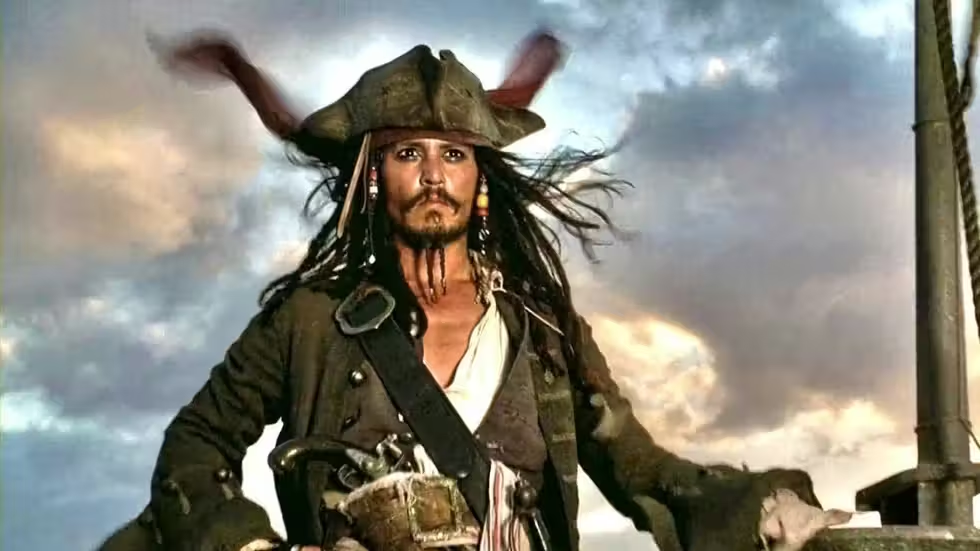
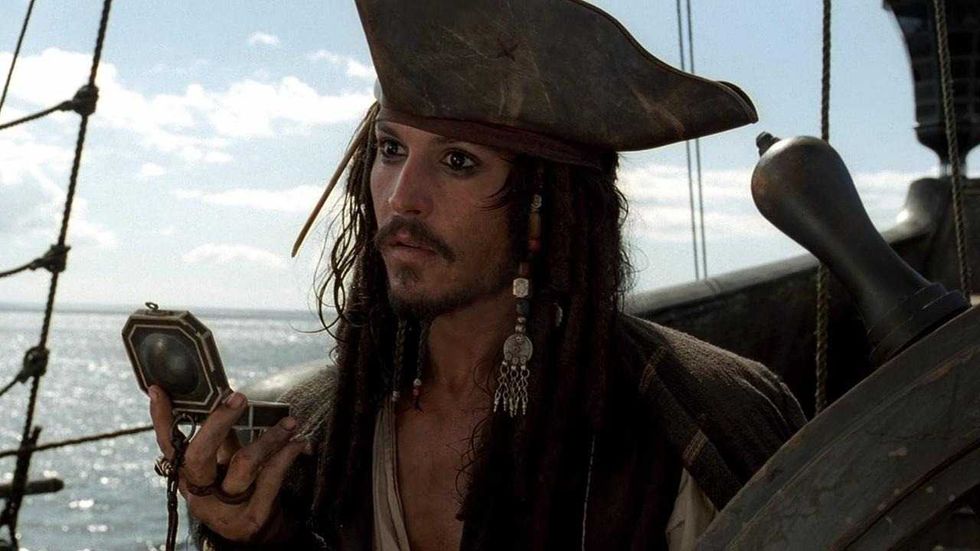
Our first time seeing Captain Jack Sparrow is atop the sail of what one would probably assume is a behemoth masterpiece of a pirate ship. Except it’s not. Calling it a dinghy would be generous. On top of that, it’s slowly sinking into the sea as Jack tries his hardest to make it to shore with it. He has a makeshift bucket setup trying to offset the water retention to no avail; he’s operating the entire boat by himself, and even if the ship wasn’t sinking, it clearly was not being kept very well for a long time prior.
Yet, in the midst of all of this, it seems as if Jack really couldn’t care less about the insanity of the moment. After the singular attempt to dump some water out of the boat, he simply climbs back on top of the sail mast, and rides the sinking boat directly into the dock, stepping off as if nothing bizarre had just occurred. To draw even more attention to himself, the place he’s docking is Port Royal which is as snottily fancy as it sounds. But…
He Can Belong Anywhere
 ‘Pirates of the Caribbean: The Curse of the Black Pearl’Walt Disney Studios
Characters around Jack often go back and forth between falling for his schemes and seeing right through him. But one thing is constant during both instances: Jack always thinks he’s fooling everyone all of the time.
As he starts totally not suspiciously walking towards the front of the dock and the mainland, everyone is staring in his direction, yet he could not care less. He’s even accosted by an officer at the top of the dock for not paying for tying his boat at the dock. Jack successfully pays the man off from making Jack give his name, and immediately after swipes someone’s money bag off a desk before taking off into the crowd.
Not only does this give us a sense of his mischievous nature and his confidence, it also shows that he actually has solid proof to feel a bit overinflated about these personal qualities. While morally ambiguous, his undeniable charm in these moments makes him a truly fascinating person to spend time with…at least with a screen serving as a boundary.
A Glimpse Into Jack’s Sense of Empathy
The biggest thing that separates Jack into the category of antihero instead of charismatic villain is his rare but powerful sense of empathy. Whether he’ll admit it or not (likely not), he has a good heart. It’s rare that it comes through in its rawest form, but when it does, it is always compelling.
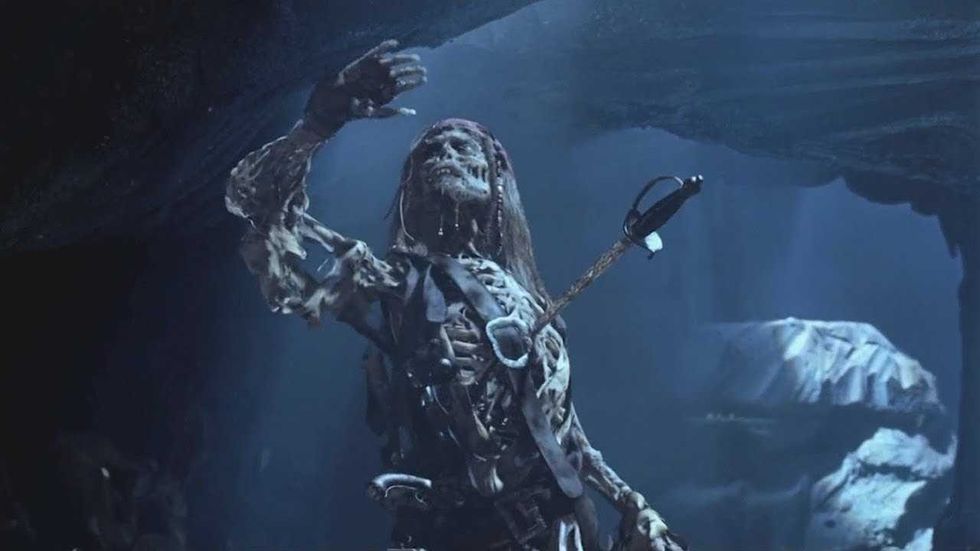
The very first time we see Jack show genuine care for someone is in his introductory scene. He notices the heavily decomposed bodies of hanged pirates dangling from a structure offshore. He stops what he’s doing, removes his hat, and salutes them as a sign of respect as he sinks into shore. What you’ll come to notice beyond this scene is that it’s far easier for Jack to feel something outwardly for another character when there aren’t others around to watch him doing so.
How These Traits Evolve
 ‘Pirates of the Caribbean: The Curse of the Black Pearl’Credit: Walt Disney Studios
The most important thing about character introductions is that the traits displayed therein are put to good use for the rest of the film, and contribute to the character going through some form of permanent change by the time the credits roll.
With regard to his controlled chaos and being able to blend in anywhere, both of these elements of Jack’s character join hand in hand during the third act of the film. Jack is double-playing Barbossa into turning back into a human, and by the time the final confrontation starts, Jack has secretly been living with the undead curse for multiple sequences without any other character knowing. He achieves all of this while simultaneously juggling nearly half a dozen other parts of his master plan. As the stakes of the climax rise, so do the parts of his character that seemed so small in the beginning.
Furthermore, it’s only because Jack begrudgingly has empathy for Will, Elizabeth, and Norrington that the plan gets this complicated at all. He very well could have let Will die well before the climax, when he was originally captured. A lot more of Norrington’s men likely would have also died in the battle that would have probably followed. Obviously, there were some casualties in the third act of the film, but it could have been far worse had Jack not intervened when he did. Once again, when the stakes rise, so does the presence of seemingly subtle character traits.
The succeeding two films in Gore Verbinski’s original trilogy expand far more outwardly on Jack as a character and his relationships. However, the more contained kinetic energy of the first film feels as if it’s captured lightning in a bottle. Thanks to a lot of things, obviously, but most importantly for introducing the world to Captain Jack Sparrow in such energetic style.
- Johnny Depp at His Best: 7 Unforgettable Roles ›
- 7 Iconic Movie Characters Who Refuse to Change — And That’s the Point ›
- The 10 Best Character Introductions of All Time ›
- The Philosophy of Jack Sparrow: How He Wins (Even When He’s Only Got a Jar of Dirt!) ›
- Iconic Film Character Intros: Mildred Hayes - The Moment You Know She Won’t Back Down ›