How a Street Incident Turned into the Most Iconic Line in 'Midnight Cowboy'
Discover how a spontaneous moment on a New York street became one of cinema’s most unforgettable lines.
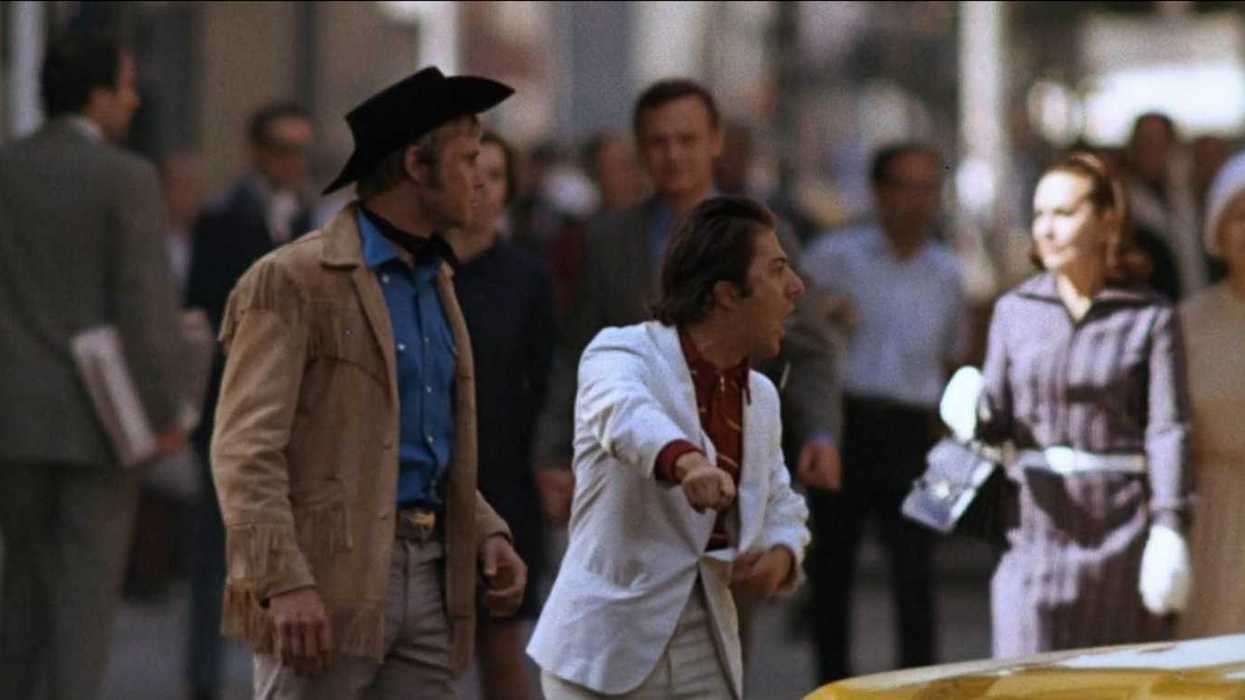
Midnight Cowboy (1969)
While some lines are meticulously conceived and written to last forever, others just pop out of nowhere—like a taxi that almost ran Dustin Hoffman over.
It’s now a known fact that Waldo Salt didn’t write this iconic line for the most well-known scene in Midnight Cowboy (1969). It came out spontaneously while filming in New York, when the city itself chose to improvise with the actors.
More than fifty years later, the phrase “I’m Walking Here!” that emerged from that instant continues to reverberate throughout popular culture.
Its unscripted nature is what makes it so brilliant. Raw, genuine, and entirely in character—not honed, practiced, or conceived during a brainstorming session in the studio. That single shout, as if, stopped time and encapsulated not only Ratso Rizzo’s annoyance but also the essence of a movie about surviving in a cold society that constantly tries to push you out of its way.
Setting the Scene
Filming in New York’s Wild Streets in the 1960s
Today, you might know New York as an—almost—sterile playground of tourists, finance bros, and other spiffy professionals. Back in the '60s, however, it was kind of dirty, raw, and unpredictable. In addition to traffic, the production had to deal with curious onlookers and wary residents. Hoffman and Voigt frequently acted in scenes while actual people watched, sometimes not even realizing they were in a movie.
And that’s exactly what the makers of Midnight Cowboy had set out to capture. The movie’s gritty realism came from that unpredictable nature. The sound of honking horns, the blur of strangers passing by, and the sense that anything could happen at any time—these are all examples of the raw energy that permeated every shot.
Loud, filthy, and alive—the city itself was intended to be a character by director John Schlesinger. This strategy distinguished the movie from the Hollywood standard. Schlesinger’s choice to capitalize on the messiness of the city gave the film a competitive edge in a time when musicals and glitzy dramas still dominated theaters. Not that this uncontrolled setting wasn’t an issue, but it was still a key component that gave the movie its timeless appeal.
It wasn’t easy shooting in that setting. There was no traffic control keeping taxis at bay, no permits closing streets. The vérité energy in the film came from the fact that the production was essentially trying to thread a needle through chaos.
The actors had to constantly navigate the actual city, not a Hollywood backlot replica, because of the guerrilla-style shooting. And—fortunately, as it appears now—since New York had no time to stop and consider that a movie was being made, you ended up with one of the most genuine movie moments ever captured on camera.
An Actual Cab, An Actual Response
As the filming was in progress, a cab driver sped by, almost clipping Joe Buck (Jon Voight) and Ratso Rizzo (Dustin Hoffman) as they were crossing a busy Manhattan street during one of the takes. Hoffman reacted instinctively. He slammed his hand against the cab's hood and yelled, “I’m walking here!”—while remaining trapped inside Ratso’s annoyance and limp.
The decision to portray it as Ratso’s rage instead of Hoffman’s was as genuine as the rage itself, and it paid off. What might have been a ruined take was turned into a work of cinematic gold with that one single instinctive shout. It’s the kind of situation where the adrenaline and danger are too real to stage or practice.
The Blur Between Script and Reality
The improvisation alone isn’t what makes the outburst so potent; Hoffman’s complete focus on Ratso made it flow naturally. That line combined his rasp, his limp, and his bitterness. It was a battered hustler, tired of being ignored, demanding space in a world that had written him off—not an actor shouting at a cab.
And exactly because of this, the audience cannot question its authenticity. It feels like Ratso’s soul spilling out in a single, enraged outburst rather than a blooper that made the final cut.
The Ripple Effect
The Reason the “Error” Persisted
Directors often toil over every word and syllable of dialogue. A more circumspect director might have discarded the take due to the fear of appearing sloppy. Schlesinger, however, knew he had lightning in a bottle when this moment happened. Naturally, he chose to preserve the scene rather than request a retake, because it captured the film’s entire ethos and represented his comprehensive approach to the film. In the underbelly of America’s most renowned city, nothing screamed “real” like a cab almost running down his lead actors in a movie about the gritty realities of New York life.
Schlesinger also established a standard for subsequent filmmakers by preserving the scene. The “shoot it as it is” philosophy was later adopted by the likes of Martin Scorsese, Sidney Lumet, and Spike Lee. He made the point that sometimes genuine accidents reveal the truth more clearly than a thousand rewrites. All one has to do is leave it in.
Cast and Crew Reactions
Later, Jon Voight recalled how the crew and actors were taken by surprise but knew right away that something extraordinary had happened. The surprise—or shock—of almost getting struck vanished into appreciation for Hoffman’s unwavering ability to hold on to his character. It enhanced the take rather than detracting from it.
These kinds of moments serve as a reminder of why movie sets can feel electrifying—because they feel like gifts from the movie gods themselves.
Why “I’m Walking Here!” Endures
A Sign of Resistance and Fortitude
In a nutshell, the line is a snappy middle finger to the society that refuses to make room for the underprivileged, and it goes beyond simple traffic etiquette. Defiance is embodied in Ratso’s shout: a sickly, limping man who will not be discarded, not even by a two-ton cab. In this one second, you can hear the Midnight Cowboy’s whole heartbeat—survival, honor, and the unadulterated desire.
The need to survive in a world that’s programmed to try and erase you is the quintessential New York mentality, which also applies universally.
The Authenticity Factor
The line’s enduring power stems from its push for authenticity in film. Stage acting had long included improvisation, but film was still catching up. This kind of risk-taking was essential to the New Hollywood movement of the late ‘60s. Hoffman, who received method acting training, blurred the distinction between character and actor, demonstrating how a film could feel when actors followed their gut feelings—especially in the ‘60s and ‘70s, when polished studio performances were becoming less common.
His choice allowed other actors, such as Meryl Streep, Al Pacino, and Robert De Niro, to focus on authenticity rather than flawless delivery.
Even directors, to catch such a “lightning in a bottle” moment, encourage improvisation to date.
Think of Heath Ledger’s Joker clapping in The Dark Knight (2008) or Leonardo DiCaprio’s Calvin Candie smashing his hand on glass in Django Unchained (2012). Hoffman’s shout could be responsible for these spontaneous mishaps.
I don’t think it would be a hyperbole to say this one act of instinctive yet character-bound reaction became one of those cinematic moments that flagged the naturalism movement.
The Line’s Journey into the Cultural Zeitgeist
Parodies, Homages, and Pervasiveness
Since then, “I’m walking here!” has come to represent New York obstinacy in general. There are t-shirts on the Times Square racks, as well as parody sketches in comedy shows such as Family Guy, The Simpsons, and innumerable late-night shows.
Even those who haven’t seen Midnight Cowboy can immediately recognize the line because it is so embedded in popular culture.
It is now a shorthand for an entire urban mindset rather than just a movie quote.
Recognition of the AFI and a Critical Reappraisal
The American Film Institute put “I’m walking here!” on its list of the 100 best movie quotes of all time in 2005, making it a permanent part of movie history. What started out as an unplanned yell in the middle of the road is now studied, quoted, and praised in books, classes, documentaries, and movie articles such as this one.
This acknowledgement does more than just honor the line; it proves the whole point of leaving such happy accidents in films.
Conclusion
At its heart, Midnight Cowboy is about outsiders who are constantly fighting for simple acknowledgement, let alone their honor, in a city that doesn’t care if they live or die. Ratso’s angry yell—which, to some, may come off as funny or an off-the-cuff remark—but it also sums up the movie’s spirit in just four simple words: a man, who people don’t pay attention to, wants to be seen, even if only for a moment.
The great thing about it is that a real close call on the set became the perfect movie moment because Schlesinger knew what was real when he saw it. The movie’s magic doesn’t always come from being in charge; sometimes it comes from chaos.
A taxi will sometimes run a red light, an actor will not break his character, and a small history will be made—that’s film at its most alive.