8 Movies That Secretly Reveal Their Endings in the First Scene
How these eight films use their opening moments to quietly shape your expectations for the finale.
The Sixth Sense (1999)
What if the ending of a film was staring you in the face from the very first frame? Not in some vague, mystical way—but right there, in plain sight, woven into the opening scene’s dialogue, imagery, or mood.
You’d think you’d notice. Yet the best filmmakers know exactly how to slip these clues past us—camouflaging spoilers as casual banter, throwaway shots, or cryptic flashbacks that we misread entirely.
This is not about cheap trickery. It’s about narrative architecture—embedding the payoff inside the setup so seamlessly that it only clicks after the credits roll. The thrill comes later, on a rewatch, when you spot the moment that was quietly whispering the ending all along.
You feel both duped and delighted, which is why audiences love these kinds of films. They reward attention without punishing you for missing the signs the first time.
The eight movies below each pull off this sleight of hand in their own way. Some open with their final shot. Others mask foreshadowing inside metaphors or misdirection. But they all prove the same thing: in the right hands, the first scene can be more than just an introduction—it can be the finale in disguise.
How Filmmakers Hide Endings in Plain Sight
Narrative Techniques
Some filmmakers start at the end and work backwards—like Fight Club (1999), where the opening gun-to-the-head standoff is literally the climax. Others rely on metaphorical imagery, like Pan’s Labyrinth (2006), showing its heroine’s death in reverse, or The Prestige (2006), opening with an on-the-nose explanation of the film’s own narrative structure. Then there’s literal foreshadowing, as in Shaun of the Dead (2004), where a throwaway bar-room plan is a beat-for-beat roadmap of the plot.
Visual & Auditory Clues
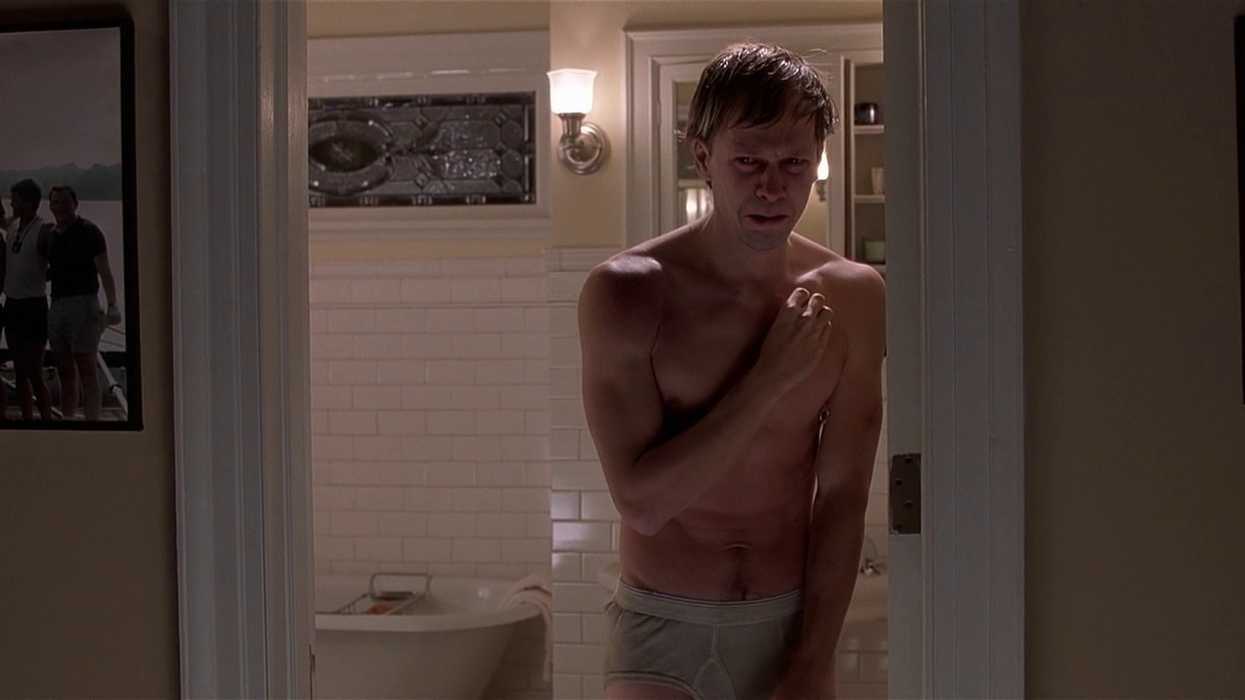
Visual symbolism can hide the truth in plain view. In The Sixth Sense (1999), the color red subtly marks moments when the living and the dead collide.
In Us (2019), mirrors in the prologue set a creepy tone, but they’re also telling you this is a story about doubles.
Even opening credit sequences can plant seeds, as in Se7en (1995), where the killer’s meticulous journals silently lay out the horror to come.
The 8 Films: Breakdown & Analysis
1. The Sixth Sense (1999)
Written by: M. Night Shyamalan | Directed by: M. Night Shyamalan
Child psychologist Dr. Malcolm Crowe (Bruce Willis) is attacked in his home by a former patient and shot—an act that appears to be the traumatic inciting incident for his story. Soon after, he begins working with a young boy, Cole Sear (Haley Joel Osment), who claims to see the dead. Crowe’s calm, rational approach masks the eerie undercurrent driving the film.
The brilliance lies in how Shyamalan hides the supernatural truth inside a very human tragedy. The attack is presented as a motivation for Crowe’s work, not the revelation that he is already dead. Shyamalan relies on our genre expectations—we expect psychological drama, not a ghost story—so we accept every scene at face value until the final reveal reframes it all.
Filmmakers can study how Shyamalan weaponizes misdirection by rooting the opening in emotional realism. By making the “twist” feel like a consequence of character, not plot mechanics, he makes the ending both shocking and inevitable.
2. Fight Club (1999)
Written by: Jim Uhls | Directed by: David Fincher
The film opens with the Narrator (Edward Norton) on his knees, a gun shoved in his mouth by Tyler Durden (Brad Pitt), while explosives wait to level the city. This tense, chaotic tableau is the story’s endpoint, but presented as the launchpad for a flashback. The narrator’s sardonic voiceover invites you into a story that seems headed elsewhere.
Fincher disguises the scene’s importance by drowning us in sensory overload and character chemistry. We’re focused on the gun, the bombs, and the anarchic energy, not the fact that both men are, in a sense, the same person. The confrontation plays as two distinct characters in opposition until the final act tears down that illusion.
Writers can take note of how the opening locks the climax into place without spoiling its meaning. By giving us the “what” but withholding the “why,” Fincher ensures we’ll stick around to fill in the blanks.
3. The Prestige (2006)
Written by: Jonathan Nolan, Christopher Nolan | Directed by: Christopher Nolan
The film begins with magician Cutter (Michael Caine) explaining the three acts of a magic trick: The Pledge, The Turn, and The Prestige. We see a clearing filled with identical top hats, a bizarre image that’s never explained in the moment. Meanwhile, rival magicians Robert Angier (Hugh Jackman) and Alfred Borden (Christian Bale) prepare to outdo one another’s illusions.
That opening monologue is beyond stagecraft. It actually serves as the film’s skeleton. The hats are the literal byproduct of Angier’s cloning machine, and Cutter’s words mirror the structure of the narrative. Nolan counts on us treating this as flavor text, not a confession of the ending.
This is a reminder that exposition doesn’t have to be boring if it’s doing double duty. Nolan uses it to teach the audience the mechanics of a trick, then performs the same trick on them.
4. Pan’s Labyrinth (2006)
Written by: Guillermo del Toro | Directed by: Guillermo del Toro
We first see young Ofelia (Ivana Baquero) lying on the ground, blood seeping back into her nose as she appears to breathe in reverse. It’s dreamlike and disorienting, then quickly replaced by the story of a girl sent to live with her cruel stepfather during Spain’s civil unrest. The fantasy realm she discovers becomes her refuge and her test.
Del Toro masks the truth by presenting the moment as a fairy-tale flourish. The reversed footage feels symbolic rather than literal, so when the ending mirrors this exact shot, the recognition hits spectacularly. We’ve seen it before—and yet, never truly looked at it.
The key takeaway here is that tone can camouflage meaning. If the scene feels surreal enough, the audience files it under “mood” instead of “plot,” freeing the filmmaker to plant major story beats right under their nose.
5. Shaun of the Dead (2004)
Written by: Edgar Wright, Simon Pegg | Directed by: Edgar Wright
Hungover in a pub, Ed (Nick Frost) lays out a plan for Shaun’s (Simon Pegg) day off: grab a “Bloody Mary,” have a “bite” at the King’s Head, then head to the Winchester for safety. At first, it’s casual pub chatter, the kind of meaningless filler you’d expect in a comedy about slackers.
Wright uses the audience’s assumption against them. The line is a literal beat-by-beat summary of the film’s plot, with “Bloody Mary” referring to their first encounter with a zombie—you guessed it, named “Mary”, the “bite” to an infected pub owner, and the Winchester to their final stand. We laugh at the throwaway joke without realizing it’s a spoiler.
Shaun of the Dead skillfully embeds plot beats inside humor. For comedic storytellers, it’s proof that jokes can pull double duty as both laughs and foreshadowing.
6. Arrival (2016)
Written by: Eric Heisserer | Directed by: Denis Villeneuve
Dr. Louise Banks (Amy Adams) narrates a montage of life with her daughter—birth, childhood, illness, and death. The mood is somber, the visuals intimate. Then aliens arrive on Earth, and the story seems to shift entirely. We assume this opening is a flashback, grounding Louise’s emotional arc.
The reveal flips the sequence’s meaning: Louise’s perception of time has changed after learning the alien language, and the montage was a flash-forward. What felt like character backstory becomes a glimpse of a future she will choose, heartbreak and all.
It’s a lesson in reframing information. Villeneuve uses our linear-thinking bias against us, reminding filmmakers that audience assumptions are some of the most powerful tools in storytelling.
7. Us (2019)
Written by: Jordan Peele | Directed by: Jordan Peele
In 1986, young Adelaide (Madison Curry) wanders into a hall of mirrors and meets her double. It’s presented as a traumatic childhood incident, setting up her adult fear and protectiveness over her family. But the tension of the encounter lingers, even as the story jumps forward.
The finale reveals the truth: the girls switched places, and the Adelaide we’ve followed is actually the double. Peele hides the key twist in plain sight by presenting it as the kind of unresolved trauma backstory we’ve seen a hundred times.
For horror writers, this is a reminder that the best scares are the ones you only understand later—when the full scope of the nightmare comes into view.
8. Sunset Boulevard (1950)
Written by: Charles Brackett, Billy Wilder, D.M. Marshman Jr. | Directed by: Billy Wilder
The film opens with struggling writer Joe Gillis (William Holden) floating dead in a swimming pool, narrating the story in retrospect. It’s the ending, given away in the first 60 seconds. The rest of the film explains how he ended up face-down in Norma Desmond’s (Gloria Swanson) Hollywood dream-gone-sour.
By using voiceover from beyond the grave, Wilder makes the ending a foregone conclusion. There’s no “will he survive?” tension—only “how will it happen?” That shift lets the audience focus on character and mood rather than plot beats.
Wilder’s approach is proof that suspense doesn’t always come from uncertainty—it can come from inevitability. Sometimes showing the destination early makes the journey more engrossing.
Why These Techniques Resonate
The joy is in the second viewing. Once you know the ending, the first scene plays like a wink from the filmmaker—a secret handshake between you and the story. It’s not about tricking you, but about deepening the rewatch value.
Great twists do give a shock, but they also recontextualize. As the saying goes, the best surprises feel inevitable in hindsight. And nothing makes a story feel more inevitable than realizing it started telling you the truth from the very beginning.
The Magic of Misdirection
The next time you settle into a theater or hit play at home, freeze-frame the first scene in your mind. What’s hiding in the frame? Is it just mood-setting, or is the ending peeking out from behind the curtain? These eight films prove that the opening shot can be the most important moment of all.
If you’re hungry for more, try The Others (2001) or Parasite (2019)—both hide their final punch in early beats. Because in the hands of a sharp storyteller, the first scene isn’t an introduction—it’s the last laugh.
- The Twist King: Ranking the 9 Best M. Night Shyamalan Movies ›
- What is a Plot Twist (Definition and Examples) ›
- How Did 'Knives Out' Pull Off That Plot Twist? ›
- Did You Know? ‘The Sixth Sense’ Almost Cut Its Most Famous Line ›
- Born 57 Years Ago, the Actor Who Made His Film Debut With a Performance That Shocked Hollywood | No Film School ›