The haunting words “I see dead people” have gone down in history as a hair-raising boundary between the mundane and the macabre. We cannot picture or discuss, or even fully enjoy, the cinematic vista of the 90s, let alone the movie itself, without these wistful words. We cannot (and honestly, don’t want to) forget how this line makes us feel when it transfers a quiet whisper into a tremor—a feeling that lasts through the entire length of the movie. The line is half the movie experience.
Right. Now, what if I told you there was a fleeting possibility of a world where The Sixth Sense existed without this line?
Don’t “lame-shame” me. This is not my hypothetical reverie. I am stating the fact: the makers thought the line was a risky giveaway, and it almost ended up on the cutting floor.
It’s a wild thought. And if the editors had followed through with their first instinct, we would have ended up with The Sixth Sense that was “I-see-dead-people” % less fun.
Let’s explore this crazy talk a little more. Shall we?
Context
A child psychologist, Malcolm Crowe (Bruce Willis), is at home with his wife, Anna (Olivia Williams), when one of his former patients, Vincent (Donnie Wahlberg), breaks in and accuses him of failing him before shooting him and then himself.
A while later, Malcolm has seemingly recovered from the gunshot wound, but his marriage to Anna is strained. He starts treating nine-year-old Cole Sear (Haley Joel Osment), who has severe social anxiety, apparently because of the harassment he suffers from school bullies.
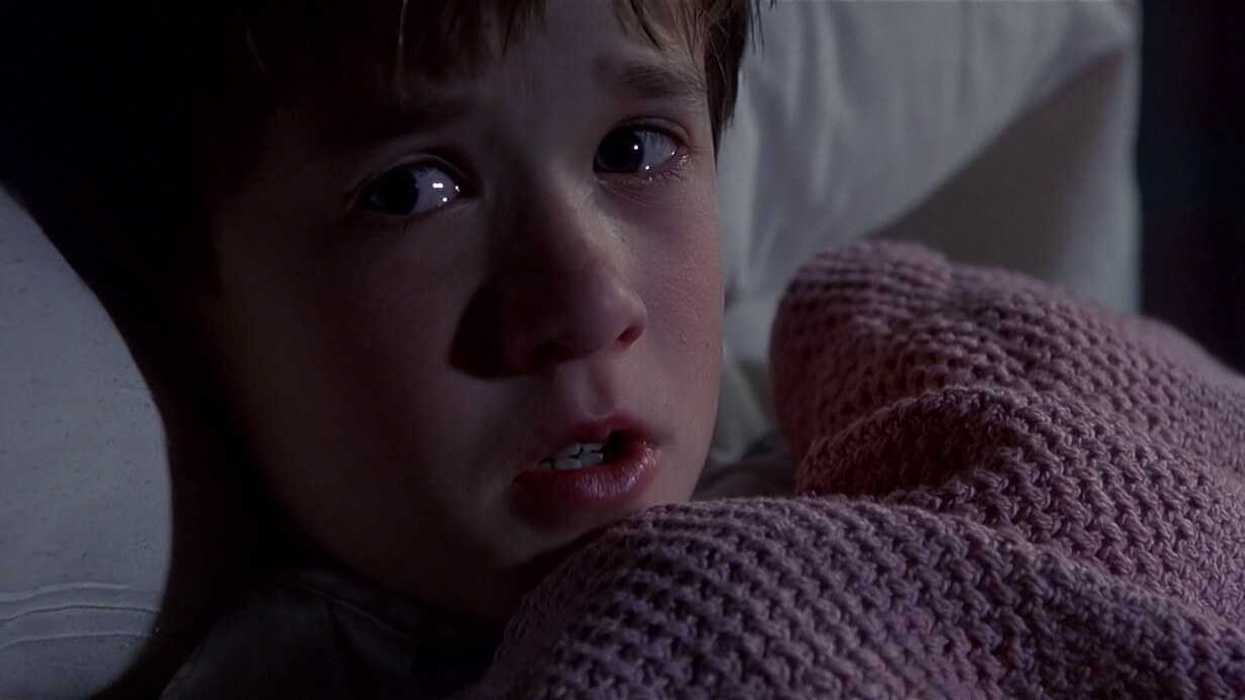
After a particularly harrowing bullying incident, disturbed and shaken Cole confides in Malcolm, saying that he sees dead people.
At first, thinking Cole is schizophrenic, Malcolm is about to drop his case. However, when he listens to a recorded audiotape from one of his sessions with Vincent, he hears a third person’s voice when Vincent was supposed to be alone in the room. This makes Malcolm realize that Vincent might have had the same ability as Cole, which means Cole is telling the truth.
With Malcolm’s counseling, Cole starts to realize that the ghosts are not only harmless but are actually seeking his help. This revelation eases him, and he starts to show improvement. All the while, Malcolm’s marriage remains troubled.
Eventually, as the clues accumulate, Malcolm discovers a painful truth: He died when Vincent shot him at the beginning of the movie. Ever since, he has been wandering around as a ghost, which is why Cole can see him. Anna is distant because she has been grieving him.
The Fear of the Spoil
Too Much Information
M. Night Shyamalan initially thought the line “I see dead people” was a dead giveaway, a “red flag," for the audience. Even his colleagues, including associate directors and editors, thought it was too on the nose. There was apprehension that the audience would figure out the big reveal, or at least start suspecting, much before the ending.
When the scene went on the editing timeline, this fear even intensified. It seemed like Cole’s hushed whispering was actually screaming the film’s secret out loud. It didn’t feel like the mystery stayed intact from this scene onwards.
The Director’s Dilemma
The common opinion in the team was that the audience was “too smart” for such a direct statement. It prompted them to try out different approaches, including different cuts, to see if the scene could work without the line. The line, no doubt, was impactful. Osment’s performance was exceptional, and it carried the scene’s psychological weight. And, at the same time, it had the potential to ruin the rest of the film.
The final decision was Shyamalan’s. He had to decide if preserving the moment’s emotional heart was worth the risk of spoiling his “possible” masterpiece.
 'The Sixth Sense' Credit: Buena Vista Pictures Distribution
The Final Call
Test Screenings and Audience Reactions
Usually, when a movie is test-screened, the makers expect a desired emotional response—the lack of which is a smoke signal, which puts their hearts in their mouths. But in this case, as in this scene, they had their fingers crossed that the audience would just slip through it, not reading anything beyond what’s on the surface.
And, much to their relief, that’s what happened. The audience was quiet. No gasps, no raised eyebrows. No immediate responsive payoff.
Although there was another lingering concern: was the audience confused? Or worse, indifferent?
As it turned out later, the audience was simply processing. The line didn’t entertain as such, but it reframed everything that had happened in the story so far.
It was a “phew” moment for the Sixth Sense team.
Why the Line Stayed Ultimately
Now, with confidence bolstered after the test screening, Shyamalan felt the audience’s silence was indeed the point. The line strengthened the film’s emotional and structural foundation. Had it not been for the line, the story may have given the impression of vagueness. Without it, the element of “mystery” would be missing. Ultimately, it worked by prompting the viewers to lean deeper into the narrative.
Conclusion
This moment of uncertainty that the team faced shows us that even the best ideas come across moments of doubt. Movies have been around for over a century, and it makes sense to assume the audience is smart, and in most cases, they are. But sometimes writers, directors, and producers overestimate the audience’s ability to “solve” a movie. But anyway, it’s still better than underestimating them—that’s how we end up with The Happening (2008) and The Last Airbender (2010).
The summing-up thought is nothing but pure joy that the line stayed. The movie already had the bones of a solid thriller; the line gave it a heart. As they say, sometimes the most obvious choice is “obvious” for a reason.
- The 14 Greatest Movie Endings Ever Filmed ›
- 8 Movies That Secretly Reveal Their Endings in the First Scene ›
- Seeing Red: The Supernatural Signal in ‘The Sixth Sense’ | No Film School ›
- Iconic One-Liner: “I See Dead People”: The Sixth Sense | No Film School ›
- 1999 Smash Hit Horror Movie Earns a Spot Among the Greatest Films in History ›