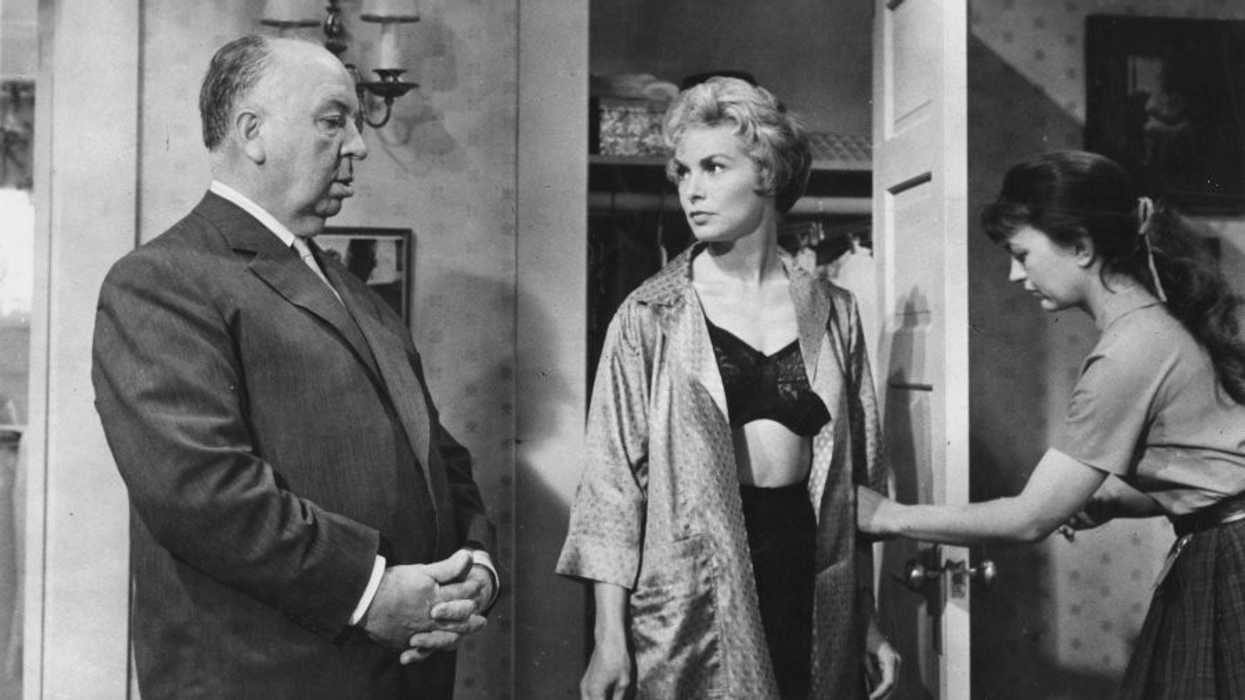
We're celebrating a classic today. Alfred Hitchcock's Psycho opened nationwide in theaters on Sept. 8, 1960.
This followed its initial outing in New York City. Psycho premiered on June 16 at the DeMille Theatre and Baronet Theatre in New York City, then expanded throughout the summer to become a nationwide phenomenon.
Rather than following the usual prestigious path his films took—opening in major cities in one or two theaters for a few weeks—he embraced the exploitation movie tactics of William Castle. In the U.S., Hitch oversaw the marketing campaign and restricted his actors from doing any press coverage to limit any potential spoilers and create public curiosity.
Theaters were asked to post a warning from Hitchcock that no one would be admitted after the film had started. These warnings also ran in the form of newspaper advertisements.
Hitch also pioneered the modern-day "spoiler warning," asking audiences not to discuss the film's shocking twists (which no doubt led to even more curiosity).

Some signs read:
“We won’t allow you to cheat yourself. You must see Psycho from the very beginning. Therefore, do not expect to be admitted into the theatre after the start of each performance of the picture. We say no one—and we mean no one—not even the manager’s brother, the President of the United States, or the Queen of England (God bless her)!
Ticket sales stopped the moment the reel started, and latecomers were directed to buy tickets for the next showing.
The gamble paid off.
In its opening week, Psycho grossed $46,500 at the DeMille and $19,500 at the Baronet, then went on to earn $32 million worldwide.
Hitchcock deliberately made Psycho look cheaper, using his television crew instead of his usual feature film collaborators and shooting in black and white when color was becoming standard. He leaned into the shock and schlock for the advertising, too, which has now become iconic.
"I was directing the viewers," Hitchcock told François Truffaut in their famous interview series. "You might say I was playing them, like an organ" (via Roger Ebert).

The lesson for anyone creating something disruptive is that sometimes your strategies, especially for marketing, can extend beyond the traditional.
Psycho's approach can be inspiring for indie filmmakers who need to generate buzz for their next project. Is there a unique (or even old-fashioned) angle you can exploit?
Hitchcock banned his stars from doing press and made the mystery itself the star. He realized that curiosity and word-of-mouth could be more powerful than traditional marketing.
It's not likely that any of us have the same pull with distribution and theaters, but maybe you can pull something similar off on a smaller scale.
Maybe like Hitchcock, you'll do something that changes cinema forever.
- How the Score of 'Psycho' Changed Movie Music Forever | No Film ... ›
- What Do Birds Symbolize in Alfred Hitchcock's 'Psycho'? | No Film ... ›
- Unpacking The 'Psycho' Shower Scene with Hitchcock | No Film ... ›
- How Hitchcock's 'Psycho' Changed How We Watch Movies in ... ›
- How Psycho Changed the Theatrical Experience ›
- 40 Years Later, This Alfred Hitchcock Sequel Remains Undefeated ›
- 4 Movies That Were Inspired By Alfred Hitchcock's 'Psycho' | No Film School ›