Switching the Gap: The Gadget Solution for Actor Training
How a live-editing switcher reconciles the theatrical process with on-camera demands.
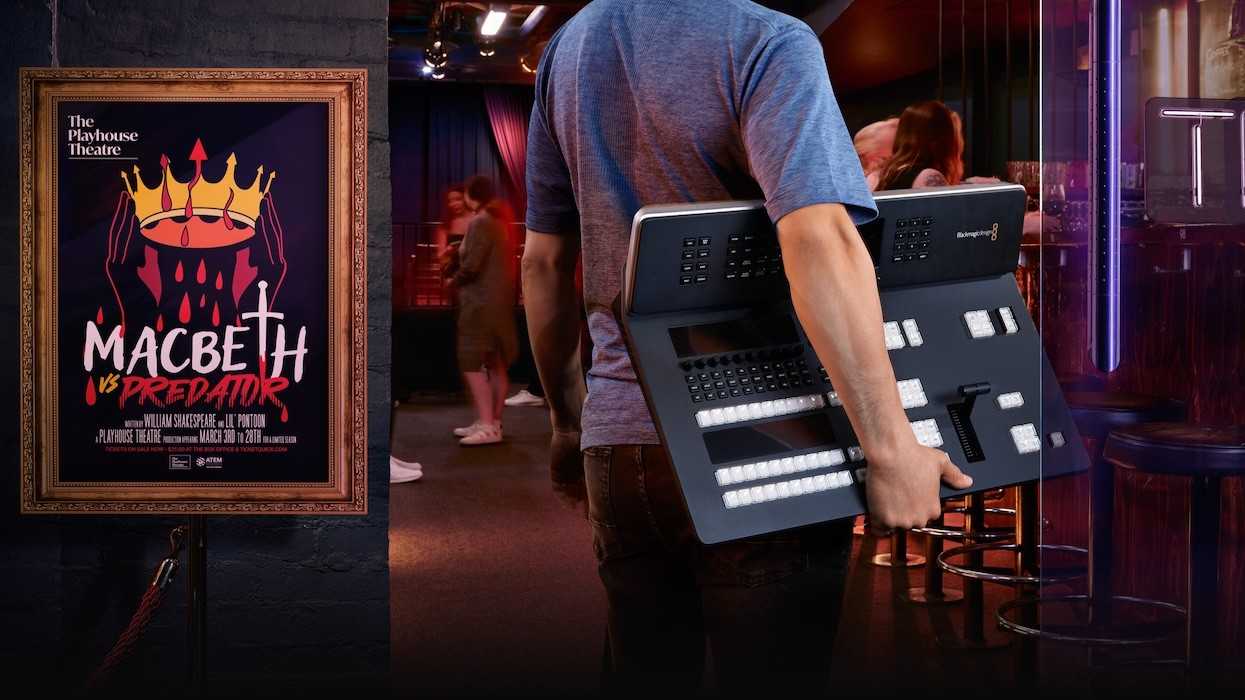
Blackmagic ATEM production switcher
"What's the difference between acting for the stage and acting for the camera?" your theater school acting teacher invariably asks on Day 1 of your Acting for the Camera class. Fair question. Unfair paradigm.
Framing the course in this way plants a seed in the actor, an insidious idea that their characters must behave differently in different mediums and that their instrument must therefore be used differently. That's not to say that there isn't some truth to adapting to the camera, but starting here focuses the actor on the result of the performance rather than on the rich underlying infrastructure of bringing a text to life.
An actor approaching a film version of a play may be tempted to start by thinking about "reining it in" or "pulling it back" or otherwise diminishing their expression of the story moments. Beginning with that mentality disconnects the actor from the complex, organic, and potentially spontaneous process of acting.
The more useful distinction between mediums is in that very process: The continuous, uninterrupted flow of theater versus the ironically named "continuity style" of on-camera work.
For the actor, the fundamental difference in the job is living a story chronologically from the beginning to the end of a scene, as opposed to on set, where the actor repeats moments out of sequence while doing mental gymnastics trying to keep track of blocking, choices, tone, and gesture so the editing process pieces together something resembling a continuous scene. The common challenge in both instances is the artifice: living and behaving in an imagined character's fictitious circumstances in fake environments under the innumerable external distractions of the production process. The more the flow is interrupted, the more intrusive thoughts can creep into the actor's mind, effectively rupturing the tenuous intellectual, emotional, and physiological connection necessary to truthfully embody a character in any medium.
The Technology Villain
To inaccurately quote the immortal Bones from Star Trek, “Damn it, Jim, I’m an acting teacher, not a production company!”
In acting class, we're faced with challenges beyond the ones inherent in the filmmaking process: sterile learning environments rather than immersive sets, deconstructed exercises rather than holistic rehearsals or filming experiences, fractional material disconnected from the broader narrative, an often distracted audience of peers (who we are simultaneously competitive with and supportive of), and worst of all, the noxious desire to "be a good actor" - to gain the approval of our classmates and our overbearing, know-it-all acting teacher* who always has notes and never seems satisfied (*no offense to my peers, but let’s be honest… students have opinions!).
A main villain in the story of teaching on-camera acting to theater actors is technology. It's impossible to engage an entire film production and post-production crew to accompany your course. Even hiring a videographer is not a sustainable option—at least not in any institution where I've ever taught, for the same reason many schools can't afford to teach regular musical theater classes: you need a pianist/accompanist, a choreographer, a vocal coach… which is prohibitively expensive. Even if you could bring in a TA or a dedicated camera operator, you're adding yet another variable to the equation of "people and things that can derail an actor in process."
Besides, who gets the honor of editing all that footage? College profs and acting teachers already have enough unpaid labor, their own auditions or gigs, and/or other part-time jobs to tend to. The coverage and editing bottleneck kills curriculum and in-class momentum. On top of that, if students never get to see the edited product, they can't really learn how montage informs or, in fact, creates the final performance. Trying to manufacture a playback workflow in class would be a nightmare... unless you also hire a DIT (Digital Information Technician, the crew-member on set responsible for director monitors and playback) alongside your in-class production company. Besides, the acting students who are observing the scene work (and probably just running lines in their heads for their upcoming scene) are also now relegated to passive observers—robbing them of valuable learning opportunities.
[Live Switcher Enters Stage Left]
If only there were a way to take the best parts of both processes and combine them into one class. How could you simultaneously allow actors to rehearse a scene as they would for the stage, then perform it on-camera without having to compromise their momentum? How do we assemble the footage from an in-class scene without having to spend hours editing? How can an instructor empower every student in the class to take part in the on-camera storytelling process even when they're not acting in it? How do we do all this without the need for more faculty or staff?
The Blackmagic ATEM production switcher is a piece of technology that closes the gap between mediums. It allows the acting instructor to reconcile the strengths of a continuous theatrical process with the mechanical demands of a fractured on-camera performance. It enables us to use multiple cameras to capture the scene simultaneously from multiple angles, preserving the continuous flow of a theater process, while someone operates the live, real-time edit during the performance with the simple push of a few buttons. The system records both the live edit AND isolated angles automatically, providing immediate playback without any post-production crew or waiting.
And who, you may ask, is the skilled creative laborer tasked with executing the live-edit? Well, I’m glad you asked — it’s a student. The system is so easy-to-use that a fellow actor-in-training can take on this in-class assignment, and it’s so intuitive that their main challenge is not learning the hardware or software, it’s learning the scene and its timing, developing a sensitivity and point-of-view on their classmate’s work that gives them the ability to follow the narrative as they see fit. This artistic agency is an invaluable byproduct of using a device that enables you to switch between angles, allows observers to see the edit in real time, and records everything that’s happening in the moment.
In terms of educational accessibility, the free Blackmagic Camera app even turns any iPhone into a viable camera input. This dramatically lowers the barrier to entry since most students already own compatible equipment and have "skin in the game" when using their own devices. No need for expensive dedicated cameras for each input, though there is an occasional audio lag issue that's hopefully solvable through software updates.
Who Is This Actually For?
This setup works for both single-camera narrative-style material (dramas, procedurals) and multicam setups where you're working on sitcoms and comedy. Theater-trained actors no longer face the false choice between authentic process and camera technique—they can maintain character flow while naturally developing camera awareness without the trap of "performing differently" from medium to medium.
For acting instructors, this banishes the "technology villain" from the classroom. You can finally reconcile theatrical strengths with on-camera demands while focusing on acting coaching (which is what we signed up for in the first place) instead of technical troubleshooting (which no one likes). Budget-conscious programs also benefit from a one-time equipment investment and no post-production software licensing or editing lab requirements, versus ongoing crew costs: Your department chair will love this part.
The Process Revolution
Scene work can proceed continuously from beginning to end with no stopping for camera setups or crew work. Actors stay in momentum throughout their performance while the natural rehearsal process is preserved, and "continuity-style" coverage is captured. In this reduced-attention-span world, maintaining that theatrical flow isn't just pedagogically sound—it's essential for keeping students engaged and present.
The live edit is available immediately after you call "cut!", allowing students to review both the edited performance AND isolated angles with no waiting. Let's be honest: in today's instant-gratification world, if students can't see their work right away, they're mentally moving on to the next thing. This immediate feedback creates coaching opportunities while the performance is still fresh, and the system automatically generates distinct folders which you can then upload to a large-capacity cloud, permitting students to review their work on their own time from anywhere.
The team approach keeps all students engaged through rotating technical roles: camera operators learn framing and composition, the switcher learns pacing and editorial choices, and actors learn to work with camera presence naturally while prioritizing their connection to themselves, their scene partner, and the material. Non-performing students become active participants rather than passive observers. Combine the student on the live switcher (or "Vision Mixer," or "Technical Director," or "Story DJ" as we call it) with students operating the cameras, someone on the boom mic, a script supervisor, someone watching for scenic, props, and costume continuity… Now you've got all students invested and actively participating in not only supporting their classmates, but also in telling and capturing the story. They learn production skills alongside acting technique while simultaneously understanding storytelling from multiple perspectives - not to mention gaining appreciation for the amount of labor and focus required of their on-set collaborators.
The iPhone integration means intuitive operation that doesn't require technical expertise, allowing schools to start with a basic setup and expand over time. Technology becomes an invisible tool rather than an intrusive villain, with no external crew members disrupting the learning environment.
Real Impact and Current Limitations
Ideally, students stop thinking about "camera acting" versus "stage acting"— their focus returns to what made them fall in love with acting in the first place: playing pretend, character truth, and moment-to-moment reality. This system facilitates the natural integration of camera awareness without compromising authenticity. The free iPhone app democratizes access to professional tools and removes financial barriers that often exclude diverse student populations. You’ll need a bunch of cables and adapters, but those costs pale in comparison to the alternatives.
Bridging the Gap
The ATEM doesn't just solve a technical problem—it solves a pedagogical one. By eliminating the false choice between an organic, authentic theatrical process and the cumbersome technical demands of on-camera training, it allows acting education to honor both the humanity of character work and the realities of contemporary media production. It can also go a long way to smash barriers—financial, technical, and conceptual—that have long prevented accessible, comprehensive actor training.
The technology can still be perfected, but it's convenient, effective, and constantly improving. For educators committed to preparing actors for today's rapidly evolving industry while preserving the foundational tenets of the craft, the live production switcher represents not just a tool but a paradigm shift toward more inclusive, holistic, and authentic actor training. If arts education hopes to survive the threat of AI and CGI, then we'd better hurry up and get comfortable with the inclusion of new technologies into the classroom. We can hide in our dark studio spaces and cling to the days of the traditional conservatory model, but then we can't complain when the industry leaves our students behind.