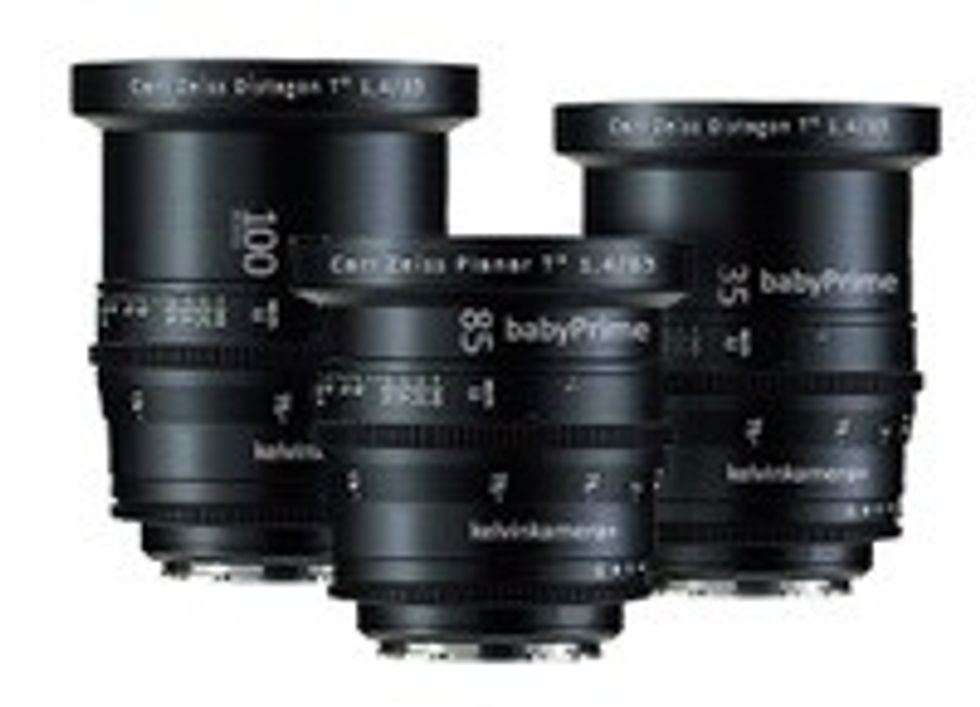
 [UPDATE from Carl Zeiss at the bottom of this post.] Zeiss CP.2 lenses are a top choice among HDSLR and AF100/F3 cinematographers because of their optics, size, and weight. At roughly $4k/lens, however, they're a tad expensive when compared to their ZF.2 still cousins (which contain the same optics and retail for around $1,500). Unknown Italian camera company kelvincamera has announced that they have successfully re-housed the ZF.2 with the CP.2 features (common front diameters, focus and iris markings, and fixed gear rings) and will be selling these "babyPrimes" for 35-40% less than the CP.2s (which would bring them in around $2,500).
Considering the ZF.2 lenses are sometimes a stop faster than their CP.2 equivalent (the 35 and 50 open to a full f/1.4 instead of f/2.1), these could certainly be of interest. Dante from kelvincamera told Cinema5D:
To reach this price and offer a serious re-housing we spent months on testing and building many different solutions and the point is that they are not 100% primes (CP.2 is one step higher and anyway not 100% true primes) but for a lot of people the Carl Zeiss lens quality and a Primes feeling with 2 side scales (also for iris) and a rock solid front mount of 95mm is a workhorse choice for digital cinematographers.
Note that kelvincamera is not saying the lenses are 100% as good as the Zeiss CP.2s, which are a "step higher," but are looking to fill the large gap in price between $1,500 and $4,000 (which is even more pronounced when you factor in the need for several primes in one kit). These babyPrimes join the Duclos Cinemod process, which costs roughly $250 per lens (to de-click the aperture, attach delrin focus rings, and add common front threads) in the Zeiss lens aftermarket. There's no further information at the babyPrimes site, but it's something to keep track of if you're going to be in the market for a set of prime lenses.
Link: babyPrimes
UPDATE: I received this email from Carl Zeiss, who would like to clarify that these are unofficial modifications. Here is what Zeiss has to say about the babyPrimes:
Since Carl Zeiss enjoys a very good reputation in camera lenses of high quality and performance we would like to clarify the situation for the benefit of our customers:
- Carl Zeiss is in no way involved in the babyPrimes project or product of and does not maintain a relationship to the manufacturer.
- The company Kelvinkamera+ or the quoted persons were not and are not in any form involved in the DigiPrime project or other projects at Carl Zeiss.
- Carl Zeiss cannot confirm that the optics used in the advertised product line are from Carl Zeiss, nor can we confirm that these optics meet the typically high standards of a Carl Zeiss lens
- All Carl Zeiss lenses are subject to extreme specifications, tests and measurements to ensure the respected Carl Zeiss Quality from their development to production to use. In this case, it is not permitted to label these products as “Carl Zeiss” lenses.
- We would like to emphasize that Carl Zeiss cannot accept any liability for products that have been altered through unauthorized modifications. Therefore these products cannot be covered under the international warranty of Carl Zeiss.
[via Cinema5D]