Film Quote of the Day: The 'Good, the Bad and the Ugly' Line That Proved Fate Can Change in an Instant
In Leone's West, a noose is never the last word. The film's coldest character explains why.
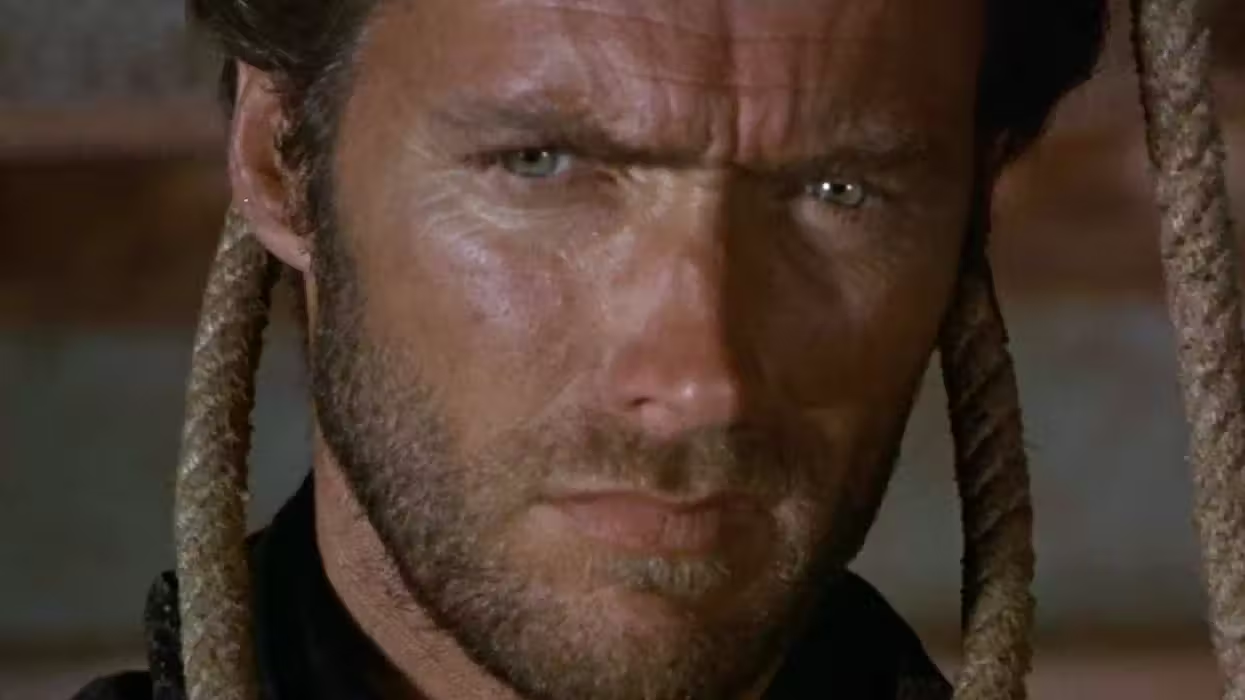
'The Good, the Bad and the Ugly'
Sometimes the simplest lines in a movie can hit the hardest, and today's example is one such line. It's from The Good, the Bad and the Ugly and is spoken by the man with probably the least use for it.
Near the beginning of the movie, as a crowd gathers to watch an outlaw hang, a woman on a passing stagecoach says she's glad they finally caught him.
The bounty killer beside her hardly reacts.
"People with ropes around their necks don't always hang," he says.
It's tossed off, delivered with total calm, and might not feel important in the moment. But in Sergio Leone's West, a noose is never the last word.
Let's look closer.
- YouTube www.youtube.com
The Scene
Early in the film, the coolheaded Blondie (Clint Eastwood) runs a dangerous routine with Tuco (Eli Wallach), the loudmouth bandit he's partnered with for profit.
In at least 15 different counties, the scam goes like this. Blondie hands Tuco over to the law, collects the reward on his wanted head, and waits for the hanging.
Then, as the trapdoor is about to drop, Blondie picks off the rope with a single rifle shot from a rooftop, and the two of them ride off to run it again in the next town.
The line arrives during the second time we see this scam running. A public official reads out Tuco's long list of crimes (and y'all, it's bad if you haven't seen the movie in a while). Tuco is sentenced to hang by the neck until dead.
A woman on a stagecoach, watching, says she's glad they captured such a terrible man.
"Glad they got him. A man guilty of all those crimes!"
Angel Eyes (Lee Van Cleef's ice-cold bounty hunter) is climbing aboard the same coach, and he already sees the whole con. He says, "People with ropes around their necks don't always hang."
"What do you mean?" she asks.
"Even a filthy beggar like that has a protecting angel," he says. His eyes find Blondie in position across the square. "A golden-haired angel watches over him."
And before Tuco hangs, Blondie rescues him again.
What the Line Reveals About Angel Eyes
What the line tells you is that Angel Eyes is the smartest man in the square. He's quiet, dangerous, and observant. Everyone else sees justice being done (they caught him, hooray), while he sees the pattern happening and the conmen up to their tricky business. How has Tuco escaped so many times, after all, if he's wanted in 15 counties?
He reads the setup, and he notes the sharpshooter standing down the road before anyone else knows to look.
The instant, amused understanding is fundamental to his character. He's a villain defined by cold intelligence rather than raw menace. He's three moves ahead and mildly entertained by everyone around him, people who are apparently much dumber.
It also fits how Leone builds him. Angel Eyes is less a person than a pure archetype, a mask. He's singled out as "the Bad" in this tale. He's the man in black.
He doesn't necessarily need a backstory here, because he's the big bad, and a Western traditionally needs one. He verbalizes the movie's central trick and in the same breath reveals exactly how dangerous he will be for the next two hours.
He isn't outraged that a guilty man might cheat the noose, and he's not rooting for him. He watches the whole thing play out. He knows what's going to happen and doesn't do a dang thing about it.
To Angel Eyes, life and death are mechanics to be observed and, when it pays, exploited.
The Rope and the Rifle
In the context of the conversation, Angel Eyes is saying that justice isn't always served. The line really works because the movie means it pretty literally.
But it also works figuratively. Fate, in this world, is a rope. And a rope is just a thing a good shot can redirect, so fate really isn't in control.
When Blondie fires, he's not gambling. Eastwood's gunman only shoots when he already knows the outcome, which turns the hanging from a moment of destiny into a part of a conman's plan. The "golden-haired angel" doesn't really care about anyone's soul. Feasibly, it could be anyone in that noose. He's protecting an investment. The condemned man's whole future depends on whether someone across the plaza decides to pull a trigger.
Leone stages it with his usual storytelling flair. As Blondie lines up the shot that spares Tuco, the film leans on Ennio Morricone and Leone's signature style.
In a traditional Western, the gallows carry moral weight. The guilty almost always die, and order is restored.
Leone takes all of that away. Here, the noose tightens or loosens based on money, aim, and timing. The film thumbs its nose at "fate." A man with a rope around his neck isn't necessarily finished.
The Good, The Bad, The Ugly - Two Kinds of People In This World www.youtube.com
A World Where Fate Is for Sale
That idea doesn't stay contained to one hanging. It runs through the foundation of the whole film.
Fortunes flip easily. Who's the faster draw? Who can offer the better deal? Alliances change mid-scene. To shoot or not to shoot?
The buried gold that everyone's chasing goes to whoever survives the final standoff, not whoever deserves it. Tuco says, "There are two kinds of people in the world, my friend. Those with a rope around their neck and the people who have the job of doing the cutting. Listen, the neck at the end of the rope is mine! I run the risks."
Meanwhile, Blondie splits the world into men with loaded guns and men who dig.
Both are describing the same hard truth. It's cynicism. Leone's spaghetti Westerns took the mythic American frontier and stripped out the romance. It's why the line has outlived its scene.
"People with ropes around their necks don't always hang" is a promise that nothing is settled until the last shot, and cosmic justice has nothing to do with it. Fate, in Leone's West, gets decided by whoever's holding the rifle and is fast enough.