Emily Wilson's Scathing 'Odyssey' Review Violates Ebert's Law
The famed critic would want you to judge the movie not on the book.
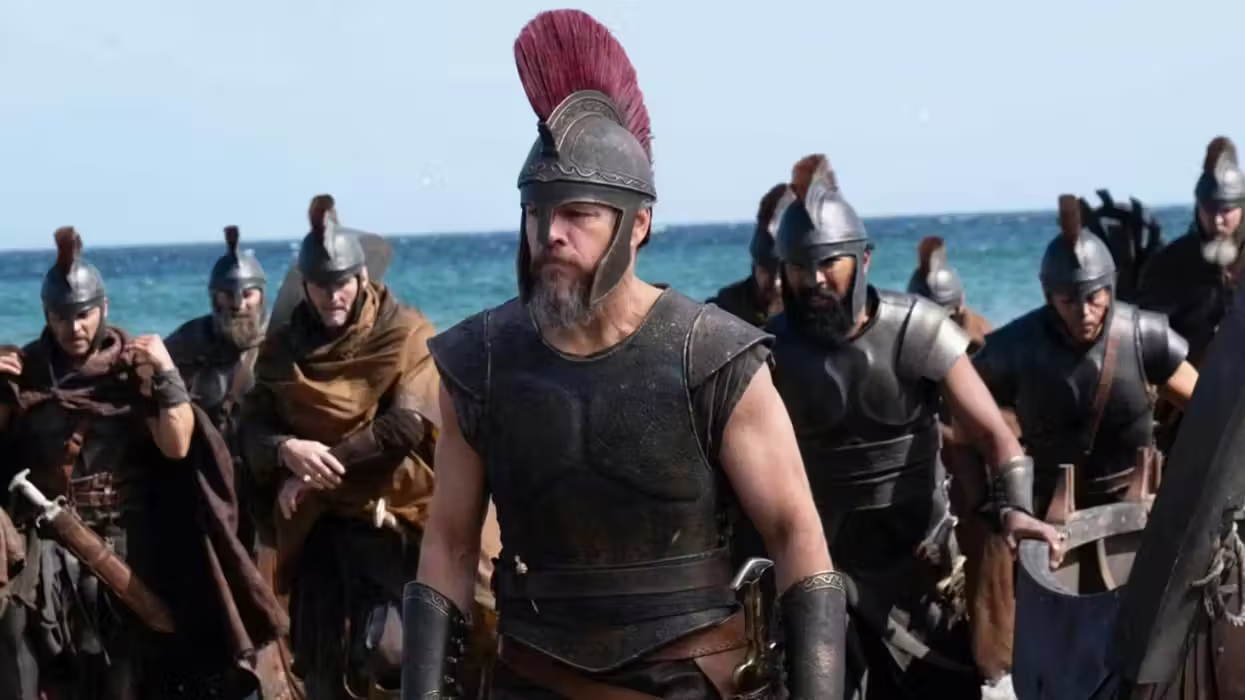
'The Odyssey'
One thing you can't take away from The Odyssey is that it is now part of the greater cultural lexicon. It feels like it is dominating every cultural conversation, inside Hollywood and outside of it.
Part of its sticking power is that even after its initial release, it's still gaining steam overseas, and now we're finally reaching a critical mass where it feelsl ike them ovoe has gone global.
It was also the title at a very stupid culture war, with people arguing over the book's translation even before it came out, along with an even dumber conversation about the film's casting and box-office prospects.
Anyway, entering this conversation is Odyssey translator Emily Wilson's scathing review, in which she argues that the audience sees inside the Trojan horse but “do not see inside the characters or their world.”
Now, I want to unpack how that actually goes against famed critic Roger Ebert's rules for film criticism, which I'll dub Ebert's Law for this conversation.
Let's dive in.
- YouTubewww.youtube.com
Ebert's Law and Film Criticism
Okay, let's start with the conversation, which I saw started on X this morning. I saw a tweet I'll link below that addresses Ebert's point of view on film criticism.
So I wanted to bring that to you here.
The basic gist is that Roger Ebert had this philosophy on how you should judge a movie. The whole idea was that "A movie is not about what it is about. It is about how it is about it."
He wrote about that in his 2006 anthology Awake in the Dark, and went on to say:
"A movie is not good because it arrives at conclusions you share, or bad because it does not. A movie is not about what it is about. It is about how it is about it: about the way it considers its subject matter, and about how its real subject may be quite different from the one it seems to provide."
I remember reading those words when I was in college and really trying to rigorously defend them when I started watching more movies seriously. What did the movie have to say? Was I judging it based on that, or was I trying to change it to be what I wanted it to be or to say?
Now, in The Odyssey, you have Zeus's law, which means extending your hand to everyone and welcoming them into your home and table.
So I was dubbing this Ebert's law, which means extending this point of view onto every movie and seeing how it changes your perception when watching them.
That means that under Ebert’s framework, the cardinal sin of film criticism is penalizing a movie for failing to be the entirely different film you wished the director had made instead.
The Counter-Argument: Brody's Critique of Ebert
Now, I should have expected the conversation on Twitter to reach other critics, so this story was kind of evolving as I began to write it.
Now, what I love about lots of film critics is that they have their own points of view on the job and what it entails, and how we should take in movies and TV.
One of the other voices I really love to read is The New Yorker’s Richard Brody.
Brody's take is that Ebert was wrong because the director's core vision itself must be subject to critical judgment.
From Brody’s perspective, technique cannot be divorced from intent. You cannot separate how a movie is made from what it is choosing to communicate.
If a filmmaker deploys some amazing technique, breathtaking scale, and flawless execution, but you get a movie that's hollow or bad, the critic’s job isn't to applaud the execution. It's to call out the bad idea at its center.
I didn't find this to be the opposite of Every's point of view; it just adds nuance. In my estimation, you still want to pick apart intent and directorial vision.
And all that gets put into action when you read the Wilson critique.
Where Wilson’s Critique Misses the Mark
This long and winding road brings us to Emily Wilson's review of The Odyssey, where she pulls apart its message and themes juxtaposed against what the epic poem had in store.
Wilson has earned the right to be the authority on The Odyssey. She translated it, and while I consider myself a Fagles guy, since it's what I read in high school, I bought a copy of her work and really enjoyed reading it, as different as it was.
Now, if you read the whole review in The Atlantic, I feel like she's adopting what would maybe be a Brody-esque position, because she's arguing that Nolan’s fundamental idea for the film is the problem.
But my issue with the review is that she's also not engaging with that movie Nolan made at all.
All she can do is engage with the poem she translated and the differences between them both. Like, at some point, in any adaptation, you can't just bang the drum of "the book is better"; you also have to have an original thought about whether the movie works or not.
To me, this is Wilson falling into the exact trap Ebert warned against.
And I can see why!
Wilson spent years carefully crafting an English translation of Homer’s epic. But a film director’s job isn't to translate ancient Greek meter into visual prose. They have to make an entertaining film that means something to the audience.
This is basically them doing another translation, one they think can get to a different audience.
And just because it's so different than your own reading, you do have to meet them on their interpretation and decide if that speaks to you while divorcing yourself from the other.
Adaptations into movies are not about a literal one-to-one voice, but about individuals taking meaning and then conveying that meaning to the audience.
You can argue that Nolan's movie doesn't do that, and I'd be fine with that, but then you have to use ideas from the movie rather than the book.
Nolan’s decision to approach The Odyssey through kinetic scale, structural time manipulation, and visual motifs is what he's done in almost every movie.
These are his markings of autism, so you have to meet him there.
Summing It All Up
This is going to be ab itter pil lto sawlloe, but adaptation is kind of violent. You can't jam everything in there, so, like Leguizamo's character in the movie, you have to kill your darlings and just pick the best parts for the screen.
When Stanley Kubrick adapted The Shining, Stephen King famously hated it because Kubrick threw out the novel's thematic core regarding family tragedy and alcoholism in favor of an ice-cold study of madness and isolation.
But for Kubrick, that's the movie he wanted, not the other one.
Nolan’s The Odyssey operates under that same banner with this ancient Homeric work. The director's goal was never to deliver a university lecture on xenia.
His movie was to build a cinematic experience around the tragedy of distance, time, and human endurance.
And according to Ebert's Law, that's where our conversation with it should begin.
Let me know what you think in the comments.