 Generally speaking, it isn't too difficult to plug something in correctly. That is to say, the relationship between a plug and its matching receptacle is often pretty self-explanatory. And yet, somehow, I still find myself trying to plug USB cables into USB ports the wrong way. USB is everywhere, and that's not something that is likely to change anytime soon. What will change, however, is the ease of plugging things into it. That's because USB specs have finalized the new Type-C reversible connector design announced earlier. The connector/cable type promises the 10Gb/s speeds and 100W power provided by USB 3.1, and yes, the physical incapability of being plugged in wrong.
We've known for some time now that USB 3's abilities would eventually be absorbed and expanded on by the updated 3.1 specification. The new spec outlines several upgrades, mainly 3.1's doubled maximum theoretical speeds of 10Gb/s over the 5Gb/s of USB 3. However, USB 3.1's more-efficient encoding scheme also uses less overall bandwidth -- meaning more user-dedicated pipe and greater real-world throughput to scale. This, as it turns out, is because 3.1 switches to 128b/132b line coding from USB 3's 8b/10b at the physical layer. Apparently the latter costs 20% in interface overhead while the new coding scheme costs only 3%, allowing for wider data payload and greater resiliency to error per bits transmitted. This is on top of the bandwidth expansion, so USB 3.1 is actually a greater-than-double increase in performance over 3.0.
We've also known that USB 3.1 will be backward-compatible all the way back to 2.0, just as USB 3 is -- and that older computers/ports will be forward-compatible with newer 3 & 3.1 devices. Plus, bus power rates will include 2A at 5V, 5A at 12V, and 5A at 20V configurations as defined in the current spec. What will tie all of this together as we move forward, however, is the USB Type-C Connector (see image below, courtesy the USB-IF, Inc. via CNET):
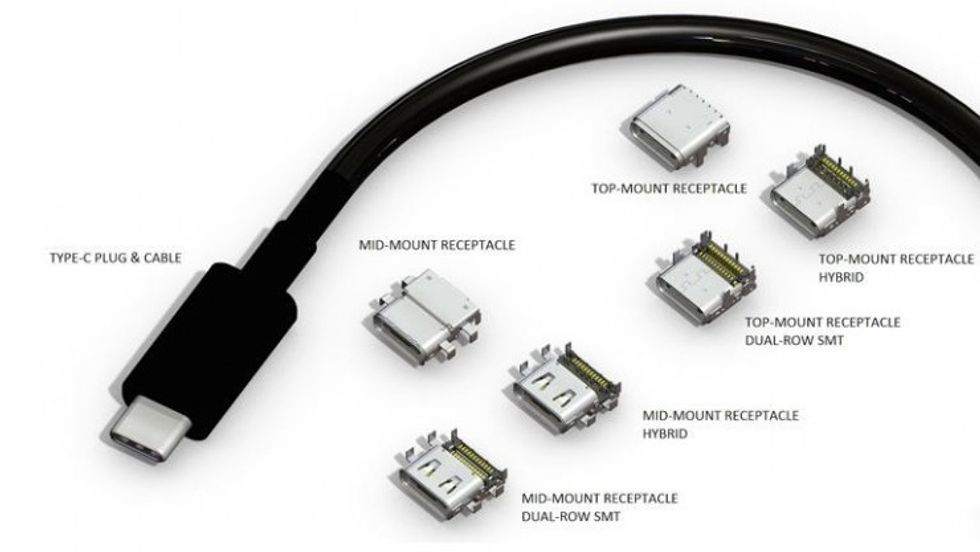
According to CNET:
The USB is comparable in size with micro USB 2.0 Type-B connectors, with a port size of 8.4 by 2.6mm, yet will be compatible with SuperSpeed USB at 10Gbps (USB 3.1). It will also support USB Power Delivery up to 100W, with additional support for scalable power charging and future USB performance needs.
Comparisons have been made to Apple's likewise-reversible Lightning connector, but chances are we won't see that technology used anywhere outside the iOS world. USB 3.1 and the Type-C connection, on the other hand, will know no such limits. As digital interface technologies continue to advance and mature, their applications in camera technology will probably become more common -- and the relationship between the two will likely deepen. We've already seen Thunderbolt built into cameras by Blackmagic and AJA, for instance. If anything, this is testament to the potential implications such an interface could have in capture, control, monitoring, or other aspects of camera workflow.
But like its meteorological cousin Lighting, Thunderbolt will probably always be more expensive than USB. And, with version 3.1, the cheaper and more universal protocol becomes robust enough to transport a data stream on the magnitude of 6G-SDI, with legroom to spare. Whether the manufacturers of tomorrow's camera technology exploit such potential -- or allow users to exploit it -- is yet to be seen. But with a pipe that wide built into the side of every next-gen camera, consumer smartphone, and SD card-accepting tablet with a high resolution-scale display, some exciting possibilities could lie ahead.
At the very least, when the USB 3.1 Type-C connector comes to fruition, you'll have no trouble plugging the damn cables in.
Link: USB 3.1 Specification -- USB.org
[via CNET]