The Ending of 'Disclosure Day' Explained
The polarizing Steven Spielberg movie has everyone talking online.
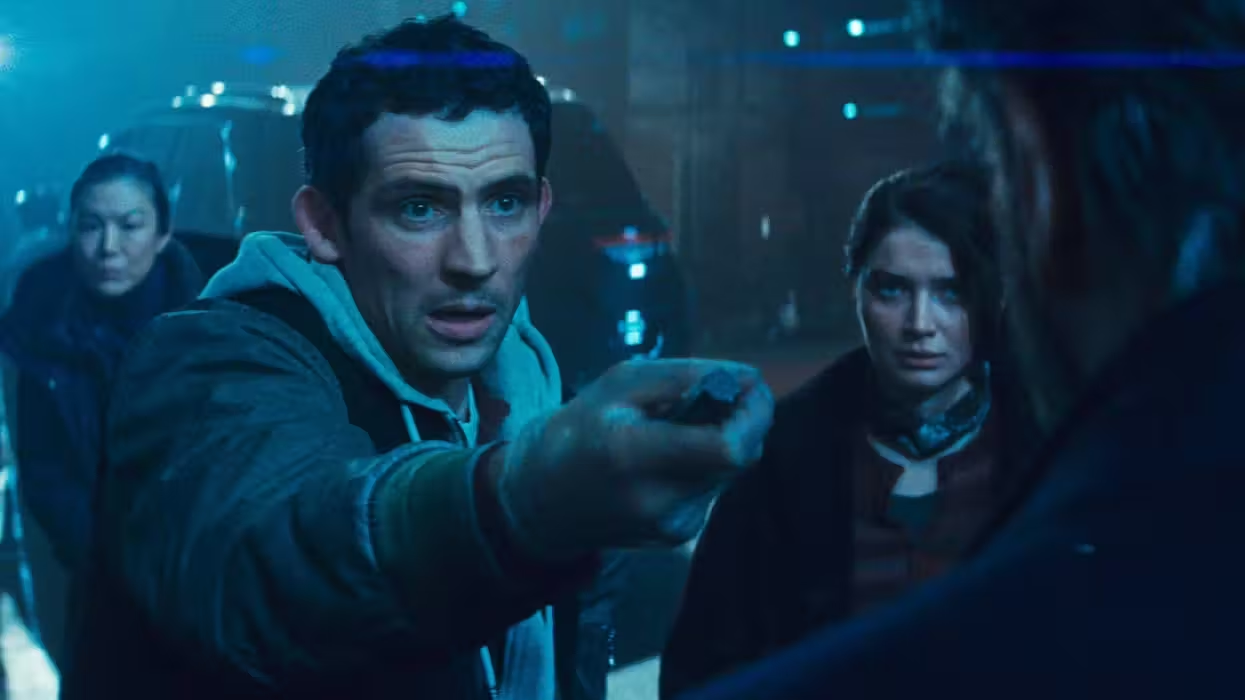
'Disclosure Day'
Steven Spielberg has released some of the most interesting science fiction movies in history. From Close Encounters of the Third Kind to E.T. to Disclosure Day, these movies get everyone talking and can be polarizing at times.
Today, I want to talk about Disclosure Day, since it seems like everyone is picking it apart and discussing not only its plot but also its ending.
Working from a script by David Koepp, the film trades the wonder of Close Encounters for the institutional paranoia of the modern age that can feel hokey at times, but had me on the edge of my seat as I leaneed into the idea that humanity needed to look up from their phone screens and into each others eyes in order to stop tearing eahc other apart and work toward a common goal.
Let's dive in.
- YouTube www.youtube.com
The Plot: A Race for the Ultimate Truth
The film kicks off on the brink of World War III. Daniel Kellner (Josh O’Connor), a cybersecurity specialist, steals a piece of alien technology and classified files from the Wardex Corporation. The files detail human-alien contact stretching all the way back to the Roswell incident.
He's being chased by Noah Scanlon (Colin Firth), the head of Wardex.
In order to get the files back, Wardex and Scanlon kidnap Daniel's girlfriend, Jane Blankenship (Eve Hewson), and we open the movie on his exchange of the files for her life.
But Daniel pulls a double cross and escapes with Jane, along with a backpack of files.
Meanwhile, in Kansas City, meteorologist Margaret Fairchild (Emily Blunt) has a bizarre encounter when a cardinal flies into her home and locks eyes with her.
The incident awakens psychic abilities that allow her to read emotions and speak unlearned languages.
When she begins speaking an alien language during a live weather broadcast, the footage goes viral, putting a massive target on her back for Wardex agents.
Daniel intends to go public with Wardex's history of experimenting on alien captives; Scanlon uses a telepathic alien device to psychically bond with Jane, tracking the couple to a hotel. Daniel is captured, but Jane manages to escape with a separate piece of stolen alien tech.
Margaret then tracks Daniel to a black site thanks to her alien visions. She uses her empathy-shifting powers to force their captors to stand down, even Scanlon, and after surviving a brutal car crash where Wardex agents attempt to murder them, the two escape onto a passing train.
They are rescued by Hugo Wakefield (Colman Domingo) and a faction of Wardex whistleblowers who want to disclose all the alien information to the world.
In a hidden warehouse containing a physical reconstruction of Margaret’s childhood home, Margaret recovers her suppressed memories and realizes that she and Daniel were abducted as children and bio-engineered with these powers to act as translators for the world to understand the aliens' message.
They also learn that the unusual animals crossing their paths throughout life, like the cardinal in Act One and a deer later, were actually cloaked extraterrestrials observing them.
What Happens at the End of 'Disclosure Day'?
With the world teetering closer to total world war, Margaret, Daniel, and the whistleblowers break into Margaret's old television studio to execute a global broadcast they dub "Disclosure Day."
Scanlon tries to cut the feed by disabling the local power grid, but Jane arrives just in time and gives Margaret her stolen alien device, which she then uses to jump-start the station's electricity.
At that point, Scanlon steps back to watch the broadcast unfold alongside the rest of humanity because he knows he cannot stop what's happening.
The transmission successfully reaches the entire planet and presents undeniable evidence of alien encounters and decades of government deception and even torture of its foreign alien peoples.
The revelation shocks the global community, instantly halting the outbreak of World War III.
Then, as a surprise, Hugo's team wheels out a living, breathing extraterrestrial (referred to as In Vivo 17) that they freed from Wardex custody and who has a message.
The alien whispers a private message into Daniel’s ear, which Daniel then translates and whispers to Margaret.
Margaret steps toward the camera, looks directly at the audience, and says one word: "Listen."
Then, the screen goes black.
- YouTube www.youtube.com
The "Passenger" Connection Explained
This feelsl like the biggest question I heard people talking about in the lobby, so I wanted to go all in on it here.
The Act Three reveal is that Daniel and Margaret weren't just random targets; they were abducted as children in 1996 by the aliens to serve as translators for this exact moment of disclosure on the world.
They called these people passengers.
- Margaret: Developed "emotional telepathy." She can see a person’s life story in their eyes, making her the perfect vessel to broadcast the feeling of the message.
- Daniel: Developed the ability to understand complex extraterrestrial mathematics and language.
This explains why Daniel could understand Margaret's weather broadcast. They were two halves of a single communication device designed decades ago to help the aliens speak to the humans.
And it explained when, in the end, the alien whispers to Daniel, who then whispers to Margaret.
Why did Spielberg end it on a cliffhanger?
The decision to cut to black after Margaret says "Listen" has sparked a massive debate on Reddit and other parts of the internet.
While some viewers feel excluded from the intended message, the thematic intent is clear: it isn't for the characters; it's for us.
The world in the film is on the verge of nuclear war. The aliens’ message, distilled into that final word, is a plea for empathy.
Only our dedication to stop killing each other can lead to the wonders of the universe.
What does "Listen" actually mean?
These are all just my interpretations,m but I think the word has a triple meaning. It can be seen as a literal instruction to listen to what the extraterrestrials have to say now that they are no longer hidden.
It's also a geopolitical plea to stop the impending world war by finding common ground.
And finally, it's a commentary on "whistleblower culture," asking the public to pay attention to the stories of those trying to expose institutional secrets.
Is a sequel coming?
Probably not.
The consensus among critics is that the abrupt ending is entirely the point of the movie. The story continues in the "real world" of the audience. e're suppsoed ot be the ones listening to one another and trying to solve the world's problems.
Summing It All Up
I found this to be an emotional and engaging movie that sort of explained all of Spielberg's views on the world and humanity in his old age. We got a ton of sentimentality, but there was also this plea to stop killing each other and fighting so we can try to find a way to unite overo ur existence on this pale blue dot.
I loved this movie, but I admit it's polarizing, and many had the opposite take.
Let me know what you think in the comments.