95 Years Later, Charlie Chaplin's 'City Lights' Still Holds the Record for Most Retakes of a Single Scene
It was a pivotal moment in silent film.
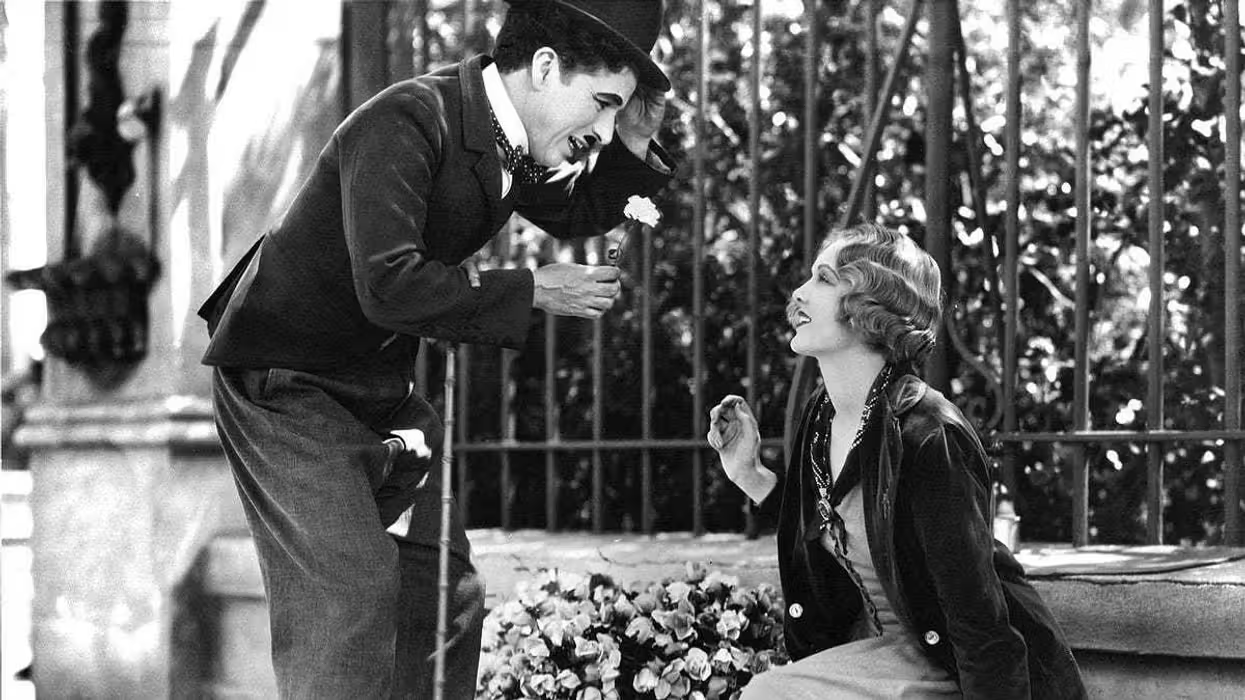
'City Lights'
Some scenes take a few tries. Some take a few more. And then there's Charlie Chaplin, who looked at a three-minute meet-cute and decided 342 takes was what he needed.
That's not a typo, and it's not internet exaggeration. According to Guinness World Records, the sequence in City Lights where the blind flower girl, played by Virginia Cherrill, sells Chaplin's Tramp a flower under the mistaken belief that he's wealthy, took 342 takes, making it the official record for most retakes of a single scene.
Ninety-five years after the film's January 1931 release, nobody has come close to touching it.
Check out the iconic moment below.
- YouTube www.youtube.com
What Happens in City Lights
City Lights follows Chaplin's Tramp as he falls for a blind flower girl who sells flowers on a street corner. After a chance encounter, she mistakes him for a wealthy man when she hears a car door slam shut as he walks away.
That night, the Tramp saves a drunken millionaire from a suicide attempt, and the two become unlikely friends. The friendship that comes and goes depending on how drunk the millionaire is at any given moment.
The Tramp learns that the flower girl needs money for an operation to restore her sight and uses his connection to the millionaire to secure the funds. He endures a string of mishaps, mistaken identities, and near-misses, all while trying to keep up the illusion that he's the wealthy benefactor the flower girl believes him to be.
Their climactic reunion is one of the most emotional moments of silent film history.
Why Chaplin Couldn't Let the Scene Go
The hang-up wasn't performance. It was a storytelling issue. This was the era of silent film, and while dialogue was performed on set, it wasn't always conveyed to the audience. Interstitial dialogue cards were brief and far between.
In this scene, Chaplin kept re-shooting because he couldn't figure out a believable way for the blind flower girl to think the Tramp was rich. He needed the audience to buy the misunderstanding that drives the entire plot, and he wasn't willing to fudge it. Sure, he could have just had the character say something about her belief in his supposed wealth, but that would have been on-the-nose and unrealistic. The fact that Chaplin pushed himself to do something better shows how talented and driven he was as a storyteller.
The solution he landed on is almost embarrassingly simple. Chaplin has the Tramp get stuck trying to cross a busy street, so he climbs into a parked limousine through one door and out the other. The flower girl hears the car door and assumes its wealthy owner has stepped out.
She stops the Tramp. Chaplin buys the flower, realizing the young woman is blind. Nearby, the man with the car returns. She again hears the car door and thinks the Tramp is already gone. It's elegant.
What City Lights Was Up Against
The timing of City Lights makes Chaplin's obsessiveness even more interesting.
By 1931, sound had already taken over Hollywood, and City Lights was Chaplin's last fully silent film before he started incorporating dialogue and music into Modern Times and eventually made a true talkie with The Great Dictator. He was making a silent film in an industry that had basically decided silent films were finished.
That's a lot of pressure riding on one street-corner scene. If the audience didn't believe the setup, the whole premise of a tramp being mistaken for a millionaire falls apart, and so does the rest of the film's plot.
The Other Contender, and Why It Doesn't Win
If you've spent any time in film trivia circles, you've probably also heard that Stanley Kubrick demanded over a hundred takes for a scene in The Shining.
That's true, but it's a different record. Guinness recognizes 148 takes for the "shine" scene between Scatman Crothers and Danny Lloyd as the record for the most retakes of a dialogue scene, in a separate category from Chaplin's overall record.
Even that number has been disputed. Steadicam operator Garrett Brown first reported the figure, but other crew members on The Shining have pushed back over the years on exactly how it was counted. Chaplin's 342, by contrast, has stood as the all-time record without anyone seriously contesting it.
The Lesson for Filmmakers
The thing about 342 takes is that it's not really about discipline or stamina, although you'd need plenty of both to pull it off. It's about knowing exactly what you're looking for, even when you can't articulate it yet.
Chaplin wasn't grinding through takes, hoping something would click by accident. He had a specific problem, a logic gap in his story, and he kept shooting and brainstorming until he found the mechanism that solved it.
Another thing to remember here is that Chaplin, by this time, was one of Hollywood's most innovative filmmakers. He had churned out hit after hit with his Tramp character and had proven his mettle as a director, writer, and performer. While it was likely a big ask for his crew to deal with shooting the same scene day after day, they did it because they trusted that he would land on the thing that served his vision.
For short filmmakers especially, this is something to learn from. You're not going to get 342 takes on a student film or a weekend shoot, and you probably shouldn't try. (Spare your crew, please.) But the underlying instinct, knowing the difference between "this technically works" and "this is the thing," is the same instinct, whether you've got unlimited 1931 studio resources or one afternoon and a friend with a camera.
If a scene isn't landing, the fix usually isn't more energy in the performance. It's often something structural and small, like Chaplin's car door, that you haven't spotted yet.
Ninety-five years on, City Lights still works precisely because Chaplin refused to settle. The 342 takes are indeed a bit of stunning trivia. But they're also the reason that scene, and the film around it, still holds up.