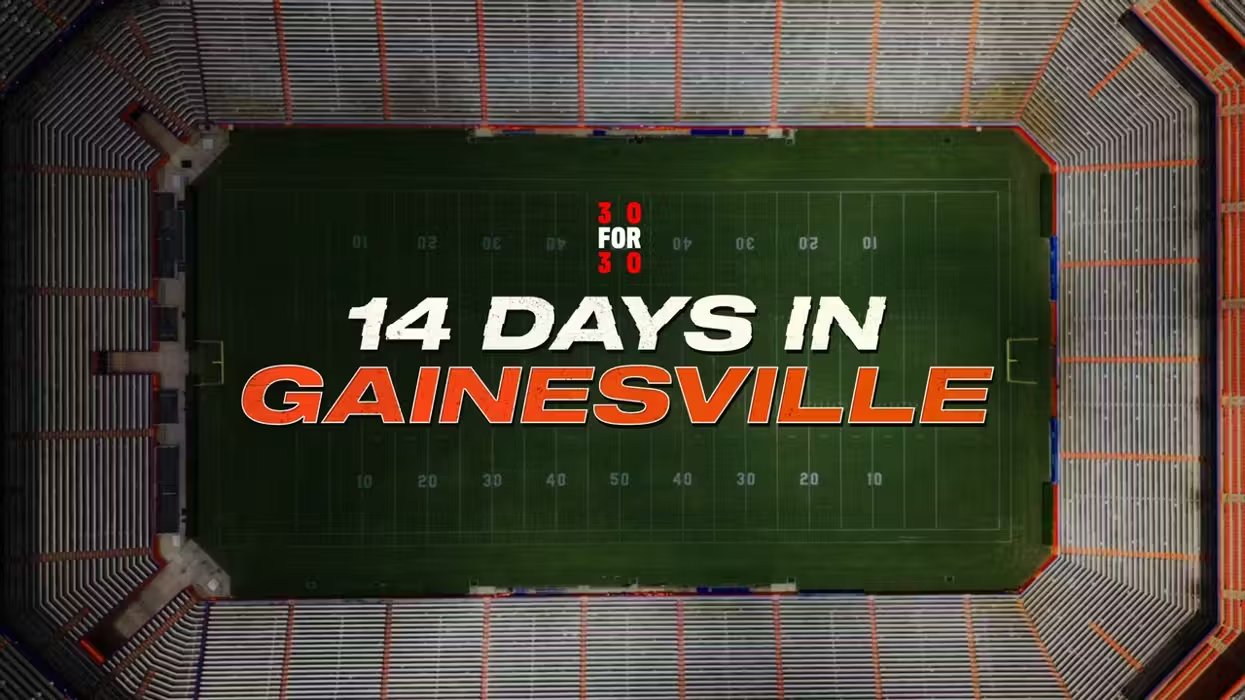
In August 1990, the city of Gainesville, Florida, was gripped by unimaginable terror as a violent crime spree claimed the lives of five college students: Sonja Larson, Christina Powell, Christa Hoyt, Tracy Paules, and Manuel Taboada.
It was a tragic moment that rocked the nation, especially the student-athletes of Florida, who had ot find a way to play football through unimaginable grief.
In the ESPN 30 for 30 documentary 14 Days in Gainesville, director Daniel B. Levin (UNINTERRUPTED: The Real Stories of Basketball) and ACE editor Rich Hyatt chronicle those chaotic two weeks that changed sport forever.
The doc balances the sensitive realities of true crime with the cathartic power of team.
We sat down with Levin and Hyatt to discuss their collaborative process, diving through discarded 1990s archival footage, "charging up" film subjects in the edit suite, and navigating the emotional weight of honoring victims while telling a complex community story.
Let's dive in.
- YouTubewww.youtube.com
NFS: Hey Daniel and Rich! Can you tell us more about 14 Days in Gainesville? How did the project come together, and what was your familiarity like with this story before you began?
Daniel B. Levin: This project initially started with two producers, Steve Helling and Brandon Blackburn. They were connected to some of the characters and students who were at UF at the time, and Steve covered the murder investigation as a journalist. They brought it to Executive Producer Joe Townley of My Entertainment, whom Rich and I had previously worked with on a doc series called "UNINTERRUPTED: The Real Stories of Basketball". Joe brought it to me, and I had spent time in Gainesville; my wife is a UF Graduate. I felt like this story had a real opportunity to make a compelling film. We brought it to ESPN, and now it is streaming on ESPN+.
Rich Hyatt, ACE: I had completely fresh eyes when it came to this story, which is my preference as an editor. It helps me see what is universal about a story, and I get a chance to experience the raw footage without any preconceived notions.
NFS: Daniel, how would you describe the overall style and approach of the documentary? How did you balance your own instincts with the broader standards of ESPN's 30 for 30 series?
DL: Since the project was for ESPN, I wanted this to be grounded in sports and for the sports story to lead the way. I also wanted to be thoughtful on how we told the crime side of the story. I wanted to be sensitive to the victims' family and friends; this wasn’t going to be a true crime investigation, but focus more on how these events unfolded in real time and how they affected the community. It was also important to keep the film’s voices to people with firsthand perspectives who lived through these chaotic events, from the football team to the press, law enforcement, students, and the victims’ family and friends. Ultimately, the challenge was how to weave these two stories together, moving back and forth seamlessly and keeping the momentum of the film going, all crescendoing with the first home football game, a moment that brought some joy back to the community, even if only for a couple of hours.
ESPN was open and flexible about how we wanted to tell the story, and since we had this 14-day framework, we really had to keep it chronological and get as much context into the film up top so you could drop the viewer into the story for these dramatic two weeks. The archival was very important, and I started by going through the local newspaper archives like the Gainesville Sun and The Alligator and looking how each story was covered day by day. You had the murder investigation dominating the front page, but the sports section was also deep in the stories of the team, Spurrier’s return, and questions around the new starting quarterback. So it all came together in the right weave in the edit. It was a small team: Rich Hyatt editing, Jay Frosting assistant editing, Dan Mclean story producing, Jason Heilig was our archival producer, and he went to UF, so he knew where to get a lot of this material, and ultimately Khari Mateen scoring the film and bringing the right musical elements to each scene.
NFS: Do you each have a favorite moment or sequence from the film?
DL: Rich cemented a montage transitional style early, using news report audio over B-roll of Gainesville in present day and archival, and there is one such transition that leads to the home opening game that I still get chills watching. That montage into the beginning of the home opening game, when we see all the football players whom we have been with for the majority of the film. When they take the field and start to play for the home crowd, it is when the film comes together and starts delivering on its biggest moments. I can’t help but feel the tensions and the catharsis of that moment.
RH: For me, it’s after the second set of murders. Panic starts to set in. Talking heads give way to something more cinematic. Thanks to archival producer Jason Heiling getting us so much unseen archival, footage that, 36 years ago, only saw the editing room floor, now takes on its true meaning. Snap zooms to candid looks reveal the true panicked looks on students’ faces, mixed with archival sound ups that pull us to the next sound bite. You can’t help but empathize with the students and what they’re going through. There’s such beauty in the once-discarded camera movements, combined with the pace and the music. It all plays together in a way that still affects me when I watch it.
 Daniel B. LevinCredit: Impact24
NFS: The project really captures the intensity of University of Florida's football culture, which has only grown in the decades since. How did you tap into the local community to convey that feeling to audiences?
DL: Football is a part of life and culture in Gainesville, so anyone you talk to, that love and excitement for the Gators is always there. I think what makes this story unique as it relates to the Gators is that this was at the beginning of a huge transformational time for the Gators. You had Spurrier coming back, a new unproven quarterback in Shane Matthews, a new style of play, and ultimately all these elements would transform Gator football as well as the SEC. The SEC changed in Spurrier's image and became a passing conference, and the Gators became dominant for the next two decades. I think for Spurrier and the players, getting to shine a light on the ‘90 team was special for them. The team started an epic run of Gator football, and given that they were never officially recognized as SEC champs that year, giving them their recognition was important. And to have this all start in such a remarkably tragic and trying time in Gainesville, and for football to be something that brought the community together in a time of tragedy, made this story that much more captivating.
RH: As an editor, I’m isolated. I’m seeing this world through a screen, and determining what to show the audience to convey what happened to this community. I tapped into this community through the archival. I would spend days just looking at raw, unused footage from that time and finding small moments and expressions that conveyed what the community was feeling. That’s something you could never put into words.
NFS: Rich, the documentary culminates in a really emotional finale. Can you walk us through assembling that final game from an editorial standpoint?
RH: To really get under the hood of this emotional moment, you have to look at three things.
First is the work we did leading up to day 14, the season opener. We spent a lot of time creating empathy for all of our characters. I call this charging up our characters. When you start watching the film, you don’t know anything about these people. They’re not necessarily known to you, but as we carefully crafted each bite, letting the viewer spend time with them and come with them on this journey to the season opener, their characters become charged in an emotional way. We had a rockstar supervising producer, Dan McClean, who was always searching and curating the best bites to get us to this moment. I consider the community to be another character that can only really speak for itself through archival. Some of that archival comes from sound ups from news, reports, interviews, etc., but the real delicate touch comes from some of this rough, unused, raw footage and photos that we took advantage of. This is where my assistant editor, Jay Frosting, with whom I’ve been working for almost 10 years at this point, helps me go through everything and often reminds me of something I missed or hadn’t considered.
Second is dynamics and pacing. Having done all this work to charge up our characters to create this heavy payload of emotion, expectation, and tension, it's important not to rip open this package quickly. We bring things all the way down to almost silence. Just the slightest sound of wind with the drone of trees and the graphic signifies that we're finally at the final day of 14. As Daniel mentioned, we use a montage of archival voices to slowly bring us into the stadium. And we managed to fill the stadium with fans, but still keep the sound design relatively quiet, matching the emotion of the community at the beginning of the game. Even as the game begins, we keep things very restrained.
Third is discipline. Only after we’ve earned the right, we let the film open up and celebrate as the team is seeing some success on the field. Even then, we do a bit of a flashback to remind the audience of where we were at the beginning of the game just to create some contrast before we take the mood even higher. We spent a lot of time refining the game down to just the key moments you need to feel the emotion. We get to celebrate with characters we’ve charged up and gotten to know and empathize with, and then we get out before we’ve overstayed our welcome. This whole film is about balance. Because it’s a 30 for 30 for ESPN, your first instinct might be to linger on gameplay, but this story is about so much more. It’s about the community and the victims as well. So we’re constantly balancing that.
NFS: Tell us more about your collaboration. How did you first start working together, and how did your dynamic evolve on 14 Days in Gainesville?
DL: Rich and I worked together on a project called "UNINTERRUPTED: The Real Stories of Basketball", which is on VICE TV and is an anthology basketball series that deals with a wide variety of untold basketball stories. Rich edited the pilot episode “Scam Dunk”, which is about the human trafficking of amateur international basketball prospects, and it was ultimately nominated for “Outstanding Journalism” at the 2025 Sports Emmys. That was a hard story to tell, and it helped us develop the style of the show. I found Rich a very collaborative editor, one who took notes well and was easy to communicate with. So when this film came up, I thought he would be the perfect editor to work with, and we dove right into the project together.
RH: Daniel’s a treat to work with. He’s one of those people in this business that knows how to get the best out of people. Even on demanding projects, he creates space for creativity. I think that’s why his career is filled with so many strong projects.
 Rich Hyatt Credit: Impact24
NFS: Is there anything else you would like to add about 14 Days in Gainesville or any other upcoming projects?
DL: I hope people will watch this story and spread the word about it – we would love to hear your feedback. I think ultimately there is something in this film for everyone, whether you are a die-hard Gators fan or have never watched college football in your life, there is a deep and emotional journey that viewers go on. And in the end, we wanted a film that people could connect with, one that shows the power of sports beyond the playing field. As well as a story that would honor the victims of these horrible murders. I hope you can learn something about who the victims were: Sonja Larson, Christina Powell, Christa Hoyt, Tracy Paules, and Manuel Taboada. They were all teenagers and young adults who had their potential and promise tragically taken from them. May they rest in peace and be remembered as the good, kind people they were. Their names were memorialized in Gainesville over the Labor Day weekend in 1990, and that memorial has been there ever since – 36 years later, a testament to the community of Gainesville making sure we don’t forget who they were and what happened in 1990.
RH: I second the sentiment that this film has something for anybody. When I signed on to this project, I made it my mission that this film play to people who are not college football fans. This is more than just a sports story. It’s a story of the community, these victims, and the healing powers of sports.