The 'Jaws' Sequel Tagline So Bad It Became Iconic for the Wrong Reasons
This time, it's personal.
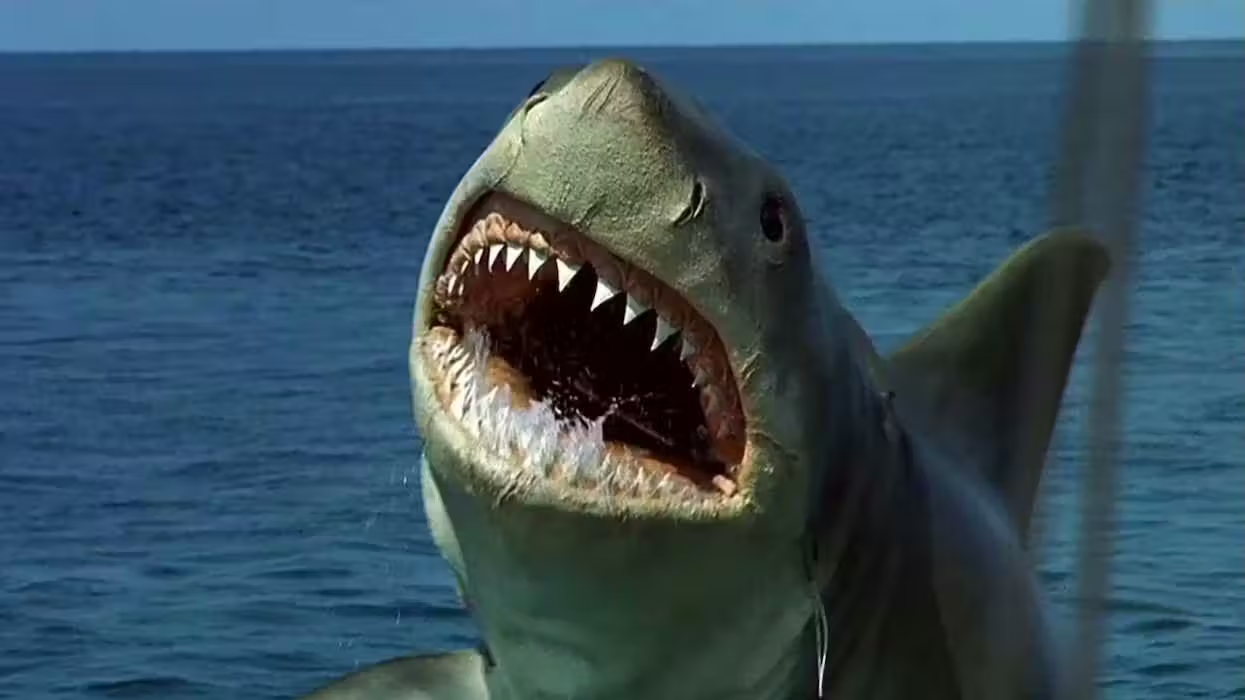
'Jaws: The Revenge'
Some movies just don't need a sequel. I think most people would agree that Jaws is one of them.
You probably already know that Jaws was Steven Spielberg's first major hit and the spark for the summer blockbuster era. Its story of a small beach community welcoming summer tourists and a deadly great white shark is one of the best creature features ever put to screen, mostly because the characters are so good. You've got the fearful sheriff, the nerdy academic, and the salty seafarer, and all of them are well-developed, fun people to watch.
Spoiler, but they kill that shark. So a sequel doesn't really make sense.
But somehow we get to 1987 and a fourth movie, Jaws: The Revenge. In this one, Ellen Brody (returning star Lorraine Gary) becomes convinced that a great white is stalking and hunting her family across the ocean to avenge the sharks killed in previous films.
The film co-stars Michael Caine as an airplane pilot. Caine famously missed collecting his Academy Award for Hannah and Her Sisters because he was busy filming this movie, later saying, "I have never seen the film, but by all accounts it is terrible. However, I have seen the house that it built, and it is terrific."
The film was not a success. It's currently sitting at a 2% on Rotten Tomatoes, so it's safe to say it was a critical disaster.
However, the tagline is one of the most recognizable pieces of movie marketing ever written. Today we want to look at the film… and how to sell something you've made.
- YouTube www.youtube.com
This Time… It's Personal
A lot about this film is confusing. It's the last of the Jaws movies, but it takes place after Jaws 2 and ignores Jaws 3-D entirely. It features a now-widowed Ellen Brody, mostly because Roy Scheider declined to play Chief Brody again.
The production was harried and plagued by difficulties. And the project moved wildly fast.
In March 1987, Boston Herald reporter Donna Rosenthal asked, "What … would motivate Universal executives to compress the usual time it takes to develop a major film from idea to production—about two years—into a frantic nine months, aiming for a July release date?" (via plume-de-pan).
Well, Universal CEO Sidney Sheinberg reportedly rushed the film into production to coincide with a new Jaws ride at the company's theme park. He went to Joseph Sargent to direct, offering him creative freedom.
"I didn't have time to laugh because Sid explained he wanted to do a quality picture about human beings. When he told me, 'It's your baby, you produce and direct,' I accepted," Sargent told Rosenthal.
According to I.Q. Hunter's research for "Jaws: The Revenge and the Production of Failure," the script was written in five weeks and edited in six.
Speaking later to The Television Academy Foundation, Sargent was asked how he came onto the project.
"That's a question I've been asking myself for 20 years. Not how, but why. Again, this was Sid Sheinberg's mandate for me. He said, 'Find a way to kill the shark a different way that hasn't been done before.' Because the shark had to be killed at the end of the movie. And the trouble with a franchise is that, unlike the original—which of course burst on the screen with such impact and such dynamics and was such a brilliant film—everything that follows can't help but be a pale reflection of the original impact. No matter how threatening you make the shark, no matter how clever a device for killing him, no matter what you do, it's only a second, pale nothing compared to the original."
He admitted that creative freedom seduced him. And how was the film received?
"It was a disaster, and rightfully [so]—because primarily we tried something that evidently came out of a little bit of desperation to find something fresh to do with a shark. Now what can that be? We thought, well, maybe if we take a mystical point of view and go for a little bit of magic, we might be able to find something interesting enough to sit through."
- YouTube www.youtube.com
The Tagline That Outlived the Film
Starting with a goofy idea is bad, but the famously horrible tagline made it worse.
"This time, it's personal."
Compare it to Jaws 2's "Just when you thought it was safe to go back in the water," a longer, atmospheric line that builds dread and one that most people hail as one of horror's stronger marketing taglines.
It just makes "it's personal" feel even sillier. ComicBook.com noted in its franchise retrospective that the line spotlights the worst thing about the movie's premise—a shark holding a grudge against a specific family and following them across international waters. Because that makes sense.
As The New York Times asked in its 1987 review, "Why hasn't this family moved to Nebraska?"
Two years later, Back to the Future Part II sent Marty McFly to 2015, where he passed a theater advertising Jaws 19, directed by "Max Spielberg," with the tagline, "This time it's REALLY personal." Then came the imitators, like Terminator 2's "It's Nothing Personal" as a direct poke (via ScreenRant).
Roger Ebert was, in his own snarky way, more forgiving of this film's premise, writing, "I believe that the shark wants revenge against Mrs. Brody. I do. I really do believe it. After all, her husband was one of the men who hunted this shark and killed it, blowing it to bits. And what shark wouldn't want revenge against the survivors of the men who killed it?"
But he didn't forgive the film's contrivances, poor editing, and lack of compelling thriller elements.
If your tagline promises a revenge thriller, you'd better deliver, because audiences won't forgive being double-crossed, either.
Look at movies whose marketing didn't oversell or obfuscate. Alien's "In space no one can hear you scream" promised isolation and horror, and then it gave us one of sci-fi's best scary stories. The Last House on the Left told us, "To avoid fainting, keep repeating, it's only a movie," and painted a picture of a movie so stressful, you'd need grounding exercises. And it worked.
For directors thinking about their own campaigns, especially at the indie level, don't market toward the movie you wish you had. Market toward the one that's on the screen. A modest premise sold honestly outperforms a big premise sold beyond its capacity, and will make a whole lot fewer people angry.